
Filter
1107
Text search:
Cochrane
Featured
126
170
Language
Document type
549
250
173
50
36
25
11
9
3
1
Countries
40
34
27
25
22
21
14
14
13
13
13
12
12
10
9
9
9
9
8
7
6
6
6
5
5
5
5
5
5
5
5
4
4
4
4
4
4
4
4
4
4
3
3
3
3
3
3
2
2
2
2
2
2
2
2
2
2
2
2
2
2
2
2
2
2
1
1
1
1
1
1
1
1
1
1
1
1
1
1
1
1
1
1
1
1
1
1
1
1
1
1
1
1
1
1
1
1
1
1
Authors & Publishers
Publication Years
Category
246
183
121
73
23
13
12
Toolboxes
196
150
94
64
63
52
32
24
21
19
15
14
10
9
7
6
6
6
6
4
4
2
1

Research
Emerging Infectious Diseases Vol. 12, No. 5, May 2006

Research Article
BMC Infectious Diseases 2014, 14:91/1471-2334/14/91
Research
BMJ 2014;349:g4643 doi: 10.1136/bmj.g4643 (Published 5 August 2014), 1-11
International Development vol. 11. DOI 10.4073/csr.2015.15
Lancet 2018; 391: 700–08

دليل عملي موجه للقابلات والأطباء المدربين في مجال التوليد والعاملين بالرعاية الصحية الذين يتعاملون مع حالات الطوارئ التوليدية

Vitamin D deficiency is thought to be common among pregnant women, particularly during the winter months, and has been found to be associated with an increased risk of pre-eclampsia, gestational diabetes mellitus, preterm birth, and other tissue-specific conditions.
This guideline is intended for
...

Guideline
Iron deficiency is one of the most common forms of nutritional deficiencies, particularly among vulnerable groups such as women, children and low-income populations. Iron deficiency often precedes anaemia, and anaemia during pregnancy is one of the strongest predictors of anaemia duri ...
Iron deficiency is one of the most common forms of nutritional deficiencies, particularly among vulnerable groups such as women, children and low-income populations. Iron deficiency often precedes anaemia, and anaemia during pregnancy is one of the strongest predictors of anaemia duri ...

The main objective of this guidance is to provide scientific advice, based on an evidence-based assessment of targeted public health interventions, to facilitate effective screening and vaccination for priority infectious diseases among newly arrived migrant populations to the EU/EEA. It is intended
...
Q5.SCOPING QUESTION: In individuals with psychotic disorders (including schizophrenia) who require long-term antipsychotic treatment, what is the safety and role of depot antipsychotic medication?
Schizophr Bull. 2014 Jan;40(1):192-213. doi: 10.1093/schbul/sbs150. Epub 2012 Dec 17.
Q8. SCOPING QUESTION: In people with bipolar disorders who require maintenance treatment, are a) antipsychotics or b) mood stabilizers (lithium, valproate or carbamazepine) effective and safe?
MhGAP-IG – это примерное руководство, поэтому крайне важно адаптировать его в соответствии с уникальной национальной или местной ситуацией. Пользователи могут выбраÑ
...
Q10: For carers of people with dementia, does respite care when compared to care as usual, produce benefits/harm in the specified outcomes?
Q3: For behavioural and psychological symptoms in people with dementia, do following drugs, when compared to placebo/comparator, produce benefits/harm in the specified outcomes?
Q 10: In adults and children with epilepsy, which psychological interventions used as adjunctive therapies with antiepileptic drugs when compared to placebo/comparator produce benefits/harm in specified outcomes?
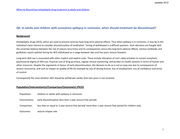
Q9. In adults and children with convulsive epilepsy in remission, when should treatment be discontinued?
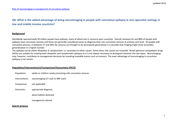
Q6: What is the added advantage of doing neuroimaging in people with convulsive epilepsy in non-specialist settings in low and middle income countries?
Scoping Question: For adults and children living with HIV, which antiepileptic medications (such as phenobarbital, phenytoin, carbamazepine or valproic acid) produce benefits and/or harms when compared to a placebo or controls?
Q8. Should Anti-Epileptic Drug (AED) treatment be started after first unprovoked seizure in non-specialist health settings?
