Filter
102
Featured
6
15
Language
Document type
71
21
5
2
1
1
1
Countries
17
10
8
8
8
5
4
3
2
1
1
1
1
1
1
1
Authors & Publishers
Publication Years
Category
8
4
2
2
2
2
2
2
2
2
2
1
1
1
1
1
1
1
1
1
1
1
Toolboxes
26
24
8
5
4
4
4
3
3
3
2
2
2
2
2
2
2
2
2
2
2
2
2
2
2
2
1
1
1
1
1
1
1
1
1
1
1
1
1
1
1
1
1
1
1
1
1
1
1
1
1
1
1
1
1
1
1
1
1
1
1
1
1
1
1
1
1
1
1
1
1
1
1
1
1
1
1
1
Midnight, Executive Director
midnightp@apcom.org
Accessed: 27.08.2019
Schistosomiasis is an infectious disease caused by helminth parasites of the genus Schistosoma. Worldwide, an estimated 250 million people are infected with these parasites with the majority of cases occurring in sub-Saharan Africa. Within Asia, three species of Schistosoma cause disease. Schistosom
...
Rabies is a neglected zoonotic disease with a global burden of approximately 59,000 human deaths a year. Once clinical symptoms appear, rabies is almost invariably fatal; however, with timely and appropriate post-exposure prophylaxis (PEP) consisting of wound washing, vaccine, and in some cases rabi
...
Rabies is a public health problem in Asia and vaccine affordability is an issue.
There is no reduction in the number of persons seeking post-exposure prophylaxis.
The high cost of cell culture vaccines for intramuscular use is a limiting factor.
Intradermal rabies vaccination offers cost-effectiv
...
Disease epidemiology has a deeper relationship with the dynamic nature of culture. Health behaviors in general are largely shaped by the cultural norms and customs in a society. A mere identification of a behavior could be only a layer on the outer sphere of a particular disease epidemiology and the
...
The Asia Pacific Observatory on Health Systems and Policies is a collaborative partnership which supports and promotes evidence-based health policy making in the Asia Pacific Region. Based in WHO’s Regional Office for South-East Asia, it brings together governments, international agencies, foundat
...

Asia-Pacific Disaster Report 2017
The report looks at the extent and impact of natural disasters across the region and how these intersect with poverty, inequality and the effects of violent conflict. But it also shows how scientific and other advances have increased the potential for building di ...
The report looks at the extent and impact of natural disasters across the region and how these intersect with poverty, inequality and the effects of violent conflict. But it also shows how scientific and other advances have increased the potential for building di ...
Meeting Report
27–30 June 2017 Manila, Philippines
Putting Asia’s HIV response back on track
KNCV Tuberculosis Foundation - Your partner in the fight against TB
Accessed November 2017
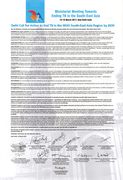
Ministrial Meeting Towards Ending TB in the South-East Asia, 15-16 March 2017, New Dehli India