
Filter
72
Text search:
explosives
Featured
4
15
Language
Document type
59
4
3
3
2
1
Countries
6
3
3
2
2
2
2
1
1
1
1
1
1
1
1
1
1
1
1
1
1
1
1
1
1
1
1
1
Authors & Publishers
Publication Years
Category
13
1
1
1
Toolboxes
35
16
4
3
2
1
1
The purpose of this interim guidance is to provide information and insight to assist public policy and
health system leaders in preparing for and responding to an MCE caused by terrorist use of explosives
(TUE). This document provides practical in
...
The use of explosive weapons, such as bombs, rockets, and mortar and
artillery shells, in cities, towns and villages and in other populated areas
has devastating humanitarian consequences. Explosive weapons act mainly
through the projection of blast and fragmentation wi
...
A manual for people working in environments contaminated by landmines and other explosive hazards including improvised explosive devices.
This is the 19th annual Landmine Monitor report. It is the sister publication to the Cluster Munition Monitor report, first published in November 2010.
Landmine Monitor 2016 provides a global overview of the landmine situation. Chapters on developments in specific countries and other areas are ava
...
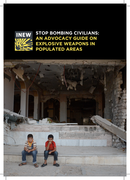
This guide has been produced by the International
Network on Explosive Weapons (INEW) to introduce the
humanitarian advocacy agenda on the use of explosive
weapons in populated areas and to provide ideas for actions
at the national level. It is aimed primarily at NGOs and
campaigners worki
...
"Explosions can produce unique patterns of injury seldom seen outside combat.
When they do occur, they have the potential to inflict multi-system life-threatening injuries
on many persons simultaneously. The injury patterns following such events are a product of
the composition and amount of the
...
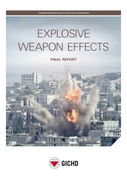
States, the United Nations and civil society organisations continue to raise concerns about the humanitarian impact caused by the use of explosive weapons in populated areas (EWIPA). This issue is currently being examined from political, legal, socio-economic and humanitarian perspectives. The GICHD
...
Spanish version of the Landmines, ERW and IED Safety Handbook
A guidebook intended for use by first responders
during the initial phase of a transportation incident
involving dangerous goods/hazardous materials

Country Profiles include summaries of developments related to mine ban policy, cluster munition ban policy, mine action, casualties, victim assistance, and support for mine action. Profiles are updated annually, when merited.
For close to 15 years, the Monitor has tracked the impact of victim assistance on the lives of victims of landmines, cluster munitions,
and other explosive remnants of war (hereafter “mine/ERW victims”). Over this time, the international communi
...
The International Network on Explosive Weapons (INEW) is an NGO partnership calling for immediate action to prevent human suffering from the use of explosive weapons in populated areas. The homepage of INEW offers various information such as reports, news, events and other related information.
Arabic version of the Landmines, ERW and IED Safety Handbook.

The International Campaign to Ban Landmines (ICBL) is a global network of non-governmental organizations, active in some 100 countries, that works for a world free of antipersonnel landmines, where landmine survivors can lead fulfilling lives. The website provides comprehensive resources such as inf
...
Reducing the humanitarian impact of the use of explosive weapons in populated areas is a key priority for the United
Nations, the International Committee of the Red Cross (ICRC), civil society and an increasing number of Member States.
The United Nations Secretary-General has expressly called on
...
This research project is comprised of a Final Report, 5 Annexed Explosive Weapons Studies, a Terminology paper and a Simulator software tool. Motivated by its strategic goal to improve human security and equipped with subject expertise in explosive hazards, in January 2015, the GICHD established the
...

Working with limited resources in armed conflict and other situations of violence. Vol.2

"The aim of this book remains as for the first edition, namely to provide an initial point of ready
reference for the identification of hazards and precautions for dangerous chemicals. It is targeted
not only at those in the chemical and process industries, but also anyone likely to work with
che
...
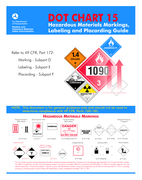
Guide on labeling and placarding hazardous materials
