
Filter
2340
Text search:
COVID-19
Impact
Featured
247
38
Language
Document type
948
521
257
187
182
86
38
35
32
29
12
7
4
Countries
228
90
66
60
58
56
50
47
46
42
41
41
41
40
39
32
31
30
30
28
25
24
24
21
21
20
17
17
17
17
17
16
16
16
16
16
15
13
13
12
12
12
12
12
11
11
11
10
10
9
9
8
8
7
7
7
7
7
7
7
7
7
7
7
6
6
6
6
6
6
6
6
6
5
5
5
5
4
4
4
4
4
4
4
4
4
4
3
3
3
3
3
3
3
3
3
3
3
3
3
3
3
3
3
3
3
3
3
2
2
2
2
2
2
2
2
2
2
2
2
2
1
1
1
1
1
1
1
1
1
1
1
1
1
1
1
1
1
1
1
1
1
1
Authors & Publishers
Publication Years
Category
897
125
91
88
83
26
19
2
1
Toolboxes
1181
182
115
87
80
72
69
58
53
52
51
40
38
29
27
22
13
7
5
3
2
2
1
1
Ce guide a pour objectif de fournir des conseils pratiques à destination du personnel de santé entreprenant des activités de préparation et de réponse aux maladies infectieuses afin de maintenir l’accès à des Soins d’Avortement sans Risque (SAR) durant une épidémie de maladie infectieus
...
Since 24 February 2022, the war in Ukraine has caused widespread suffering to its people and serious damage
to the country’s infrastructure. Attacks on the country’s health system and its power network threaten people, compromise the provision of health care, and complicate the distribution of
...
PLoS Negl Trop Dis 16(10): e0009774. Although the practice of communication is often called upon when intervening asn involgvingcommunties affected by NTD's, the disciplinary framewokr of healt communication research has been largely absent from NTD strategies. To illustrate how practices conceptual
...
Today, patient harm due to unsafe care is a large and growing global public health challenge and is one of the
leading causes of death and disability worldwide. Most of this patient harm is avoidable. As countries strive to
achieve universal health coverage and the Sustainable Development Goals, t
...
The PS Centre has released three publications addressing the need for MHPSS tools and guidance in Ukraine and surrounding countries.
The Introduction to Psychological First Aid, presents a training module on basic psychological first aid skills for people affected by the international armed confl
...
Lymphatic filariasis (LF) is an avoidable, debilitating, disfiguring disease caused by infection with the filarial parasites Wuchereria bancrofti, Brugia malayi and B. timori. Globally, 51.4 million people are
estimated to be infected. Lymphoedema and hydrocoele are the visible, chronic clinical co
...
La filariose lymphatique (FL) est une maladie évitable, incapacitante et défigurante, due à une infestation par des filaires parasites des espèces Wuchereria bancrofti, Brugia malayi et B. timori. On estime que 51,4 millions de personnes sont infectées dans le monde. Le lymphœdème et l’hydr
...
Accessed on 04.04.2023
The Drugs for Neglected Diseases initiative (DNDi) is an international
non-profit organization that discovers, develops, and delivers safe,
effective, and affordable treatments for the most neglected patients
L’initiative Médicaments contre les Maladies Négligées (DNDi) est une organisation internationale à but non lucratif spécialisée dans la recherche, le développement et la mise à disposition de traitements sûrs, efficaces et abordables aux patients les plus négligés.
Africa is off track to reach the Sustainable Development Goals by 2030 and lags behind in building resilient health systems
and health security, against a backdrop of limited resources. The world envisaged a significant role for governments
in funding the Sustainable Development Agenda, but inadeq
...
This publication is a compendium of 49 country examples highlighting efforts in improving refugees’ and migrants’ health following the adoption of the WHO Global Action Plan on Promoting the health of refugees and migrants at the seventy-second World Health Assembly, in May 2019.
Global Report on Food Crises 2023
recommended
The Global Report on Food Crises (GRFC) 2023 highlights that the number of people experiencing high levels of acute food insecurity and requiring urgent food and livelihood assistance increased for the fourth consecutive year in 2022. Over a quarter of a billion people were estimated to face acute h
...
The overall objective of the framework is to support WHO and Members States in meaningful engagement of people living with NCDs, and mental health and neurological conditions to co-create and enhance related policies, programmes and services. This framework will contribute to advancing understanding
...
L’objectif général de ce cadre est de permettre à l’OMS et à ses États Membres d’assurer la participation significative des personnes vivant avec des maladies non transmissibles, des problèmes de santé mentale et neurologiques, via un processus de cocréation et de renforcement des poli
...
Emergency medical teams (EMT) are first response health care providers – doctors, nurses, paramedics, and others – during outbreaks and emergencies or disasters, working with governments, charities such as nongovernmental organizations (NGOs), armies, and international organizations such as the
...
WHO Ghana 2022 annual report
recommended
“2022 was an eventful year for the WHO Country Office in Ghana,” says Dr Francis Kasolo, WHO Representative to Ghana.
In 2022, WHO Ghana collaborated with partners to deliver interventions in support of the Government of Ghana's health sector agenda to ensure healthy lives for all towards ach
...
This checklist is for any organization or person supporting the routine use of evidence in
the process of policy-making. Evidence-informed policy-making (EIPM) is essential for achieving the Sustainable Development Goals (SDGs) and universal health coverage (UHC). Its importance is emphasized in WH
...
The Regional Action Framework for Noncommunicable Disease Prevention and Control provides a unified vision of objectives and recommended actions to combat the noncommunicable disease (NCD) epidemic in the Western Pacific Region. Implementation should be supported by cross-sectoral coordination
...
There is growing international consensus that food systems transformation is important to address the challenges of malnutrition in all its forms, the burden of noncommunicable diseases (NCDs), environmental sustainability, increasing inequality and ensuring the welfare of workers and animals. In li
...
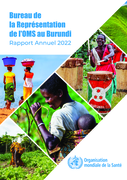
Les activités menées au cours de l'année 2022 ont été effectuées dans le cadre de la mise en œuvre de la stratégie de coopération OMS -Burundi 2019 – 2023 et en accord avec les quatre axes stratégiques qui soustendent le Budget-Programme 2022-2023.
Ce Budget-Programme (BP) est issu du 1
...
