
Filter
1935
Text search:
PCR
Featured
257
470
Language
Document type
884
475
241
83
82
76
36
21
15
12
5
3
2
Countries
82
80
58
52
48
45
44
40
38
33
33
31
31
30
29
27
26
26
25
25
24
24
24
23
23
21
20
20
20
19
19
18
17
17
15
14
14
13
13
12
12
12
12
11
11
11
10
10
10
9
9
9
8
8
8
7
7
6
6
6
6
6
6
5
5
5
4
4
4
3
3
3
3
3
3
3
3
3
3
3
3
3
2
2
2
2
2
2
2
2
2
2
2
2
2
1
1
1
1
1
1
1
1
1
1
1
1
1
1
1
1
1
1
1
1
1
1
1
1
1
1
1
Authors & Publishers
Publication Years
Category
906
216
55
50
26
22
21
1
Toolboxes
537
162
124
115
112
102
81
34
22
22
20
19
16
14
6
6
6
4
2
2
1
1

Trypanosoma cruzi is the etiological agent of Chagas disease (CD), considered one of the most important parasitic infections in Latin America. Between 25 and 90 million humans are at infection risk via at least one of multiple infection mechanisms. Under natural conditions, the principal transmissio
...
This report provides a review and analysis of the research landscape for three diseases – Chagas disease, human African trypanosomiasis and leishmaniasis – that disproportionately afflict poor and remote populations with limited access to health services. It represents the work of the disease re
...

Epidemiology
Chagas disease (American trypanosomiasis) is caused by the protozoan parasite Trypanosoma cruzi, and transmitted to humans by infected triatomine bugs, and less commonly by transfusion, organ transplant, from mother to infant, and in rare instances, by ingestion of contaminated food or
...

Chagas disease (American trypanosomiasis) is caused by the protozoan parasite Trypanosoma cruzi, and transmitted to humans by infected triatomine bugs, and less commonly by transfusion, organ transplant, from mother to infant, and in rare instances, by ingestion of contaminated food or drink.1-4 The
...
Theodor Bilharz, a German professor of anatomy and chief of surgery at the Kasr El Ani Hospital of Cairo from 1850, first identified an infective organism, Distomum hematobium in 1851, which was renamed Schistosoma haematobium in 1858. It arose from a cestode worm, Hymenoleptis nana, lying in the sm
...

Schistosomiasis is a neglected tropical disease of global medical and veterinary importance. As efforts to eliminate schistosomiasis as a public health problem and interrupt transmission gather momentum, the potential zoonotic risk posed by livestock Schistosoma species via viable hybridisation in s
...
Epidemiological Update
Dengue
7 February 2020
Situation summary
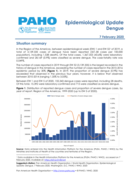
In the Region of the Americas, between epidemiological week (EW) 1 and EW 521 of 2019, a total of 3,139,335 cases of dengue have been reported (321.58 cases per 100,000 population), including 1,538 deaths. Of the total cases, 1,367,
...

The aim of this toolkit is to guide countries on how to best estimate their current burden of dengue by combining existing data from dengue surveillance systems with on-going research efforts to measure the community burden
of dengue.
In support of the London Declaration goals, PATH aims to catalyze engagement of the diagnostics industry and product development efforts. As part of this work, PATH conducted a diagnostic landscape analysis to identify gaps and evaluated current and nascent HAT diagnostics that may provide solutions
...
Localized cutaneous leishmaniasis and its evolving forms (diffuse cutaneous leishmaniasis, mucosal leishmaniasis and cutaneous leishmaniasis recidivans), together with the sequela of visceral leishmaniasis (post-kala-azar dermal leishmaniasis), account for about one million cases of dermal leishmani
...

Cholera which disproportionally impacts poor countries and the most vulnerable continues to affect at least 47 countries across the globe, resulting in an estimated 1.3 – 4 million cases, and 21,000 - 143,000 deaths per year worldwide. In Ethiopia, despite major improvements seen in the increasing
...

During the year 2022, COVID-19 continued to be a significant challenge in Eritrea as in many other countries across the world. As COVID-19 devastated communities around the world, WHO worked with the MoH to strengthen the National and Sub-National health systems in order to meet community needs and
...
Un comité OMS d’experts sur la trypanosomiase humaine africaine (THA) : lutte et surveillance, s’est réuni à Genève (Suisse), du 22 au 26 avril 2013. Le Dr H. Nakatani, sous-directeur général pour le VIH/SIDA, la tuberculose, le paludisme et les maladies tropicales négligées, a ouvert la
...
PLoS Negl Trop Dis 15(8): e0009697. Chagas disease (CD), caused by the parasite Trypanosoma cruzi, affects ~6–7 million people worldwide. Significant limitations still exist in our understanding of CD. Harnessing individual participant data (IPD) from studies could support more in-depth analyses t
...
Research and Reports in Tropical Medicine 2022:13 25–40.
Chagas disease (CD) is caused by the parasite Trypanosoma cruzi, and it is endemic in Central, South America, Mexico and the South of the United States. It is an important cause of early mortality and morbidity, and it is associated with po
...
This technical report presents the epidemiology of human and animal leishmaniases in the EU and its neighbouring countries and concludes that the disease remains widespread and underreported in many countries of southern Europe, northern Africa, and the Middle East and that there is a need to improv
...
Yaws is a disfiguring non-venereal disease caused by infection with the spirochaete. Treponema pallidum subspecies pertenue which is closely related to the causative agent of syphilis and those of the other endemic treponematoses, bejel and pinta. The disease is endemic in certain areas of the World
...
Background: The World Health Organization (WHO) published a clinical case definition of post COVID-19
condition, by a Delphi consensus, on 6 October 2021. That process concluded that a separate definition
may be applicable for children. It is important to understand the frequency, characteristics
...

In response to the recent publication “Is onchocerciasis elimination in Africa feasible by 2025: a perspective based on lessons learnt from the African control programmes” by Dadzie et al., it is important to clarify and highlight the positive and unequivocal research and operational contributio
...
Leptospirosis is a bacterial zoonotic disease of worldwide importance, though relatively neglected in many African countries including sub Saharan Africa that is among areas with high burden of this disease. The disease is often mistaken for other febrile illnesses such as dengue, malaria, rickettsi
...
