The World Health Organization (WHO) defines mental h
...
ealth as ‘a state of well-being in which the individual realizes his or her own abilities, can cope with the normal stresses of life, can work productively and fruitfully, and is able to make a contribution to his or her community’. Mental illness refers to all of the diagnosable mental disorders, which are characterised by abnormalities in thinking, feelings or behaviours. Mental illness is closely related to vulnerability, both in its causes and in its effects. Globally, 14 per cent of the global burden of disease is attributed to mental illness – with 75 per cent of those affected being found in low-income countries – which includes a broad spectrum of diagnoses, from common mental illnesses such as anxiety and
substance abuse, to severe illnesses like psychosis.
more
An overview of validation structures and responsibilities at national, regional and global levels.
This governance document supplements the global guidance document. Validation of elimination requires rigorous assessment at the national,
...
regional and global levels of the impact and process indicators and the fulfilment of the four foundational requirements for (1) data quality, (2) strong programmes, (3) laboratory quality and (4) human rights, gender equality and community engagement.
more
The WHO Global Tuberculosis Report 2022 provides a comprehensive and up-to-date assessment of the TB epidemic, and of progress in prevention, diagnosis and treatment of the disease, at global, regional
...
and country levels. This is done in the context of global TB commitments, strategies and targets.
The 2022 edition of the report is as usual, based primarily on data gathered by WHO from national ministries of health in annual rounds of data collection. In 2022, 202 countries and territories with more than 99% of the world’s population and TB cases reported data
more
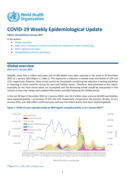
Globally, more than 3 million new cases and 10 000 deaths have been reported in the week of 26 December 2022 to 1 January 2023. This represents a reduction in weekly cases and deaths of 22% and 12%, respectively. In the last 28 days (5 December 2022 to 1 January 2023), over 14.5 million cases and ov
...

er 46 000 new fatalities were reported globally – an increase of 25% and 21%, respectively, compared to the previous 28 days. As of 1 January 2023, over 656 million confirmed cases and over 6.6 million deaths have been reported globally.
In this edition, we include:
The COVID-19 epidemiological update at the global and regional levels.
An update on the circulating SARS-CoV-2 variants of concern (VOCs) and Omicron subvariants under monitoring.
An update on hospitalizations and ICU admissions related to COVID-19.
more
Ebola disease and Marburg disease outbreaks continue to occur in Africa, with increased frequency. In addition to resulting in high mortality and morbidity, the outbreaks generate fear and mistrust about the response activities within the communities affected.
Infection prevention and control (IP
...
C) is a key pillar in the outbreak response; adherence to IPC practices can prevent and control transmission of infections to health and care workers, patients and their family members.
During the 2014-2016 West African Ebola disease outbreak, there was an urgent need for rapid IPC guidance to help support ministries of health, health-care providers and non-governmental organizations (NGOs). In response, WHO produced several documents related to the outbreak based on expert opinion, including IPC-specific documents and documents on clinical management that also referenced key IPC principles and practices. Since that time, many practices in the field have become institutionalized.
more
Trustworthy, evidence-based health guidelines form the basis of national policies affecting both patients and health-care workers. Emphasizing the link between robust evidence and people’s trust i
...

n their health systems, Dr Hans Henri P. Kluge, WHO Regional Director for Europe said at the launch event, “Trust and transformation are key words for us, especially when we talk about improving and strengthening our health systems. Transformation should first and foremost serve the interests of patients and health-care workers”.
While it is not always easy to demonstrate the immediate effect of guidelines on people’s health, there is no viable alternative to utilizing guidelines based on the best available evidence.
Yet, developing robust guidelines remains a challenge for most countries. “Guidelines need to be both simple to use and timely, they need to address people’s real needs, especially at the local level, and should ultimately reflect the resources available,” said Dr Natasha Azzopardi-Muscat, Director, Country Health Policies and Systems, WHO/Europe. “This means that any successful guideline needs to be adjusted and adapted to local contexts and realities.”
more
A review of proactive risk assessment and risk management practices to ensure the safety of drinking-water
Based on information gathered from 118 countries representing every region of the globe, this report provides a picture of WSP uptake wor
...

ldwide. It presents information on WSP implementation and the integration of WSPs into the policy environment. It also explores WSP benefits, challenges and future priorities.
more
Yaws is a disfiguring non-venereal disease caused by infection with the spirochaete. Treponema pallidum subspecies pertenue which is closely related to the causative agent of syphilis and those of the other endemic treponematoses, bejel and pinta. The disease is endemic in certain areas of the
...

World Health Organization (WHO) African, South-East Asia and Western Pacific regions. Of the neglected tropical diseases identified for elimination and eradication, yaws is one of two diseases targeted for eradication. In 1949, the Second World Health Assembly adopted resolution WHA2.36, which addresses yaws, bejel and pinta as major public health problems that need attention.
more
The meningitis road map has been designated as a flagship global strategy of the WHO’s Thirteenth General Programme of Work, 2019–2023 and is an essential component in achieving universal health
...
coverage.
The road map will reinforce and combine with wider initiatives, such as those aimed at strengthening primary health care and health systems, increasing immunization coverage, improving global health security, fighting antimicrobial resistance and advocating for the rights of persons with disabilities. It will complement other global control strategies, such as those addressing sepsis, pneumonia, tuberculosis and HIV. Implementation will be a challenge for all countries across the world, but especially in resource-poor settings where the burden of meningitis is greatest. The targets for the visionary and strategic goals will be adapted to regional and local contexts.
more
Each year, the WHO Global TB Report provides a comprehensive and up-to-date assessment of the TB epidemic, and of progress in prevention, diagnosis and treatment of the disease, at global, regional
...
and country levels. This is done in the context of global TB commitments, strategies and targets.
The 2021 edition of the report has been produced in a new and more web-centric format. This is designed to make the content available in smaller (more “bite-sized”) chunks that are easier to read, digest, navigate and use. There is a short and slim report PDF with 30 pages of main content plus six short annexes. This is accompanied by expanded and more detailed digital content on web pages. The total amount of content remains similar to that of previous years.
Available in English, French, Arabic and Chinese
more
Building on the 2021 Interim guidance, this second version and update, incorporates the lessons and feedback from the hepatitis pilots that successfully demonstrated the feasibility of measuring hepatitis B and C impact targets to demonstrate elimination, whilst highlighting challenges caused by hig
...
h disease burden in some countries, as well as delays in reaching mortality targets due to the long natural history of disease progression to liver cirrhosis and hepatocellular carcinoma.
The path to elimination provides a framework with 3 levels of achievements for which WHO certification is available. Each stepwise progression from bronze to silver to gold tiers will promote an iterative expansion of prevention, diagnosis and treatment services for viral hepatitis services and strengthen measurement systems to support attainment of the 2030 elimination goals.
This updated version also includes changes, clarifications and new guidance on alternative measurement approaches for country validation of elimination. Through the validation process, WHO and partners continue to provide country support for strengthening health system capacity and patient-centred services that respect and protect the human rights of people living with viral hepatitis and ensures meaningful engagement of communities in the national, regional and global viral hepatitis response.
more
Histoplasmosis is a disease caused by the fungus Histoplasma capsulatum. This disease is highly endemic in some regions of North America, Central America, and South America and is also reported in certain countries of Asia and Africa. It often affects people with impaired immunity, including people
...
living with HIV, among whom the most frequent clinical presentation is disseminated histoplasmosis. The symptoms of disseminated histoplasmosis are non-specific and may be indistinguishable from those of other infectious diseases, especially disseminated tuberculosis (TB), thus complicating diagnosis and treatment. Histoplasmosis is one of the most frequent opportunistic infections caused by fungal pathogens among people living with HIV in the Americas and may be responsible for 5–15% of AIDS-related deaths every year in this Region. These guidelines aim to provide recommendations for the diagnosis, treatment, and management of disseminated histoplasmosis in persons living with HIV
more
The Pandemic Influenza Pandemic (PIP) Framework's Partnership Contribution (PC) High-Level Implementation Plan III (HLIP III) outlines the strategy for strengthening global pandemic influenza preparedness from 2024 to 2030. HLIP III takes into consideration the lessons learned from the response to t
...

he COVID-19 pandemic, the gains made over time, including from previous HLIPs, and the broader programmatic and policy context in order to address gaps in pandemic influenza preparedness. Implementation of HLIP III will strengthen global, regional, and country-level pandemic influenza preparedness.
more
To complement the Global Strategy progress reporting, this report provides a detailed look at country leadership and action toward the Every Newborn National Milestones by 2020. Countries have taken the initiative to show the way forward and have demonstrated significant progress. As part of monitor
...

ing this progress, countries have adopted the Every Newborn Tracking Tool. This report presents a compilation of the data collated by the Every Newborn Tracking Tool in 2016, when 51 countries adopted the tool; it also spotlights examples of specific country activity for each National Milestone. Finally, Global Milestones for 2020 were part of the Every Newborn Action Plan to guide global and regional work in support of country efforts and this report highlights relevant progress towards those Global Milestones.
more
Small island developing states (SIDS) are a set of islands and coastal states that share similar sustainable development challenges, as a result of their size, geography and vulnerability to climate change. Thirty-nine WHO member states in four regi
...
ons – the African Region, the Region of the Americas, the South-East Asian Region, and the Western Pacific region – are classified as SIDS. Whilst the individual countries differ in many respects, collectively they face unique social, economic and environmental challenges.
more
54th directing council; 67th session of the regional Committee of WHO for the Americas
CD54/11, Rev. 1, 2 October 2015, Original: Spanish

Promoting health and preventing disease is a critical component of the effort required to achieve Universal Health Coverage (UHC). to date, efforts to achieve UHC have focused mostly on strengthenin
...
g health systems and their capacities to provide curative care. However, experience from the COVID-19 pandemic has reaffirmed the need for resilient health systems, emphasizing primary health care, including preventive and promotive health and well-being.
Emerging from the eye of the storm as the global health lead agency during the pandemic, WHO is equipped with the required insights and actions for a holistic approach to “building back fairer and better” after COVID-19.
The Healthier Populations (UHP) Cluster in the African Region is designed to support Pillar 3 of WHO’s 13th Global Programme of Work (GPW13) which aims to make 1 billion people healthier by reducing health inequities, preventing diseases and injuries, addressing health determinants, and promoting partnerships for collaborative actions amongst all stakeholders.
more
While there has been real progress in addressing the burden of disease in the WHO African region, the COVID-19 pandemic has highlighted the link be
...
tween health, economics and security, as the region saw decades of progress threatened, including positive trends in decreasing inequality. In the African Region the momentum towards achieving the 2030 SDG disease burden reduction targets (SDG targets 3.3, 3.4 and 3B) has stalled.
The COVID-19 pandemic was also a major threat to gains made, such as the eradication of polio in the region, declared in 2020; reduced numbers of new HIV infections in 2021 compared to 2010; and passing the 2020 milestone of the End TB Strategy, with a 22% reduction in new cases compared with 2015. However, the pandemic also disrupted essential health services in 92% of countries globally, 22.7 million children missed basic immunization, there was an increase in malaria and TB, and global deaths from TB rose for the first time since 2015.
more
This is the 42nd situation report for the multi-country outbreak of mpox, which provides an update on the epidemiological situation of mpox in Africa (including countries in the WHO African
...
Region and some countries in the WHO Eastern Mediterranean Region), with data as of 3 November 2024.
more
The Global status report on violence prevention 2014, which reflects data from 133 countries, is the first report of its kind to assess national efforts to address interpersonal violence, namely child maltreatment, youth violence, intimate partner and sexual violence, and elder abuse. Jointly publis
...

hed by WHO, the United Nations Development Programme, and the United Nations Office on Drugs and Crime, the report reviews the current status of violence prevention efforts in countries, and calls for a scaling up of violence prevention programmes; stronger legislation and enforcement of laws relevant for violence prevention; and enhanced services for victims of violence.
You can download summaries in different languages, single chapters and graphics
more