
Filter
1760
Text search:
social
class
Featured
133
471
Language
1639
103
30
21
14
11
10
5
4
3
3
3
3
2
2
2
2
2
2
2
2
2
2
2
1
1
1
1
1
1
1
1
1
1
1
1
1
1
1
1
1
1
1
1
1
1
Document type
1153
285
144
80
36
36
11
8
3
2
1
1
Countries
137
56
53
48
44
34
33
33
31
28
28
28
25
24
20
20
20
20
19
19
17
16
16
15
14
12
12
11
11
11
10
10
9
9
8
8
8
7
7
7
6
6
6
6
5
5
5
5
5
5
5
5
4
4
4
4
4
4
4
4
3
3
3
3
3
3
2
2
2
2
2
2
2
2
2
2
2
2
2
2
2
2
1
1
1
1
1
1
1
1
1
1
1
1
1
1
1
1
1
1
1
1
1
1
1
1
1
1
1
1
1
1
Authors & Publishers
121
80
55
51
44
30
28
23
20
20
19
17
15
15
13
11
10
9
9
9
9
9
9
8
8
8
7
7
7
7
7
7
6
6
6
6
5
5
5
5
5
5
5
5
5
5
4
4
4
4
4
4
4
4
4
4
4
4
4
4
4
3
3
3
3
3
3
3
3
3
3
3
3
3
3
3
3
3
3
3
3
3
3
3
3
3
3
3
3
3
3
3
3
3
3
3
3
3
3
3
3
3
3
2
2
2
2
2
2
2
2
2
2
2
2
2
2
2
2
2
2
2
2
2
2
2
2
2
2
2
2
2
2
2
2
2
2
2
2
2
2
2
2
2
2
2
2
2
2
2
2
2
2
2
2
2
2
2
2
2
2
2
2
2
2
2
2
2
2
2
2
2
2
2
2
2
2
2
2
2
2
2
2
2
2
2
2
2
2
2
2
2
2
2
2
2
2
2
2
2
2
2
2
2
2
2
2
2
2
2
2
2
2
2
2
2
2
2
2
2
2
2
2
2
2
2
2
2
2
2
2
2
2
2
2
2
2
2
2
2
2
2
2
2
2
2
1
1
1
1
1
1
1
1
1
1
1
1
1
1
1
1
1
1
1
1
1
1
1
1
1
1
1
1
1
1
1
1
1
1
1
1
1
1
1
1
1
1
1
1
1
1
1
1
1
1
1
1
1
1
1
1
1
1
1
1
1
1
1
1
1
1
1
1
1
1
1
1
1
1
1
1
1
1
1
1
1
1
1
1
1
1
1
1
1
1
1
1
1
1
1
1
1
1
1
1
1
1
1
1
1
1
1
1
1
1
1
1
1
1
1
1
1
1
1
1
1
1
1
1
1
1
1
1
1
1
1
1
1
1
1
1
1
1
1
1
1
1
1
1
1
1
1
1
1
1
1
1
1
1
1
1
1
1
1
1
1
1
1
1
1
1
1
1
1
1
1
1
1
1
1
1
1
1
1
1
1
1
1
1
1
1
1
1
1
1
1
1
1
1
1
1
1
1
1
1
1
1
1
1
1
1
1
1
1
1
1
1
1
1
1
1
1
1
1
1
1
1
1
1
1
1
1
1
1
1
1
1
1
1
1
1
1
1
1
1
1
1
1
1
1
1
1
1
1
1
1
1
1
1
1
1
1
1
1
1
1
1
1
1
1
1
1
1
1
1
1
1
1
1
1
1
1
1
1
1
1
1
1
1
1
1
1
1
1
1
1
1
1
1
1
1
1
1
1
1
1
1
1
1
1
1
1
1
1
1
1
1
1
1
1
1
1
1
1
1
1
1
1
1
1
1
1
1
1
1
1
1
1
1
1
1
1
1
1
1
1
1
1
1
1
1
1
1
1
1
1
1
1
1
1
1
1
1
1
1
1
1
1
1
1
1
1
1
1
1
1
1
1
1
1
1
1
1
1
1
1
1
1
1
1
1
1
1
1
1
1
1
1
1
1
1
1
1
1
1
1
1
1
1
1
1
1
1
1
1
1
1
1
1
1
1
1
1
1
1
1
1
1
1
1
1
1
1
1
1
1
1
1
1
1
1
1
1
1
1
1
1
1
1
1
1
1
1
1
1
1
1
1
1
1
1
1
1
1
1
1
1
1
1
1
1
1
1
1
1
1
1
1
1
1
1
1
1
1
1
1
1
1
1
1
1
1
1
1
1
1
1
1
1
1
1
1
1
1
1
1
1
1
1
1
1
1
1
1
1
1
1
1
1
1
1
1
1
1
1
1
1
1
1
1
1
1
1
1
1
1
1
1
1
1
1
1
1
1
1
1
1
1
1
1
1
1
1
1
1
1
1
1
1
1
1
1
1
1
1
1
1
1
1
1
1
1
1
1
1
1
1
1
1
1
1
1
1
1
1
1
1
1
1
1
1
1
1
1
1
1
1
1
1
1
1
1
1
1
1
1
1
1
1
1
1
1
1
1
1
1
1
1
1
1
1
1
1
1
1
1
1
1
1
1
1
1
1
1
1
1
1
1
1
1
1
1
1
1
1
1
1
1
1
1
1
1
1
1
1
1
1
1
1
1
1
1
1
1
1
1
1
1
1
1
1
1
1
1
1
1
1
1
1
1
1
1
1
1
1
1
1
1
1
1
1
1
1
1
1
1
1
1
1
1
1
1
1
1
1
1
1
1
1
1
1
1
1
1
1
1
1
1
1
1
1
1
1
1
1
1
1
1
1
1
1
1
1
1
1
1
1
1
1
1
1
1
1
1
1
1
1
1
1
1
1
1
1
1
1
1
1
1
1
1
1
1
1
1
1
1
1
1
1
1
1
1
1
1
1
1
1
1
1
1
1
1
1
1
1
1
1
1
1
1
1
1
1
1
1
1
1
1
1
1
1
1
1
1
1
1
1
1
1
1
1
1
1
1
1
1
1
1
1
1
1
1
1
1
1
1
1
1
1
1
1
1
1
1
1
1
1
1
1
1
1
1
1
1
1
1
1
1
1
1
1
1
1
1
1
1
1
1
1
1
1
1
1
1
1
1
1
1
1
1
1
1
1
1
1
1
1
1
1
1
1
1
1
1
1
1
1
1
1
1
1
1
1
1
1
1
1
1
1
1
1
1
1
1
1
1
1
1
1
1
1
1
1
1
1
1
1
1
1
1
1
1
1
1
1
1
1
1
1
1
1
1
1
1
1
1
1
1
1
1
1
1
1
1
1
1
1
1
1
1
1
1
1
1
1
1
1
1
1
1
1
1
1
1
1
1
1
1
1
1
1
1
1
1
1
1
1
1
1
1
1
1
1
1
1
1
1
1
1
1
1
1
1
1
1
1
1
1
1
1
1
1
1
1
1
1
1
1
1
1
1
1
1
1
1
1
1
1
1
1
1
1
1
1
1
1
1
1
1
1
1
1
1
1
1
1
1
1
1
1
1
1
1
1
1
1
1
1
1
1
1
1
1
1
1
1
1
1
1
1
1
1
1
1
1
1
1
1
1
1
1
1
1
1
1
1
1
1
1
1
1
1
1
1
1
1
1
1
1
1
1
1
1
1
1
1
1
1
1
1
1
1
1
1
1
1
1
1
1
1
1
1
1
1
1
1
1
1
1
1
1
1
1
1
1
1
1
1
1
1
1
1
1
1
1
1
1
1
1
1
1
1
1
1
1
1
1
1
1
1
1
1
1
1
1
1
1
1
1
1
1
1
1
1
1
1
1
1
1
1
1
1
1
1
1
1
1
1
1
1
1
1
1
1
1
1
1
1
1
1
1
1
1
1
1
1
1
1
1
1
1
1
1
1
1
1
1
1
1
1
1
1
1
1
1
1
1
1
1
1
1
1
1
1
1
1
1
1
1
1
1
1
1
1
1
1
1
1
1
1
1
1
1
1
1
1
1
1
1
1
1
1
1
1
1
1
1
1
1
1
1
1
1
1
1
1
1
1
1
1
1
1
1
1
1
1
1
1
1
1
1
1
1
1
1
1
1
1
1
1
1
1
1
1
1
1
1
1
1
1
1
1
1
1
1
1
1
1
1
1
1
1
1
1
1
1
1
1
1
1
1
1
1
1
1
1
1
1
1
1
1
1
1
1
1
1
1
1
1
1
1
1
1
1
1
1
1
1
1
1
1
1
1
1
1
1
1
1
1
1
1
1
1
1
1
1
1
1
1
1
1
1
1
1
1
1
1
1
1
1
1
1
1
1
1
1
1
1
1
1
1
1
1
1
1
1
1
1
1
1
1
1
1
1
1
1
1
1
1
1
1
1
1
1
1
1
1
1
1
1
1
1
1
1
1
1
1
1
1
1
1
1
1
1
1
1
1
1
1
1
1
1
1
1
1
1
1
1
1
1
1
1
1
1
1
1
1
1
1
1
1
1
1
1
1
1
1
1
1
1
1
1
1
1
1
1
1
1
1
1
1
1
1
1
1
1
1
1
1
1
1
1
1
1
1
1
1
1
1
1
1
1
1
1
1
1
1
1
1
1
1
1
1
1
1
1
1
1
1
1
1
1
1
1
1
1
1
1
1
1
1
1
1
1
1
1
1
1
1
1
1
1
1
1
1
1
1
1
1
1
1
1
1
1
1
1
1
1
1
1
1
1
1
1
1
1
1
1
1
1
1
1
1
1
1
1
1
1
1
1
1
1
1
1
1
1
1
1
1
1
1
1
1
1
1
1
1
1
1
1
1
1
1
1
1
1
1
1
1
1
1
1
1
1
1
1
1
1
1
1
1
1
1
1
1
1
1
1
1
1
1
1
1
1
1
1
1
1
1
1
1
1
1
1
1
1
1
1
1
1
1
1
1
1
1
1
1
1
1
1
1
1
1
1
1
1
1
1
1
1
1
1
1
1
1
1
1
1
1
1
1
1
1
1
1
1
1
1
1
1
1
1
1
1
1
1
1
1
1
1
1
1
1
1
1
1
1
1
1
1
1
1
1
1
Publication Years
350
1185
217
7
1
Category
730
85
82
76
53
39
8
3
1
Toolboxes
222
155
95
86
62
54
43
39
38
34
33
32
29
28
28
27
27
20
14
13
6
5
4
1
1

This was a Phase 3, multi-center, randomized, open-label, parallel-group, active control study where 273 male and female patients with first stage Trypanosoma brucei gambiense HAT were treated at six sites: one trypanosomiasis reference center in Angola, one hospital in South Sudan, and four hospita
...
ls in the Democratic Republic of the Congo between August 2005 and September 2009 to support the registration of pafuramidine for treatment of first stage HAT in collaboration with the United States Food and Drug Administration. Patients were treated with either 100 mg of pafuramidine orally twice a day for 10 days or 4 mg/kg pentamidine intramuscularly once daily for 7 days to assess the efficacy and safety of pafuramidine versus pentamidine. Pregnant and lactating women as well as adolescents were included.
more
Since 2000, concerted efforts by national programmes, supported by public–private partnerships, nongovernmental organizations, donors and academia under the auspices and coordination of the World Health Organization (WHO), have produced important achievements in the control of human African trypan
...
osomiasis (HAT). As a consequence, the disease was targeted for elimination as a public health problem by 2020. The Sixty-sixth World Health Assembly endorsed this goal in resolution WHA66.12 on neglected tropical diseases, adopted in 2013.
National sleeping sickness control programmes (NSSCPs) are core to progressing control of the disease and in adapting to the different epidemiological situations. The involvement of different partners, as well as the support and trust of long-term donors, has been crucial for the achievements.
more
Rabies is a devastating and societally important zoonotic disease, which is transmitted principally to humans through the bite of infected dogs. This acute, progressive viral encephalitis has the highest case fatality of any infectious disease and kills tens of thousands of people annually, with chi
...
ldren and impoverished communities being affected disproportionately.
more
The WHO Pharmaceuticals Newsletter provides you with the latest information on the safety of medicinal products and regulatory actions taken by authorities around the world.
In addition, this edition includes summary and recommendations from the virtual meeting of the members of the WHO Programme f
...
or International Drug Monitoring (PIDM) and other partners, which was held on 20 October 2022.
more
Medical care for people caught up in armed conflict and other insecure environments saves lives and alleviates suffering. It is one of the most immediate and high priority needs of an affected population and is often the first type of response activated and/or requested by authorities and affected c
...
ommunities. Medical teams working in armed conflict and other insecure environments
frequently face serious threats to their security and safety, challenges to patient access, and at times limited acceptance by affected communities in which they work and parties to the conflict. Such difficulties are likely to increase (6) and
thereby creating a critical need to establish contact and trust with all sides in conflicts and in other insecure environments to ensure operational continuity. This trust can best be achieved when all sides perceive the medical teams to be neutral, impartial, and independent, and specifically not aiding (or being perceived to aid) any one party to achieve a military, political or economic
advantage. For medical teams that are deploying increasingly closer to the frontlines, the implications of and consequences for both staff and patients of teams not being fully prepared, and/or not fully comprehending the context in which they work, can be severe. Medical response can easily be hindered or compromised by intentional or unintentional acts and the behaviour and
conduct of the teams themselves
more

Access to NCD medicines: emergent issues during the COVID-19 pandemic and key structural factors
recommended
The coronavirus disease (COVID-19) pandemic exacerbated pre-existing inequalities in the treatment and care of noncommunicable diseases (NCDs). This report examines the effect of the COVID-19 pandemic on access to NCD medicines, and the policies and strategies implemented by countries and health sys
...
tems to anticipate and mitigate stresses across NCD medicine supply chains. The full range of upstream and downstream impacts are investigated, including: manufacturing; procurement, importation and last mile delivery; patient-level effects through affordability and availability; and the effects on NCD medicine availability by category of disease. The report culminates in recommended actions and interventions for key stakeholders in the NCD pharmaceutical supply chain, including governments, regulatory authorities, manufacturers and the private sector; as well as directions for future research for improving access and supply chain access resilience.
more
Human Rights based research into COVID-19 related violations with focus on persons with disabilities
The goal of the study was to assess the feasibility of the COVID-19 measures and their resultant impact on Persons with Disabilities in Malawi.
Specifically, the study addressed the following objectives:
a) To evaluate Government’s response to COVID-19 following the adoption of the new measures
...
of COVID-19 in January 2021 in line with principles and norms of human rights. (This includes establishing the extent to which the new measures have been implemented)
b) To assess the extent to which the provision health service delivery specifically access to health for PWDs including vaccine inflammation and facilities.
c) To establish the key COVID-19 related human rights violations during the pandemic period affecting PWDs
d) To assess the extent to which Government (and other nonstate actors) have implemented the recommendations from the preliminary MHRC statement
e) To provide advice and make recommendations to the Executive, Parliament and other stakeholders on how they can improve their response to COVID-19 from a rights perspective with a focus on PWDs.
more
Accessed on 04.04.2023
The Drugs for Neglected Diseases initiative (DNDi) is an international
non-profit organization that discovers, develops, and delivers safe,
effective, and affordable treatments for the most neglected patients
Stunting as a Risk Factor of Soil-Transmitted Helminthiasis in Children: A Literature Review
Fauziah, N.; Ar-Rizqi, M.A.; Hana, S. et al.
Interdisciplinary Perspectives on Infectious Diseases
(2022)
CC
As a high-burden neglected tropical disease, soil-transmitted helminth (STH) infections remain a major problem in the world, especially among children under five years of age. Since young children are at high risk of being infected, STH infection can have a long-term negative impact on their life, i
...
ncluding impaired growth and development. Stunting, a form of malnutrition in young children, has been long assumed as one of the risk factors in acquiring the STH infections. However, the studies on STH infection in children under five with stunting have been lacking, resulting in poor identification of the risk. Accordingly, we collected and reviewed existing related research articles to provide an overview of STH infection in a susceptible population of stunted children under five years of age in terms of prevalence and risk factors. There were 17 studies included in this review related to infection with Ascaris lumbricoides, Trichuris trichiura, hookworm, and Strongyloides stercoralis from various countries. The prevalence of STH infection in stunted children ranged from 12.5% to 56.5%. Increased inflammatory markers and intestinal microbiota dysbiosis might have increased the intensity of STH infection in stunted children that caused impairment in the immune system. While the age from 2 to 5 years along with poor hygiene and sanitation has shown to be the most common risk factors of STH infections in stunted children; currently there are no studies that show direct results of stunting as a risk factor for STH infection. While stunting itself may affect the pathogenesis of STH infection, further research on stunting as a risk factor for STH infection is encouraged.
more
The overall objective of the framework is to support WHO and Members States in meaningful engagement of people living with NCDs, and mental health and neurological conditions to co-create and enhance related policies, programmes and services. This framework will contribute to advancing understanding
...
, knowledge and action on meaningful engagement and related participatory approaches from an evolving evidence base. It provides practical guidance and actions for transitioning from intention to action to operationalize meaningful engagement.
The aim of the framework is to guide people working at WHO and in Member States in ensuring meaningful engagement with individuals with lived experience. WHO will advocate for, provide technical assistance and operationalize implementation at its three levels (headquarters, regional and country offices) and will support Member States in implementation at national level through established processes and procedures.
more
UNFPA has been implementing programming for women and girls through Women Friendly Health Spaces (WFHSs), which provide access to critical services, information and support. The WFHS is providing: psychosocial counseling services; awareness raising sessions on PSS in the community; and life skills &
...
vocational training opportunities. The WFHS also facilitates referral to other services including Psychosocial Counseling Centers (PSCCs).
The aim of this guidance note is to provide an overview of approaches on how to successfully integrate adolescent and youth (A&Y) programming into the WFHSs. UNFPA activities for women’s and girl’s protection in health facilities aim to protect women and girls including child marriage. Given that vulnerable women and girls in Afghanistan continue to access health facilities, particularly for reproductive health and maternal health services, it is crucial to provide support for survivors in the same location to improve access to essential psychosocial and protection support for women and girls. To support the integration of A&Y in the WFHS programming each WFHS will be supported by two full time Youth Educators. A female Youth Educator who will be working within the WFHS and a male Youth Educator who will be working in the community. The role of the Youth educators is to increase A&Y awareness and knowledge on living healthy lifestyles and ensuring a referral system to services in existing facilities.
more
A System of Health Accounts 2011: Revised edition
Organisation for Economic Co-operation and Development (OECD), Eurostat and World Health Organization (WHO)
OECD Publishing, Paris
(2017)
CC
A System of Health Accounts 2011: Revised Edition provides an updated and systematic description of the financial flows related to the consumption of health care goods and services. As demands for information increase and more countries implement and institutionalise health accounts according to the
...
system, the data produced are expected to be more comparable, more detailed and more policy relevant. It builds on the original OECD Manual, published in 2000, and the Guide to Producing National Health Accounts to create a single global framework for producing health expenditure accounts that can help track resource flows from sources to uses. It is the result of a collaborative effort between the OECD, WHO and the European Commission, and sets out in more detail the boundaries, the definitions and the concepts – responding to health care systems around the globe – from the simplest to the more complicated.
more
This document provides technical guidance on concepts, definitions, indicators, criteria, milestones and tools to assist leprosy programmes in their journey towards the goals of interruption of transmission and elimination of leprosy disease and through the post-elimination period. Importantly, it p
...
rovides criteria with benchmarks, where possible, for all key aspects of leprosy programmes and services. Not only those related to elimination efforts, but also those related to diagnosis and management of leprosy, leprosy-related disabilities, mental wellbeing, stigma and discrimination and inclusion and participation of persons affected by leprosy. The document emphasises that the elimination of leprosy is a long-term, continuous journey on the one hand, while, on the other, clear milestones can be recognised on the way and programme implementation can be assessed against benchmarks, guiding appropriate action to keep the programme on track.
more
Diets are changing everywhere, and the burden of disease associated with unhealthy diets is a worldwide concern. Measurement and monitoring of diets across countries and population groups is critical. However, there are no harmonized metrics for tracking how the healthfulness of diets around the wor
...
ld is evolving.
This report assesses the validity, usefulness and fitness for purpose of existing healthy diet metrics as global and national monitoring indicators, presents a comparative assessment of selected healthy diet metrics and discusses priorities and opportunities to improve diet monitoring. This report is an important first step of the Healthy Diets Monitoring Initiative to respond to the need for developing healthy diets metrics for assessing and monitoring diets at national and global level.
more
The Mapping Antimicrobial Resistance and Antimicrobial Use Partnership (MAAP) project has conducted a multi-year, multi-country study that provides stark insights on the under-reported depth of the antimicrobial resistance (AMR) crisis across Africa and lays out urgent policy recommendations to addr
...
ess the emergency.
MAAP reviewed 819,584 AMR records from 2016-2019, from 205 laboratories across Burkina Faso, Cameroon, Eswatini, Gabon, Ghana, Kenya, Malawi, Nigeria, Senegal, Sierra Leone, Tanzania, Uganda, Zambia, and Zimbabwe. MAAP also reviewed data from 327 hospital and community pharmacies and 16 national-level AMC datasets.
more
ACT-A - Urgent Priorities & Financing Requirements at 10 November 2020
World Health Organization (WHO), The Global Fund, Gavi et al.
World Health Organization (WHO)
(2020)
CC
Six months after its launch on 24 April, the Access to COVID-19 Tools (ACT) Accelerator has already delivered concrete results in speeding up the development of new therapeutics, diagnostics, and vaccines. Now mid-way through the scale-up phase, the tools we need to fundamentally change the course o
...
f this pandemic are within reach. But to deliver the full impact of the ACT-Accelerator – and ultimately an exit to this global crisis – these tools need to be available everywhere. On behalf of the ACT-Accelerator Pillar lead agencies – CEPI, Gavi, the Global Fund, FIND, Unitaid, Wellcome Trust, the World Bank, and the World Health Organization, as well as the Bill & Melinda Gates Foundation – I am pleased to share this document setting out the near-term priorities, deliverables and financing requirements of the ACT-Accelerator Pillars and Health Systems Connector. Urgent action to address these financing requirements will boost the impact of the ACTAccelerator achievements to date, fast-track the development and deployment of additional game-changing tools, and mitigate the risk of a widening gap in access to COVID-19 tools between low- and high-income countries. Delivering on this promise requires strong political leadership, financial investment, and incountry capacity building. COVID-19 cannot be beaten by any one country acting alone. We must ACT now, and ACT together to end the COVID-19 crisis.
more
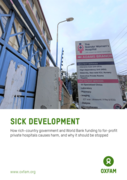
Development finance institutions owned by European governments and the World Bank Group are spending hundreds of millions of dollars on expensive for-profit hospitals in the Global South that block patients from getting care, or bankrupt them, with some even imprisoning patients who cannot afford th
...
eir bills. At the height of the COVID-19 pandemic, some of these same hospitals denied entry to patients suffering from the virus or sold intensive care beds at eyewatering prices to the highest bidder. These development institutions have woefully inadequate safeguards, invest via a complex web of tax-avoiding financial intermediaries, and offer little to zero evidence on the impacts their investments are having. Oxfam is calling on rich-country governments and the World Bank Group to immediately halt their spending on for-profit private healthcare, and for an urgent independent investigation to be conducted into all active and historic investments.
more
The definition of Official Development Assistance (ODA) has for 40 years been the global standard for measuring donor efforts in supporting development co-operation objectives. It has provided the yardstick for documenting the volume and the terms of the concessional resources provided, assessing do
...
nor performance against their aid pledges and enabling partner countries, civil society and others to hold donors to account. Yet for all its value, the ODA definition has always reflected a compromise between political expediency and statistical reality. It is based on interpretation and consensus and therefore allows for flexibility. It has evolved over the decades, while preserving the original concepts of a definition based on principal developmental motivation, official character and a degree of concessionality. While agreement on the ODA concept was a major achievement, discussion of the appropriateness of this measure has never ended. The paper documents the evolution of the ODA concept and proposes a possible new approach to measuring aid effort.
more
In line with the Climate and Environment Charter for Humanitarian Organisations which IFRC, ICRC and various Red Cross Red Crescent National Societies have endorsed, this short Guide aims to help practitioners integrate environmental and climate change considerations into their work. It has been dev
...
eloped primarily for logistics staff, administrative staff, and management. It is not necessary to be an environmental expert to use this Guide.
more
Climate change is one of the most urgent challenges for people and ecosystems worldwide. The recently published sixth Assessment Report (AR6) of the Intergovernmental Panel on Climate Change (IPCC) stresses the occurrence of widespread adverse impacts of climate change. Increased frequency and inten
...
sity of extreme weather events, as well as slow-onset processes cause enormous losses and damages to human and natural systems. Marginalized groups and people in vulnerable situations are often disproportionally affected. While the impacts of climate change already become more tangible and threatening, action for addressing them remains insufficient. Adaptation to climate change is, thus, becoming a necessity for governments, companies, and private citizens.
To provide practical and scientifically sound guidance on how to conduct vulnerability assessments, GIZ published its Vulnerability Sourcebook in 2014. The Vulnerability Sourcebook was used in over twenty different GIZ partner countries and provides a step-by-step guidance for designing and implementing a vulnerability assessment. It is also one of the methodological foundations for the ISO 14091:2021 standard on vulnerability, impacts and risk assessment for climate change adaptation.
more
