
Filter
861
Text search:
social
distancing
Featured
103
28
Language
Document type
268
247
78
68
58
57
39
16
14
6
4
4
2
Countries
65
31
29
26
25
24
23
20
18
17
16
15
15
13
12
12
11
11
11
11
10
10
9
9
9
8
8
7
7
7
6
6
6
5
5
5
5
5
5
5
5
5
4
4
4
4
4
4
4
4
4
4
3
3
3
3
3
3
3
3
3
3
2
2
2
2
2
2
2
2
2
2
2
2
2
2
2
2
1
1
1
1
1
1
1
1
1
1
1
1
1
1
1
1
1
1
1
1
1
1
1
1
1
1
1
1
1
Authors & Publishers
Publication Years
Category
352
26
20
17
15
9
3
1
Toolboxes
623
34
33
27
23
20
18
14
13
11
10
8
8
5
4
4
3
2
2
2
2
1
Ce document d'orientation explique comment la distance physique (désignée dans les documents d'orientation précédents sous le nom de «distance sociale») peut aider à ralentir la transmission.
orientations provisoires, 14 juin 2021
Consideraciones para aplicar y ajustar medidas de salud pública y sociales en el contexto de la COVID-19
recommended
orientaciones provisionales, 14 de junio de 2021
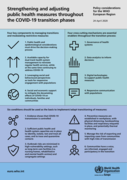
Policy considerations for the WHO European Region
24 April 2020
Guidance on easing lockdown in Arabic Version
Millions of children are at increased risk of harm as their lives move increasingly online during lockdown in the COVID-19 pandemic, UNICEF and partners said today.
“The coronavirus pandemic has led to an unprecedented rise in screen time,” said Global Partnership to End Violence Executive Dire
...
This document provides guidance for African Union Member States on actions to be taken to ensure they continue to meet all the health
needs of their citizens in accordance with achieving the objectives of the Africa Health Strategy 2016 – 2030.

Self-care interventions are among the most promising and exciting new approaches to improve health and well-being, both from a health systems perspective and for people who use these interventions.
The World Health Organization (WHO) uses the following working definition of self-care: Self-care i
...
WHO Guideline on self-care interventions for health and well-being, 2022 revision: executive summary
recommended
A global shortage of an estimated 18 million health workers is anticipated by 2030, a record 130 million people are in need of humanitarian assistance, and there is the global threat of pandemics such as COVID-19. At least 400 million people worldwide lack access to the most essential health service
...
The Government of India is embarking on a mammoth task to prevent COVID-19 spread among communities. The Rapid Evidence Synthesis team received a request to support the planning and development of resources for ensuring preparedness of FLHWs for COVID-19 . The rapid evidence synthesis was conducted
...
WHY THIS GUIDE?
Because, in the face of crises and emergencies, it is vital to include a human rights perspective in responses. Vulnerable groups face major obstacles to accessing and benefiting from prevention, mitigation, and health care policies due to structural barriers of inequality. To offer
...

Several countries affected by COVID-19, have seen increases in levels of violence occurring in the home, including violence against children, intimate partner violence and violence against older people. Countries also face increasing challenges in maintaining support and care for survivors of violen
...
MMWR Morb Mortal Wkly Rep. ePub: 4 December 2020. DOI: http://dx.doi.org/10.15585/mmwr.mm6949e2
People with mental health conditions are challenged in
dealing with the symptoms that result from the condition
but are also challenged by the prejudice and stereotypes
that result from misconception and misunderstanding about
mental health.
But what is mental health stigma and why is it a cent
...
Hand Hygiene and COVID-19
recommended
MEDBOX Issue Brief No.2.
The main route of transmission of the Sars-CoV-2 virus are small respiratory droplets. Therefore, thoroughly cleaning of hands with either alcohol-based hand rub or soap and water is one of the corner stones of basic protective measures against COVID-19 for everyone. A part
...
Accessed: 31.03.2020
