
Filter
2751
Text search:
personal
hygiene
Featured
383
714
Language
2542
101
79
69
45
43
22
18
14
10
10
8
7
6
5
5
5
5
5
5
4
4
4
4
3
3
3
3
3
3
3
2
2
2
2
2
2
1
1
1
1
1
1
1
1
1
1
1
1
1
Document type
1379
496
387
170
114
65
65
49
9
8
5
1
1
Countries
115
99
98
84
67
63
60
55
54
53
52
52
48
47
44
44
39
37
35
32
29
27
27
26
24
24
23
22
22
21
21
20
19
19
15
15
15
15
14
14
13
12
11
11
11
11
10
10
10
10
9
9
9
9
9
8
8
8
7
7
7
6
5
5
5
5
5
5
5
5
5
5
5
5
5
4
4
4
4
4
4
4
4
4
3
3
3
3
3
3
3
3
3
3
2
2
2
2
2
2
2
2
2
2
2
2
2
2
1
1
1
1
1
1
1
1
1
1
1
1
1
1
1
1
1
1
1
1
1
1
1
1
1
Authors & Publishers
399
142
85
74
70
57
48
39
37
34
26
24
20
19
17
17
16
16
14
13
13
13
13
13
12
12
12
12
12
11
11
11
11
11
10
9
9
9
9
9
8
8
8
8
8
8
8
8
7
7
7
7
7
7
6
6
6
6
6
6
6
6
6
6
6
6
6
6
6
6
6
5
5
5
5
5
5
5
5
5
5
5
5
5
5
5
5
5
5
5
5
5
5
5
5
4
4
4
4
4
4
4
4
4
4
4
4
4
4
4
4
4
4
4
4
4
4
4
4
4
4
4
4
4
4
3
3
3
3
3
3
3
3
3
3
3
3
3
3
3
3
3
3
3
3
3
3
3
3
3
3
3
3
3
3
3
3
3
3
3
3
3
3
3
3
3
3
3
3
3
3
3
3
3
3
3
3
3
3
2
2
2
2
2
2
2
2
2
2
2
2
2
2
2
2
2
2
2
2
2
2
2
2
2
2
2
2
2
2
2
2
2
2
2
2
2
2
2
2
2
2
2
2
2
2
2
2
2
2
2
2
2
2
2
2
2
2
2
2
2
2
2
2
2
2
2
2
2
2
2
2
2
2
2
2
2
2
2
2
2
2
2
2
2
2
2
2
2
2
2
2
2
2
2
2
2
2
2
2
2
2
2
2
2
2
2
2
2
2
2
2
2
2
2
2
2
2
2
2
2
2
2
2
2
2
2
2
2
2
2
2
2
2
2
2
2
2
2
2
2
2
2
2
2
2
2
2
2
2
2
2
2
2
2
2
2
2
2
2
2
2
2
2
2
2
1
1
1
1
1
1
1
1
1
1
1
1
1
1
1
1
1
1
1
1
1
1
1
1
1
1
1
1
1
1
1
1
1
1
1
1
1
1
1
1
1
1
1
1
1
1
1
1
1
1
1
1
1
1
1
1
1
1
1
1
1
1
1
1
1
1
1
1
1
1
1
1
1
1
1
1
1
1
1
1
1
1
1
1
1
1
1
1
1
1
1
1
1
1
1
1
1
1
1
1
1
1
1
1
1
1
1
1
1
1
1
1
1
1
1
1
1
1
1
1
1
1
1
1
1
1
1
1
1
1
1
1
1
1
1
1
1
1
1
1
1
1
1
1
1
1
1
1
1
1
1
1
1
1
1
1
1
1
1
1
1
1
1
1
1
1
1
1
1
1
1
1
1
1
1
1
1
1
1
1
1
1
1
1
1
1
1
1
1
1
1
1
1
1
1
1
1
1
1
1
1
1
1
1
1
1
1
1
1
1
1
1
1
1
1
1
1
1
1
1
1
1
1
1
1
1
1
1
1
1
1
1
1
1
1
1
1
1
1
1
1
1
1
1
1
1
1
1
1
1
1
1
1
1
1
1
1
1
1
1
1
1
1
1
1
1
1
1
1
1
1
1
1
1
1
1
1
1
1
1
1
1
1
1
1
1
1
1
1
1
1
1
1
1
1
1
1
1
1
1
1
1
1
1
1
1
1
1
1
1
1
1
1
1
1
1
1
1
1
1
1
1
1
1
1
1
1
1
1
1
1
1
1
1
1
1
1
1
1
1
1
1
1
1
1
1
1
1
1
1
1
1
1
1
1
1
1
1
1
1
1
1
1
1
1
1
1
1
1
1
1
1
1
1
1
1
1
1
1
1
1
1
1
1
1
1
1
1
1
1
1
1
1
1
1
1
1
1
1
1
1
1
1
1
1
1
1
1
1
1
1
1
1
1
1
1
1
1
1
1
1
1
1
1
1
1
1
1
1
1
1
1
1
1
1
1
1
1
1
1
1
1
1
1
1
1
1
1
1
1
1
1
1
1
1
1
1
1
1
1
1
1
1
1
1
1
1
1
1
1
1
1
1
1
1
1
1
1
1
1
1
1
1
1
1
1
1
1
1
1
1
1
1
1
1
1
1
1
1
1
1
1
1
1
1
1
1
1
1
1
1
1
1
1
1
1
1
1
1
1
1
1
1
1
1
1
1
1
1
1
1
1
1
1
1
1
1
1
1
1
1
1
1
1
1
1
1
1
1
1
1
1
1
1
1
1
1
1
1
1
1
1
1
1
1
1
1
1
1
1
1
1
1
1
1
1
1
1
1
1
1
1
1
1
1
1
1
1
1
1
1
1
1
1
1
1
1
1
1
1
1
1
1
1
1
1
1
1
1
1
1
1
1
1
1
1
1
1
1
1
1
1
1
1
1
1
1
1
1
1
1
1
1
1
1
1
1
1
1
1
1
1
1
1
1
1
1
1
1
1
1
1
1
1
1
1
1
1
1
1
1
1
1
1
1
1
1
1
1
1
1
1
1
1
1
1
1
1
1
1
1
1
1
1
1
1
1
1
1
1
1
1
1
1
1
1
1
1
1
1
1
1
1
1
1
1
1
1
1
1
1
1
1
1
1
1
1
1
1
1
1
1
1
1
1
1
1
1
1
1
1
1
1
1
1
1
1
1
1
1
1
1
1
1
1
1
1
1
1
1
1
1
1
1
1
1
1
1
1
1
1
1
1
1
1
1
1
1
1
1
1
1
1
1
1
1
1
1
1
1
1
1
1
1
1
1
1
1
1
1
1
1
1
1
1
1
1
1
1
1
1
1
1
1
1
1
1
1
1
1
1
1
1
1
1
1
1
1
1
1
1
1
1
1
1
1
1
1
1
1
1
1
1
1
1
1
1
1
1
1
1
1
1
1
1
1
1
1
1
1
1
1
1
1
1
1
1
1
1
1
1
1
1
1
1
1
1
1
1
1
1
1
1
1
1
1
1
1
1
1
1
1
1
1
1
1
1
1
1
1
1
1
1
1
1
1
1
1
1
1
1
1
1
1
1
1
1
1
1
1
1
1
1
1
1
1
1
1
1
1
1
1
1
1
1
1
1
1
1
1
1
1
1
1
1
1
1
1
1
1
1
1
1
1
1
1
1
1
1
1
1
1
1
1
1
1
1
1
1
1
1
1
1
1
1
1
1
1
1
1
1
1
1
1
1
1
1
1
1
1
1
1
1
1
1
1
1
1
1
1
1
1
1
1
1
1
1
1
1
1
1
1
1
1
1
1
1
1
1
1
1
1
1
1
1
1
1
1
1
1
1
1
1
1
1
1
1
1
1
1
1
1
1
1
1
1
1
1
1
1
1
1
1
1
1
1
1
1
1
1
1
1
1
1
1
1
1
1
1
1
1
1
1
1
1
1
1
1
1
1
1
1
1
1
1
1
1
1
1
1
1
1
1
1
1
1
1
1
1
1
1
1
1
1
1
1
1
1
1
1
1
1
1
1
1
1
1
1
1
1
1
1
1
1
1
1
1
1
1
1
1
1
1
1
1
1
1
1
1
1
1
1
1
1
1
1
1
1
1
1
1
1
1
1
1
1
1
1
1
1
1
1
1
1
1
1
1
1
1
1
1
1
1
1
1
1
1
1
1
1
1
1
1
1
1
1
1
1
1
1
1
1
1
1
1
1
1
1
1
1
1
1
1
1
1
1
1
1
1
1
1
1
1
1
1
1
1
1
1
1
1
1
1
1
1
1
1
1
1
1
1
1
1
1
1
1
1
1
1
1
1
1
1
1
1
1
1
1
1
1
1
1
1
1
1
1
1
1
1
1
1
1
1
1
1
1
1
1
1
1
1
1
1
1
1
1
1
1
1
1
1
1
1
1
1
1
1
1
1
1
1
1
1
1
1
1
1
1
1
1
1
1
1
1
1
1
1
1
1
1
1
1
1
1
1
1
1
1
1
1
1
1
1
1
1
1
1
1
1
1
1
1
1
1
1
1
1
1
1
1
1
1
1
1
1
1
1
1
1
1
1
1
1
1
1
1
1
1
1
1
1
1
1
1
1
1
1
1
1
1
1
1
1
1
1
1
1
1
1
1
1
1
1
1
1
1
1
1
1
1
1
1
1
1
1
1
1
1
1
1
1
1
1
1
1
1
1
1
1
1
1
1
1
1
1
1
1
1
1
1
1
1
1
1
1
1
1
1
1
1
1
1
1
1
1
1
1
1
1
1
1
1
1
1
1
1
1
1
1
1
1
1
1
1
1
1
1
1
1
1
1
1
1
1
1
1
1
1
1
1
1
1
1
1
1
1
1
1
1
1
1
1
1
1
1
1
1
1
1
1
1
1
1
1
1
1
1
1
1
1
1
1
1
1
1
1
1
1
1
1
1
1
1
1
1
1
1
1
1
1
1
1
1
1
1
1
1
1
1
1
1
1
1
1
1
1
1
1
1
1
1
1
1
1
1
1
1
1
1
1
1
1
1
1
1
1
1
1
1
1
1
1
1
1
1
1
1
1
1
1
1
1
1
1
1
1
1
1
1
1
1
1
1
1
1
1
1
1
1
1
1
1
1
1
1
1
1
1
1
1
1
1
1
1
1
1
1
1
1
1
1
1
1
1
1
1
1
1
1
1
1
1
1
1
1
1
1
1
1
1
1
1
1
1
1
1
1
1
1
1
1
1
1
1
1
1
1
1
1
1
1
1
1
1
1
1
1
1
1
1
1
1
1
1
1
1
1
1
1
1
1
1
1
1
1
1
1
1
1
1
1
1
1
1
1
1
1
1
1
1
1
1
1
1
1
1
1
1
1
1
1
1
1
1
1
1
1
1
1
1
1
1
1
1
1
1
1
1
1
1
1
1
1
1
1
1
1
1
1
1
1
1
1
1
1
1
1
1
1
1
1
1
1
1
1
1
1
1
1
Publication Years
980
1498
259
12
2
Category
970
211
166
140
125
69
25
5
Toolboxes
534
201
136
130
126
103
99
98
92
78
76
75
62
55
39
36
27
20
16
16
9
5
4
4
1
1
The American Journal of Tropical Medicine and Hygiene Volume 106: Issue 1 p.12-14.he piece highlights a body of research that suggests tiny plastic particles could disrupt immune and endocrine systems, damage organs, and cause other health probl
...
ems. “Without a fundamental reimagining of global industrial practices, we will continue to see dire impacts on the climate, the planet and our health
more

This technical brief presents the current options for safe storage and point of use water treatment. It is intended to help field staff working in a variety of locations to decide upon the most appropriate course of action for providing safe water for the communities in which they work. The effectiv
...
eness of household water treatment options now and in the future rely to a huge extent on user compliance; it is critical that users are involved in the decision making process, and are aware of the purpose, how to use, maintain and manage their household water options. The brief therefore details relevant hygiene promotion steps for the different treatment options.
more
A field guide for accelerating and sustaining open defecation free communities through a Community-Led Total Sanitation approach
Follow-up MANDONA (FUM) is an action-oriented approach for accelerating community-wide sanitation and hygiene behaviour
...
change following the initial triggering session. Directly based on Community-Led Total Sanitation (CLTS) principles, FUM involves a series of participatory, facilitated sessions that brings the entire community together to analyze their sanitation situation
and collectively undertake small, immediate and doable actions to end open defecation (OD) in the shortest time possible
more

This document highlights the key aspects of safe health-care waste management in order to guide policy-makers, practitioners and facility managers to improve such services in health-care facilities. It is based on the comprehensive WHO handbook Safe management of wastes from health-care activities (
...
WHO, 2014), and also takes into consideration relevant World Health Assembly resolutions, other UN documents and emerging global and national developments on water, sanitation and hygiene and infection prevention and control.
more
N95 or equivalent respirators are single-use personal protective equipment (PPE) designed for use by health workers that provide direct care to patients with diseases transmitted by aerosols or during aerosol generating procedures (AGP) for patients
...
with acute respiratory disease, as is the case of COVID-19. • Given the current shortage of N95 and equivalent respirators, the World Health Organization (WHO) has suggested the possibility of their extended use by the same individual for up to 6 hours or the reprocessing of respirators when necessary.
more
24 Nov. 2021; This guidance provides considerations and a series of options that can be used to inform country strategies to minimise risk associated with shortages of personal protective equipment (PPE).
Re-use and reprocessing of single use PPE m
...
ust be a last-resort temporary measure that is implemented only until stocks are replenished (2).This remains an area of active research and further updates to this evidence base are anticipated.
more
GUIDE PRATIQUE À L’INTENTION DES PROGRAMMES DE LUTTE CONTRE LES MALADIES TROPICALES NÉGLIGÉES
This toolkit provides step-by-step guidance to NTD programme managers and partners on how to engage and work collaboratively with the WASH community to improve delivery of water, sanitation and
...
hygiene services to underserved population affected by many neglected tropical diseases. The toolkit is based on real-life programme experience, which users can match to their needs and local context. It includes a series of tools to help build multisectoral partnerships, mobilize resources, and design, implement and evaluate interventions.
more
At its 48th session of Codex Committee on Food Hygiene (CCFH), the Committee noted the importance of water quality and safety in food production and processing. CCFH requested the Food and Agriculture Organization of the United Nations
(FAO) and th
...
e World Health Organization (WHO) to provide guidance for those scenarios where the use of “clean water” (i.e. water that does not compromise the safety of the food in the context of its use) was indicated in Codex texts and on
where it is appropriate to use “clean water”. In particular, guidance was sought for the use of irrigation water and “clean” seawater and on the safe reuse of processing water.
more

Esta nota de orientación elaborada por el UNICEF tiene por objeto ayudar al personal de agua, saneamiento e higiene en su preparación y respuesta a la actual pandemia de COVID-19. Proporciona una visión general de la prevención y el control de l
...
as infecciones (IPC) y su intersección con el agua, el saneamiento y la higiene (WASH), y cómo el personal puede ayudar a prevenir la infección y su propagación en las escuelas, ya sea a través de la relación entre personas o tocando superficies contaminadas con el virus. Los servicios de WASH, incluyendo la gestión de residuos y la limpieza del medio ambiente, son todos importantes para el CPI. Este informe está disponible en inglés, español y francés aquí.
more
El objetivo de esta guía es brindar recomendaciones prácticas al personal de salud que se hace cargo de las actividades de preparación y respuesta a las enfermedades contagiosas para asegurar que se mantenga el acceso a servicios de aborto seguro
...
(SAS) cuando surja un brote de enfermedades contagiosas. Es una guía operativa que puede servir para apoyar a los actores de la salud para que los SAS se mantengan durante los brotes y asegurar que las consideraciones necesarias de SAS se integren dentro de la respuesta al brote; no es una guía clínica. El enfoque centrado en la ubicación de este documento se dirige a los asentamientos frágiles y de ayuda humanitaria; sin embargo, las recomendaciones pueden aplicarse a brotes de enfermedades contagiosas a cualquier población con escasez de recursos. Esta guía busca complementar el trabajo llamado La salud sexual y reproductiva y los derechos durante los brotes de enfermedades contagiosas: Guía operativa para escenarios frágiles y de ayuda humanitaria.
more
The Water and Sanitation for Health Facility Improvement Tool (WASH FIT) presents a framework and acts as a guide to support multisectoral action to improve water, sanitation and hygiene (WASH) in health care. Central to the WASH FIT methodology is
...
training and incremental improvements.
Implementation of WASH FIT requires six preparatory steps at the national level, one of which is conducting national sensitization and training of trainers, followed by facility-level training. At the facility level, step 1 (of five) involves establishing and training a WASH FIT team.
The WASH FIT methodology is outlined in WASH FIT: A practical guide for improving quality of care through water, sanitation and hygiene in health care facilities. Second edition. (the WASH FIT guide), which includes a set of templates designed to help users with each phase of the improvement cycle.
more

Civil Society Organisations’ contribution towards community engagement to access and demand health services and encourage communities to practice appropriate health-seeking behaviour in Mon and Chin States
The following report is a study of 14 villages under the Collective Voices project (Nov ... ember 2015-December 2017) in the states of Mon and Chin. The objectives of the study were:
(1) to explore Village Health Committee (VHC) members, Basic Health Staff (BHS), and community members’ perceptions on community engagement in seeking and demanding health care and
(2) to describe health-seeking behaviours relating to Maternal, Newborn, and Child Health and hygiene practices among target beneficiaries. more
The following report is a study of 14 villages under the Collective Voices project (Nov ... ember 2015-December 2017) in the states of Mon and Chin. The objectives of the study were:
(1) to explore Village Health Committee (VHC) members, Basic Health Staff (BHS), and community members’ perceptions on community engagement in seeking and demanding health care and
(2) to describe health-seeking behaviours relating to Maternal, Newborn, and Child Health and hygiene practices among target beneficiaries. more
Infection prevention and control (IPC) in a CTC/ CTU IPC are all practical measures taken in the healthcare facility to prevent harm caused by infections to patients, health workers and communities.
The main goal of IPC in the cholera response is to
• To reduce transmission of health care-as
...
sociated infections of cholera and any other infectious disease
• To enhance the safety of staff, patients and visitors
• To enhance the ability of the organization/health care facility to respond to an outbreak
• To reduce the risk of the hospital (health care facility) itself amplifying the outbreak
Water, Sanitation and Hygiene (WASH)
WASH are all measures taken to guarantee environmental hygiene, safe water of all used within the health facility. It encompasses water, sanitation, waste management, cleaning within the health facility which in this case is CTU/C. A complete WASH package in the CTU/CTC reduces the risk of spread of Vibrio cholerae inside and outside the CTC/CTU.
The probability of spreading or acquiring cholera through a CTC/CTU can be highly reduced when proper IPC and WASH measures are respected, followed and monitored. These measures are, in principle, valid in CTC/CTUs and ORPs, although they need to be adapted to the specific characteristics of the facility concerned.
more
Interim guidance 2 February 2021 . Available in Arabic, Chinese, English, French, Ukranian, Russian
Health workers are at the front line of the COVID-19 outbreak response and as such are exposed to different hazards that put them at risk. Occupational hazards include exposure to SARS-CoV-2 and othe
...
r pathogens, violence, harassment, stigma, discrimination, heavy workload and prolonged use of personal protective equipment (PPE). This document provides specific measures to protect occupational health and safety of health workers and highlights the duties, rights and responsibilities for health and safety at work in the context of COVID-19.
more
Functionality and sustainability of community latrines under the health urban programme
Ahsan, T., Islam, S. and Ryan, P.
Water Aid and IRC International Water and Sanitation Centre
(2008)
In: Beyond construction : use by all : a collection of case studies from sanitation and hygiene promotion practitioners in South Asia. Chapter 2
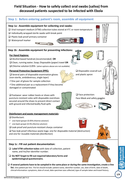
Field Situation - How to safely collect oral swabs (saliva) from deceased patients suspected to be infected with Ebola
World Health Organization
(2014)
Steps on how to safely collect oral swabs (saliva) from deceased patients suspected to be infected with Ebola: before entering patient’s room, how to put on and remove personal protective equipment (PPE), how to collect oral swab from deceased pat
...
ient and how to prepare VTM collection tube for transport.
more
Globally, environmental pollution and other environmental risks cause 24% of all deaths, and these deaths are largely preventable. A shift towards policies and actions that minimize risks to health and promote health and sustainable personal and soc
...
ietal choices will reduce environmental risks to health. These changes will result in many more people enjoying good health, living in appealing and unspoiled environments and in fewer people requiring health care, which will lower health care
expenditures.
more
This guidance note developed by UNICEF helps WASH staff in their preparedness and response to the current COVID-19 pandemic. It provides an overview of Infection Prevention and Control (IPC) and its intersection with water, sanitation and hygiene (W
...
ASH). It also provides key actions that staff can implement to help prevent infection and its spread in health-care facilities: from human to human, among health care workers and patients, through droplets, and by touching surfaces contaminated with the virus. WASH, including waste management and environmental cleaning, is essential for IPC
more

This guidance note developed by UNICEF is intended to help WASH staff in their preparedness and response to the current COVID-19 pandemic. It provides an overview of Infection Prevention and Control (IPC) and its intersection with water, sanitation and hyg
...
iene (WASH), and how staff can help prevent infection and its spread in schools, whether through human-to-human or by touching surfaces contaminated with the virus. WASH services, including waste management and environmental cleaning, are all important for IPC. This brief is available in English, Spanish, and French here.
more
This guidance note is for UNICEF Regional and Country Office WASH staff to help them in their preparedness and response to the current COVID-19 global pandemic. It provides an overview of Infection Prevention and Control (IPC) and its intersection with water, sanitation and
...
hygiene (WASH) and how UNICEF staff can help prevent infection and its spread in schools, through human to human and by touching surfaces contaminated with the virus. WASH services including waste management and environmental cleaning are all important for IPCs.
more
