Filter
395
Text search:
European
Centre
for
Disease
Prevention
and
Control
(ecdc)
Featured
36
79
Language
Document type
171
71
69
26
18
9
7
6
6
4
4
2
2
Countries / Regions
78
17
16
16
16
6
6
5
5
5
4
4
4
4
2
2
2
2
2
2
2
2
2
1
1
1
1
1
1
1
1
1
1
1
1
1
1
1
1
1
1
1
Authors & Publishers
Publication Years
Category
69
19
13
8
3
2
1
Toolboxes
76
54
54
54
42
24
24
20
15
10
5
4
3
2
2
2
1
1
1
The toolkit offers advice on how national public health authorities could engage with primary care prescribers so as to promote appropriate and responsible use of antibiotics. The toolkit contains template materials
...
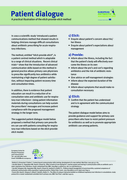
The method, entitled “elicit-provide-elicit”, is a patient centred method which is adaptable to a range of clinical situations. Recent clinical trials show that the introduction of advanced communication skills based on this method in general practice allows primary care physicians to prescribe
...
verall strategy and objective of the European Antibiotic Awareness Day The overall objective of the European Antibiotic Awareness Day is to suppor
...
Este documento de orientación se basa en la investigación de la actividad de los medios sociales relacionados con el uso de antibióticos a nivel de la UE, así como en una encuesta sobre las actividades de los medios sociales de las organizaciones asociadas a la EAAD, en su mayoría organizacione
...
2016 data
The report was coordinated by Anastasia Pharris and Annemarie Stengaard.
Report review and production support were provided by Andrew J. Amato-Gauci, Mike Catchpole, Denis Coulombier
...
10–21 March 2014
Joint Press Release
Stockholm/Copenhagen 20/03/2017
Eurosurveillance
Impact Factor 5.7
June 2015
www.eurosurveillance.org
Featuring a series of articles on HIV and STI epidemiology, prevention and
...
The global increase of healthcare-associated infections (HAI) presents a growing concern in healthcare worldwide. According to the European Centre
...
Here you can find the latest reports
This document simplifies the WHO guidance on severe acute respiratory infection (SARI) treatment centres and is meant to be accessible to healthcare workers, policymakers and others who want
a quic
...
Infectious disease outbreaks and epidemics are increasing in frequency, scale and impact. Health care facilities can amplify the transmission of em
...
The WHO continuously reviews available data on SARS-CoV-2 variants of concern. For this version, the global epidemiological
situation of the COVID-19 pandemic as of 21 January 2022 – at a time when the Omicron VOC had been identified in 171
coun
...

The Infection prevention and control in the context of coronavirus disease 2019 (COVID-19): a li
...
Antimicrobials are medicines, including antibiotics, antivirals, antifungals, and antiparasitics, that are used to prevent and treat infections in humans, animals,
...

This bi-weekly brief details the latest developments in scientific knowledge and public health policy from around the world as well as updates to the COVID-19-related guidance from Africa CDC, WHO and
...

The Event-based Surveillance Framework is intended to be used by authorities and agencies responsible for
surveillance and response. This framewo
...
In 2007, WHO warned that infectious diseases are emerging and re-emerging at a rate that has not been seen before. The potential for infectious diseases to spread rapidly results in high morbidity
...