
Filter
774
Text search:
myths
Featured
63
163
Language
Document type
435
91
63
45
33
32
28
17
15
5
5
2
2
1
Countries
50
26
26
19
18
17
17
16
16
15
13
11
11
11
9
9
9
8
8
7
7
7
6
6
6
5
5
5
5
5
5
5
5
4
4
4
4
3
3
3
3
3
3
3
3
3
2
2
2
2
2
2
2
2
2
2
2
2
2
2
2
2
1
1
1
1
1
1
1
1
1
1
1
1
1
1
1
1
1
1
1
1
1
1
1
1
Authors & Publishers
Publication Years
Category
279
56
38
31
25
17
1
Toolboxes
138
89
81
59
37
18
16
16
14
13
11
8
7
6
5
5
4
4
3
2
2
1
1
In the context of health, stigma is the negative association between a person or group of people who share certain characteristics and a specific disease. In an outbreak, this may mean people are labeled, stereotyped, discriminated against, treated separately, and/or experience loss of status becaus
...
PERC produces regional and member state situation analyses, updated regularly.
PERC produces regional and member state situation analyses, updated regularly.
This guide focuses on three main areas: how to support a person whose condition warrants home care because of non-severe symptoms and home care is recommended by local jurisdictions; how to prevent the spread of COVID-19 in the home; and how to provide emotional support to family members. While this
...
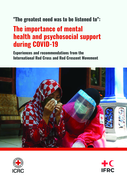
Experiences and recommendations from the International Red Cross and Red Crescent Movement.
Measures imposed by governments to prevent the spread of the disease, including lockdown restrictions, quarantines, physical distancing, and their economic and social consequences, further increase this dist
...
More than 8 million children have access to distance learning thanks to partnerships with 322 radio stations and 23 TV channels
1.2 million community masks distributed
25 million people reached with key messages on how to prevent COVID-19 through mass media channels (300 radio stations and
...
This document offers tools to help journalists practice responsible coverage of the pandemic using evidence-based information. It also proposes ways to approach coverage and encourages journalists to provide advice and solutions that can help reduce health risks and save lives.
Excessive consumption of salt (more than 5 g per day) raises blood pressure, a major risk factor for cardiovascular diseases such as heart disease and stroke, and is the leading cause of death in the WHO European Region. Many countries in the Region have initiated national salt reduction strategies,
...
Getting story ideas right -- Getting your sources right -- Getting your facts right -- Getting your report right -- Getting images and videos verified accurately -- Getting maps right -- Getting your language right
Internal displacement at all-time high after unprecedented year of crises
The total number of people living in internal displacement reached a record 55 million by the end of 2020. During a year marked by intense storms and persistent conflict, 40.5 million new displacements were triggered across
...
Menstruation is a natural fact of life and a monthly occurrence for 1.8 billion girls and women of reproductive age. Yet millions of menstruators across the world are denied the right to manage their monthly menstrual cycle in a dignified, healthy way. Girls and women with disabilities face even gre
...
The Federal Ministry of Health of Ethiopia (FMOH), the National Disaster Risk Management Commission (NDRMC) and other government actors together with UN agencies (UNICEF, UNHCR, WHO and WFP) and nutrition development partners call for all parties involved in the response to emergencies in Ethiopia t
...
This training guide applies a participatory approach, reflecting the considerable evidence that adults learn best by practicing and reflecting on their experiences. It thus emphasizes exercises to improve skills in counseling that support clients to adopt optimal nutrition practices. Women’s nutri
...
New displacements by conflict and disasters in 2020
Key messages
● Pre-crisis Infant and Young Child Feeding (IYCF) Practices:
The Code has not been adequately implemented and enforced in Ukraine.
Multiple Indicator Cluster Survey (MCIS) data from 2012: Child ever breastfed (95.4%); early initiation of breastfeeding (EIBF) within 1
...
WHO eLearning Caregiver Skills Training for Families of Children with Developmental Delays or Disabilities
recommended
These easy to use e-learning modules will teach you different strategies to use at home with your child. This course focuses on supporting you on how to use everyday play and home activities as opportunities for learning and development. Specifically, how to support your child to improve their commu
...
APRIL 2021- JULY 2022
A clear understanding of the knowledge, attitudes and practices (KAP) of a particular community is necessary in order to improve control of human African trypanosomiasis (HAT).New screening and diagnostic tools and strategies were introduced into South Sudan, as part of integrated delivery of primar
...
