
Filter
971
Text search:
World
Health
Organisation
(WHO)
Regional
Office
for
Africa
Featured
Recommendations
76
New Publications
258
Language
Document type
No document type
546
Studies & Reports
225
Guidelines
67
Strategic & Response Plan
46
Manuals
33
Training Material
21
Fact sheets
14
Situation Updates
13
Resource Platforms
3
Infographics
2
Online Courses
1
Countries / Regions
Africa
40
Kenya
36
Zambia
34
South Africa
33
Global
33
Sierra Leone
31
Uganda
28
Ghana
25
Tanzania
23
Nigeria
22
India
22
Malawi
22
Liberia
20
Ethiopia
20
Namibia
17
Rwanda
15
East and Southern Africa
13
Western and Central Europe
13
Mozambique
12
Lesotho
12
Guinea
11
Syria
10
Asia
10
Eswatini/ Swaziland
9
Senegal
8
Cameroon
8
Zimbabwe
8
Nepal
8
South Sudan
8
Eastern Europe
8
Central African Republic
7
Middle East and North Africa
7
Ukraine
6
Botswana
6
West and Central Africa
6
South–East Asia Region
6
Latin America and the Carribbean
6
Congo, Democratic Republic of
4
Mali
4
Cambodia
4
China
4
Indonesia
4
Thailand
3
Bangladesh
3
Benin
3
Brazil
3
Myanmar / Burma
3
Sri Lanka
3
Russia
3
Mauritius
3
Burkina Faso
2
Guinea-Bissau
2
Haiti
2
Philippines
2
Somalia
2
Pakistan
2
Lebanon
2
Chad
2
Gambia
2
Burundi
2
Angola
2
Madagascar
2
Mexico
2
Western Pacific Region
2
Venezuela
2
Portugal
2
Côte d’Ivoire / Ivory Coast
1
Morocco
1
Niger
1
Togo
1
Jordan
1
Afghanistan
1
Turkey
1
Sudan
1
Argentina
1
Peru
1
North Macedonia
1
Serbia
1
Hungary
1
Colombia
1
Southern Africa
1
Laos
1
Qatar
1
Bulgaria
1
Moldova
1
Iran
1
Kyrgyzstan
1
Georgia
1
Vietnam
1
Gabon
1
Jamaica
1
Japan
1
United Kingdom
1
Norway
1
Spain
1
Israel
1
Authors & Publishers
Publication Years
Category
Countries
365
Key Resources
58
Public Health
55
Clinical Guidelines
49
Women & Child Health
39
Capacity Building
17
Pharmacy & Technologies
9
Toolboxes
Disability
75
COVID-19
64
HIV
58
Planetary Health
54
AMR
50
Mental Health
48
Rapid Response
38
Ebola
35
TB
35
Global Health Education
34
Caregiver
27
Refugee
25
NTDs
25
Conflict
23
Health Financing Toolbox
19
Natural Hazards
12
Cholera
9
NCDs
9
Pharmacy
7
Zika
5
Polio
3
Social Ethics
2
Specific Hazards
1
Evidence- and rights-based national policies, guidelines and legislation play a key role in improving sexual, reproductive, maternal, newborn, child and adolescent health (SRMNCAH), framing the enabling environment
...
Taeniasis and cysticercosis caused by the parasite T. solium affect vulnerable populations,
mainly in Latin America, sub-Saharan Africa and Asia, where pigs (the intermediate host) roam
free and poor sanitation allows pigs access to human faeces.
Ethiopia has seen high economic growth over the last decade, but remains a poor country with a high burden of disease. It has made considerable health gains in recent years, mainly by having
...
This annual report gives an overview of WHO lesotho Country office's undertakings and achievements in the context of an extraordinary health emerge
...
Conformément aux recommandations de divers comités de l’Organisation mondiale de la Santé (OMS), le Bureau régional de l’OMS pour l’Afrique a mis en place trois initiatives phares afin de
...

The major areas of focus for the plan will be:
- Social mobilization and community empowerment (health promotion & education for disease preve ...
- Social mobilization and community empowerment (health promotion & education for disease preve ...
Nigeria reported its first case of COVID-19 at the end of February 2020 and subsequently experienced
four waves, with peaks in June 2020 and January, August and December 2021. The COVID-19 pandemic
severely impacted the economy of Nigeria and caused disruption of
...
This Pharmaceutical Country Profile for Kenya (2010) has been developed by the Ministry of Medical Services with support of the World Health Organi
...
The WHO Global tuberculosis report 2024 provides a comprehensive and up-to-date assessment of the TB epidemic, and of progress in prevention, diagnosis and treatment of the disease, at global, regional
...
El presente informe incluye análisis de consultas informales en cinco de las regiones de la OMS: la Región de África, la Región de las Américas (donde se realizaron consultas separadas para el Caribe y América del Norte, y para América Latina
...
The objective of this guidance document is to support the public health professionals
in implementing effective surveillance of cholera in at-risk, endemic and epidemic
areas. This document has been developed by the Surveillance Working Group of t
...
The WHO continuously reviews available data on SARS-CoV-2 variants of concern. For this version, the global epidemiological
situation of the COVID-19 pandemic as of 21 January 2022 – at a time wh
...
The key to a lasting world free of all forms of poliovirus lies in rapidly interrupting all remaining endemic transmission of WPV in the endemic areas of Pakistan and Afghanistan. This is the only way to ensure that such strains do not re-emerge glo
...
This handbook builds on lessons learned from surveys implemented 2015-2017 and advice provided by the Global task force on TB patient cost surveys. It provides a standardized methodology for conducting hea
...
Developmental disabilities are common. Yet, children with developmental disabilities have been neglected in health systems planning and policy provisions for
...

Despite the significant role of vector control in national leishmaniasis control programmes, the programmatic community perceives vector control as the weakest component of leishmaniasis control strategies in terms of resources, scientific evidence of the usefulness of interventions and capacity
...
Lack of trained providers capable of identifying which labouring women could benefit from assisted vaginal birth (AVB), and of safely performing the procedure is a major barrier for its use. Education and training are, therefore, considered crucial
...
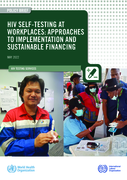
Countries are making progress toward the global goal of 95% of people living with HIV knowing their status by 2025. However, considerable gaps remain in achieving these goals globally. Men in high HIV burden settings and men from key populations in all settings are consistently less likely to know t
...

The WHO Global Antimicrobial Resistance and Use Surveillance System (GLASS) was launched in 2015 to foster AMR surveillance and inform strategies to contain AMR. The system started with surveillance of AMR in bacteria causing common human infections
...

Access to NCD medicines: emergent issues during the COVID-19 pandemic and key structural factors
recommended
The coronavirus disease (COVID-19) pandemic exacerbated pre-existing inequalities in the treatment and care of noncommunicable diseases (NCDs). This report examines the effect of the COVID-19 pandemic on access to NCD medicines, and the policies and strategies implemented by countries and
...
