
Filter
325
Text search:
South
African
Nursing
Council
Featured
Recommendations
17
New Publications
63
Language
Document type
No document type
186
Studies & Reports
67
Guidelines
34
Strategic & Response Plan
17
Manuals
9
Fact sheets
5
Situation Updates
4
Training Material
2
App
1
Countries / Regions
South Africa
54
Kenya
18
Nigeria
16
Global
15
Malawi
13
Uganda
9
Lesotho
9
Africa
9
Ghana
7
Tanzania
7
Ethiopia
6
Zimbabwe
6
India
6
Rwanda
6
Sierra Leone
5
Eswatini/ Swaziland
5
Botswana
5
Liberia
4
Zambia
4
Namibia
4
South Sudan
3
Congo, Democratic Republic of
2
Mali
2
Somalia
2
Nepal
2
Afghanistan
2
Syria
2
Central African Republic
2
Colombia
2
Myanmar / Burma
2
Yemen
2
East and Southern Africa
2
Latin America and the Carribbean
2
Russia
2
Burkina Faso
1
Senegal
1
Cameroon
1
China
1
Indonesia
1
Bangladesh
1
Mozambique
1
Brazil
1
Ukraine
1
Libya
1
Mexico
1
West and Central Africa
1
South–East Asia Region
1
Venezuela
1
Eastern Europe
1
Palestine
1
Armenia
1
Southern Africa
1
Canada
1
Mauritius
1
Israel
1
Authors & Publishers
Publication Years
Category
Countries
159
Clinical Guidelines
33
Public Health
26
Women & Child Health
23
Key Resources
4
Capacity Building
2
Protection & Security
1
Toolboxes
Caregiver
28
Mental Health
27
HIV
23
COVID-19
15
AMR
14
TB
13
Global Health Education
10
Disability
8
Refugee
8
Rapid Response
6
NCDs
6
Ebola
5
Conflict
5
Pharmacy
5
NTDs
5
Specific Hazards
4
Social Ethics
4
Planetary Health
3
Natural Hazards
2
Health Financing Toolbox
2
Cholera
1
Globalization and Health 2012, 8:15
21 January 2022
The overall threat posed by Omicron largely depends on four key questions: (i) how transmissible the variant is; (ii) how well vaccines and prior infection protect against infection, transmission, clinical disease and death; (iii) how virulent the variant is compared to other varian
...
Trustworthy, evidence-based health guidelines form the basis of national policies affecting both patients and health-care workers. Emphasizing the link between robust evidence and people’s trust in their health systems, Dr Hans Henri P. Kluge, WHO Regional Director for Europe said at the launch ev
...
The World Health Organization Assessment Instrument for Mental Health Systems (WHO-AIMS) was used to collect information on the mental health system in Ghana for the year 2011. The goal of collecting this information is to improve the mental health system and to provide a baseline for monitoring the
...
This document is an evidence-based policy for the implementation of sound tuberculosis (TB) infection control by all stake- holders. It recommends a combination of measures aimed at reducing the risk of TB transmission within populations. The emphasis is on early and rapid diagnosis, and proper mana
...
A paper presented at the 10th International Congress on Infectious Disease, Singapore


Prices people pay for medicines.
Manual on the Effective Investigation and Documentation of Torture and Other Cruel, Inhuman or Degrading Treatment or Punishment

The toolkit is a collection of assessment tools and checklists that describe the key considerations to be taken into account when transitioning to Option B/B+. The toolkit provides a roadmap to support the planning and implementation of Option B/B+, and to help countries scale up more effective inte
...

This report summarizes the latest scientific knowledge on the links between exposure to air pollution and adverse health effects in children. It is intended to inform and motivate individual and collective action by health care professionals to prevent damage to children’s health from exposure to
...
In early 2015, the Americas region began to experience a surge in migration flows due in large part to the rise of people emigrating from Venezuela in response to the country’s faltering economy. This swell in migration continued in the years following, as the number of Venezuelans living in Latin
...
Case Study on Improving HIV Testing and Services for Children Orphaned or made Vulnerable by HIV (OVC)
Accessed: 07.11.2019
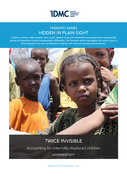
Internally displaced children are twice invisible in global and national data. First, because internally displaced people (IDPs) of all ages are often unaccounted for. Second, because age-disaggregation of any kind of data is limited, and even more so for IDPs.
Planning adequate responses to meet
...

Antibiotics and other antimicrobial agents are invaluable life savers, particularly in resource-limited countries where infectious diseases are abundant. Both uncomplicated and severe infections are potentially curable as long as the aetiological agents are susceptible to the
...
Primary health care offers a cost–effective route to achieving universal health coverage (UHC). However, primary health-care systems are weak in many low- and middle-income countries and often fail to provide comprehensive, people-centred, integrated care. We analysed the primar
...
Objectives and scope of the document
This document was developed to provide recommended management strategies for problems and disorders that are specifically related to the occurrence of a major stressful event. The recommended strategies will form the basis of a new module to be added to the WHO
...
