
Filter
242
Text search:
L.
Ferreira
Featured
Recommendations
31
New Publications
29
Language
Document type
No document type
77
Studies & Reports
64
Guidelines
54
Manuals
19
Strategic & Response Plan
13
Fact sheets
5
Training Material
4
Resource Platforms
4
Situation Updates
2
Countries / Regions
Brazil
34
Latin America and the Carribbean
12
Western and Central Europe
9
Global
9
Paraguay
8
Russia
8
Mozambique
7
Eastern Europe
7
Ukraine
6
Colombia
6
Kenya
4
Eastern Europe and Central Asia
4
Germany
3
South Africa
3
Sierra Leone
2
Argentina
2
Africa
2
Tajikistan
2
Kyrgyzstan
2
Kazakhstan
2
Vietnam
2
France
2
Portugal
2
Spain
2
Guinea
1
Liberia
1
Ethiopia
1
Haiti
1
India
1
Turkey
1
Tanzania
1
China
1
Ecuador
1
Angola
1
Mexico
1
West and Central Africa
1
Middle East and North Africa
1
Venezuela
1
Italy
1
Southern Africa
1
North America
1
Uruguay
1
United Kingdom
1
Authors & Publishers
Publication Years
Category
Countries
89
Public Health
18
Clinical Guidelines
18
Women & Child Health
7
Capacity Building
4
Key Resources
3
Toolboxes
COVID-19
68
Mental Health
31
NCDs
19
TB
16
HIV
14
NTDs
12
Planetary Health
10
Rapid Response
8
Zika
8
AMR
7
Disability
6
Caregiver
5
Ebola
3
Conflict
3
Natural Hazards
3
Global Health Education
3
Refugee
2
Pharmacy
2
This report includes analysis from informal regional consultations in the African Region, the Caribbean and North America, Latin America, South-East Asia Region, European Region, Eastern Mediterranean Region, alongside three forums in the Western Pacific Region. It analyses the overarching similarit
...
El presente informe incluye análisis de consultas informales en cinco de las regiones de la OMS: la Región de África, la Región de las Américas (donde se realizaron consultas separadas para el Caribe y América del Norte, y para América Latina), la Región de Asia Sudoriental, la Región de Eu
...
The pharmacological management of asthma has changed considerably in recent decades, as it has come to be understood that it is a complex, heterogeneous disease with different phenotypes and endotypes. It is now clear that the goal of asthma treatment should be to achieve and maintain control of the
...
The pharmacological management of asthma has changed considerably in recent decades, as it has come to be understood that it is a complex, heterogeneous disease with different phenotypes and endotypes. It is now clear that the goal of asthma treatment should be to achieve and maintain control of the
...
This revision covers the main non-communicable diseases in Mozambique as well as the National Strategic Plan's aim to create a positive environment to minimize or eliminate the exposure to risk factors and guarantee access to care.
We are IntechOpen, the world’s leading publisher of Open Access books Built by scientists, for scientists
Selection of our books indexed in the Book Citation Index in Web of ScienceTM Core Collection (BKCI)
http://dx.doi.org/10.5772/intechopen.68759

Non-communicable diseases (NCDs) are the second common cause of death in sub-Saharan Africa (SSA) accounting for about 35% of all deaths, after a composite of communicable, maternal, neonatal, and nutritional diseases. Despite prior perception of low NCDs mortality rates, current evidence suggests t
...


Updated 6 September 2016. This guidance has been developed to provide advice on the prevention of potential sexual transmission of Zika virus. The primary transmission route of Zika virus is via the Aedes mosquito. However, sexual transmission of Zika virus may also be possible, with limited evidenc
...
Actualização das orientações provisórias 7 de Junho de 2016
Actualización de las orientaciones provisionales 7 de junio de 2016
Lignes directrices provisoires actualisées 7 juin 2016
Extraced from the full version of WDI 2016
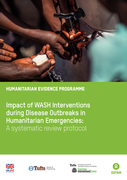
In this review, the editors will investigate the impact of eight WASH interventions in preventing (reducing the risk of) and controlling outbreaks in LMIC, with particular focus on three diseases of current concern to the response community – cholera, Ebola, and Hepatitis E. Additionally, we will
...
Working document from an informal consultation of experts. A Protocol for risk assessment at the field level. The purpose of document is to provide guidance on the methodology to be used for assessing, at field level, the yellow fever virus circulation in areas at risk, and is primarily intended fo
...

The ICAT is a simple and practical approach for assessing the adequacy of existing infection prevention and control practices and provides specific recommendations for improving practices and monitoring their effectiveness over time
TNew data from the World Health Organization reveal that the COVID-19 pandemic has disrupted malaria services, leading to a marked increase in cases and deaths.
According to WHO’s latest World malaria report, there were an estimated 241 million malaria cases and 627 000 malaria deaths worldwide i
...
