Filter
1708
Text search:
Africa
CDC
Featured
212
428
Language
Document type
894
243
223
93
87
65
36
24
20
15
8
Countries
129
95
82
73
73
69
58
52
52
48
48
42
38
36
33
31
30
29
28
26
25
24
23
23
23
21
21
18
13
12
12
11
9
9
9
9
9
9
8
8
8
8
8
7
7
7
7
6
5
5
5
4
4
4
4
4
4
4
3
3
3
3
3
3
3
2
2
2
2
2
2
2
2
2
2
2
2
2
2
1
1
1
1
1
1
1
1
1
1
1
1
1
1
1
1
1
1
1
1
1
1
1
1
1
Authors & Publishers
Publication Years
Category
704
135
77
61
60
37
27
1
Toolboxes
349
166
162
112
110
69
36
32
30
23
20
18
17
14
14
14
12
12
10
8
7
6
1
1
Accessed: 02.04.2020
Accessed: 02.04.2020

Available in English, French and Arabic
This guidance document addresses how physical distancing (referred to in previous guidance documents as ‘social distancing’) can help slow down transmission.
Ce document d'orientation explique comment la distance physique (désignée dans les documents d'orientation précédents sous le nom de «distance sociale») peut aider à ralentir la transmission.

This guidance will assist staff, students and caregivers in schools (including day care centres, pre-school, primary and secondary schools), higher educational institutions (including universities, research institutes) and other educational institutions with how to address coronavirus disease 2019 (
...
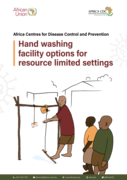
This document provides guidance to AU Member States, states/local bodies, and communities
on how to construct and maintain non-contact hand washing stations like Tippy Taps and other
alternative hand washing stations.
This statement aims to provide guidance and recommendation to African Union Member States in responding to the following questions:
What should countries do when announcing identification of a herbal remedy or medicine?
What are the implications for the rest of the continent?
Strategies for managing acute shortages of personal protective equipment during COVID-19 pandemic
recommended
This guidance provides considerations and a series of options that can be used to inform country strategies in managing any shortages of personal protective equipment.Re-use and reprocessing of single-use PPE must be a last resort temporary measure to be adopted until stocks are replenished. The WH
...
The number of confirmed COVID-19 cases detected and reported in each country is influenced by
many factors including limited access and/or utilization of healthcare and COVID-19 testing, limited
surveillance, lack of knowledge amongst the population about when to seek testing, an asymptomatic pres
...
This document simplifies the WHO guidance on severe acute respiratory infection (SARI) treatment centres and is meant to be accessible to healthcare workers, policymakers and others who want
a quick overview of the key requirements for a COVID-19 isolation centre either within an existing facility
...
It is intended for use among clinicians taking care of moderate to severe COVID-19 cases.
The COVID-19 outbreak has brought with it the need for improved critical care for patients who develop severe disease. The majority of COVID-19 patients present with mild to moderate illness, 15% develop sever
...
Guidance on pooled testing for severe acute respiratory syndrome coronavirus 2 (SARS-CoV-2)
recommended
The purpose of this document is to provide guidance on the use of pooled sample testing strategy in coronavirus disease (COVID-19)
testing laboratories of the African Union Member States for scaling up SARS-CoV-2 nucleic acid testing capacity with the available resources. The current document descr
...
Available in English, French, Portuguese and Arabic
Successful immunization of a critical mass of the African population with one or several safe and efficacious COVID-19 vaccines.Key objectives1. Accelerate African involvement in the clinical development of a vaccine. 2. Ensur
...
These guidelines outline the minimum operational guidance for infection prevention and control (IPC) in ambulances transferring suspected or confirmed COVID-19 patients. Ambulance staff should be trained in the procedures outlined here as part of their induction and prior to starting work. They are
...
Caregivers provide invaluable service and support to patients in health facilities. In many health systems, caregivers (often members of the patient’s family or friends) are responsible for providing basic care for a patient, including providing food and drinks, cleaning clothes and bed linen, as
...
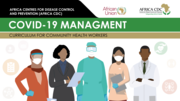
According to the World Health Organization (WHO), sub-Saharan Africa has only 3% of the world’s health workers to cater for 11% of the world population, bearing over 25% of the global disease burden (WHO, 2014). With a steady increase in reported
...
This document draws on scientific evidence from the COVID-19 pandemic and from prior public health research on behaviour change, with the purpose of empowering African Union Member States to promote widespread adoption of masks in the general population. This document complements existing
...