
Filter
1568
Text search:
Noncommunicable
Diseases
Featured
131
367
Language
Document type
683
424
172
97
74
39
20
19
10
8
8
5
4
3
Countries
180
47
45
42
37
29
26
26
25
23
23
20
19
19
19
19
17
16
16
15
15
14
14
14
13
13
13
12
11
11
10
10
10
8
8
8
7
6
6
5
5
5
5
4
4
4
4
4
4
4
4
4
3
3
3
3
3
3
3
3
3
3
3
3
3
2
2
2
2
2
2
2
2
2
2
2
2
2
1
1
1
1
1
1
1
1
1
1
1
1
1
1
1
1
1
1
1
1
1
1
1
1
1
1
1
1
1
1
1
1
Authors & Publishers
Publication Years
Category
545
293
155
70
37
25
11
1
Toolboxes
247
162
111
87
63
62
49
47
40
37
19
18
14
13
11
10
10
4
4
3
2
2
1
Thesis presented in partial fulfilment of the requirements for the degree of Master of Nursing Science in the Faculty of Health Sciences at Stellenbosch University.
The mobile clinic health care services fulfil an essential role in delivering primary health care to the dwellers in the rural commun
...
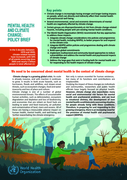
We need to be concerned about mental health in the context of climate change
This report has been prepared in response to informal requests by SIDS Member States and territories for WHO assistance in confronting the stark and dire situation which climate change has created in their countries and the impact it is having on their peoples
WBCSD Vision 2050 sets out the goal to achieve the highest attainable standard of health and wellbeing for everyone by 2050, calling for a world in which: people live healthy lives; societies promote and protect health; everyone has access to robust, resilient and sustainable healthcare services; an
...

Tuberculosis continues to represent a severe public health problem in the Region of the Americas, even more so in the case of indigenous peoples, whose TB incidence is much higher than that of the general population. To achieve tuberculosis control in these communities, it is necessary to respond t
...
Curr HIV/AIDS Rep. 2022; 19(1): 37–45.
Published online 2022 Jan 29. doi: 10.1007/s11904-021-00589-4.
COVID-19 has had an unprecedented impact on the cascade-of-care among PLWH in LAC. There is a need for
longitudinal studies that assess clinic implication of these pandemic interactions in LAC.
...
WHO Guideline on self-care interventions for health and well-being, 2022 revision: executive summary
recommended
A global shortage of an estimated 18 million health workers is anticipated by 2030, a record 130 million people are in need of humanitarian assistance, and there is the global threat of pandemics such as COVID-19. At least 400 million people worldwide lack access to the most essential health service
...
Latin America and the Caribbean is characterized by a matrix of social inequality whose axes —such as
socioeconomic stratum, gender, stage in the life cycle, ethnicity and race, territory, disability, and immigration
status— create multiple, often concurrent, situations of exclusion and discri
...
The World Health Organization (WHO) recognizes the challenges countries face for maintaining their COVID-19 response while addressing competing public health challenges, conflicts, climate change and economic crises.
It remains critical for national programmes to continue to offer testing for COVI
...
The survey highlights changes that have taken place in Bangladesh’s demographic and health situation since the previous BDHS surveys. The survey provides important information for policymakers and program personnel in addressing the monitoring and evaluation needs of the 4th Health, Population and
...
The primary audience for these recommendations includes health professionals who are responsible for developing national and local health-care guidelines and protocols and health workers involved in the provision of care to women and their newborns during pregnancy, labour and childbirth; this inclu
...
The primary audience for these recommendations includes health professionals who are responsible for developing national and local health-care guidelines and protocols and health workers involved in the provision of care to women and their newborns during pregnancy, labour and childbirth; this inclu
...
The primary audience for these recommendations includes health professionals who are responsible for developing national and local health-care guidelines and protocols and health workers involved in the provision of care to women and their newborns during pregnancy, labour and childbirth; this inclu
...
This collection of case studies on risk communication and community engagement (RCCE) from 18 different country/area level public health partners in the WHO European Region provides evidence of numerous results achieved and lessons learned since the start of the COVID-19 pandemic. RCCE has not
...
Monitoring financial protection and utilization of health services in Mongolia 2009-2018 is based on national representative household socioeconomic surveys. The study finds that between 2009 and 2018, despite ambitious health reforms, the incidence of catastrophic health spending and impoverishing
...
This global progress report attempts to lay the groundwork for the kind of accelerated action needed. Section 1 presents key data, trends and developments in women’s, children’s and adolescents’ health and well-being. That is followed in Section 2 by a deeper dive into the impact of the COVID-
...

January 2020 to December 2021

An estimated 1.3 billion people – or 16% of global population worldwide – experience a significant disability today. Persons with disabilities have the right to the highest attainable standard of health as those without disabilities. However, the WHO Global report on health equity for persons w
...
