
Filter
1290
Text search:
neglected
tropical
diseases
Featured
109
256
Language
Document type
452
377
120
87
68
55
32
31
19
13
12
11
6
5
2
Countries
224
33
31
25
24
24
21
21
21
15
14
14
14
13
13
12
11
11
11
10
10
10
10
9
9
8
8
7
7
7
6
6
5
5
5
4
4
3
3
3
3
3
3
3
3
3
2
2
2
2
2
2
2
2
2
2
2
2
2
2
2
2
2
1
1
1
1
1
1
1
1
1
1
1
1
1
1
1
1
1
1
1
1
1
1
1
1
1
1
1
1
1
1
1
1
1
1
1
1
1
1
Authors & Publishers
Publication Years
Category
279
149
89
37
29
22
14
1
Toolboxes
561
61
46
36
32
29
27
25
24
22
18
15
15
14
10
9
7
6
4
4
4
2
Skin NTDs App
recommended
Recognizing neglected tropical diseseases through changes on the skin.
App for Android and IOS, free of charge. The App is available in English and French, with plans to explore translations into o
...
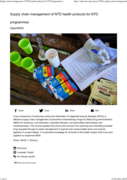
A key component of achieving control and elimination of neglected tropical diseases (NTDs) is effective supply chain management of preventive chemo
...

Trachoma is one of the 17 WHO-defined Neglected Tropical Diseases
(NTDs) that affect over 1 billion of the world’s poorest and most
marginalize
...

Two adjectives raise an issue for communicators working on Chagas disease (CD): “invisible and silent”. Two adjectives that can be ascribed to other neglected tropical
...
Schistosomiasis is a helminthic infection and one of the neglected tropical diseases (NTDs). It is caused by blood flukes of the genus Schistosoma.
...
Leptospirosis is a perplexing conundrum for many. In the existing literature, the pathophysiological mechanisms pertaining to leptospirosis is still not understood in full. Considered as a neglected tropic
...

As part of its 2019–2030 global strategy for the prevention and control of snakebite envenoming, WHO is launching a new Snakebite Information and Data Platform. This is the result of collaboration between the Departments of Control of Neglected
...
Website last accessed on 14.04.2023
One of the ongoing challenges with neglected tropical diseases (NTDs) is that the discovery of medicines to
...
Ending the neglect to attain the Sustainable Development Goals: a road map for neglected tropical diseases 2021–2030 (“the road map”) sets ex
...
Human schistosomiasis, a parasitic and often chronic illness, is one of the major neglected tropical diseases worldwide. It is estimated that 240 m
...
SDG target 3.3: by 2030, end the epidemics of AIDS, tuberculosis, malaria and neglected tropical diseases and combat hepatitis, waterborne
...
Progress towards achieving the Roadmap targets for control and elimination of the Neglected Tropical Diseases.
Leishmaniasis is a vector-borne tropical/subtropical disease caused by an intracellular parasite transmitted to humans by sand fly bite. It is endemic in Asia, Africa, the Americas, and the Mediterranean region. Worldwide reports include 1.5–2 mil
...

International commitment to eliminate trachoma as a public health problem worldwide is supported by resolution WHA51.11 of the World Health Assembly .1 Important progress towards this goal has been made by harnessing the mostly informal relationships that exist between partners including Member Stat
...

Human African Trypanosomiasis (HAT, sleeping sickness) and Animal African Trypanosomiasis (AAT) are neglected tropical diseases generally caused by
...
In 2012, the World Health Organisation (WHO) set out a roadmap for the control, elimination, or eradication of 17 neglected tropical diseases by 20
...

J Glob Health Sci. 2020 Jun;2(1):e3. A group of enzootic and zoonotic protozoan infections, the leishmaniases constitute among the most severely neglected tropical
...
Websites last accessed on 04.04.2023
Chagas disease, also known as the “kissing disease,” is considered one of the Neglected Tropical Diseases
...

Human schistosomiasis is caused mainly by 3 schistosome species: Schistosoma haematobium, S. mansoni and S. japonicum. S. guineensis, S. intercalatum and S. mekongi have a highly localized distribution in Central Africa and along the Mekong River in South-East Asia, respectively. Soil-transmitted h
...

Findings on maternal and child health in Nepal, Mozambique and
Rwanda, and neglected tropical diseases in Cambodia and Sierra Leone | This report
...
