
Filter
1215
Text search:
hospitalization
Featured
150
258
Language
Document type
614
226
181
68
44
36
21
13
5
5
2
Countries
95
42
42
28
27
23
23
19
16
16
16
15
14
14
14
14
13
12
12
12
11
11
10
10
8
8
7
7
7
6
6
6
6
5
5
5
5
5
5
5
4
4
4
4
4
4
4
3
3
3
3
3
3
3
3
3
3
3
3
3
2
2
2
2
2
2
2
2
2
2
2
2
1
1
1
1
1
1
1
1
1
1
1
1
1
1
1
1
1
1
1
1
1
1
1
1
Authors & Publishers
Publication Years
Category
398
141
76
46
24
16
9
1
1
Toolboxes
212
113
110
60
60
39
38
30
30
29
27
26
21
21
20
17
9
8
5
4
4
3
2


ICF is WHO's framework for health and disability. It is the conceptual basis for the definition, measurement and policy formulations for health and disability. It is a universal classification of disability and health for use in health and health related sectors. ICF therefore looks like a simple he
...

The Journal of Infection in Developing Countries 7(3):289-292
Fact sheet
Good hygiene is critical to ensure that healthcare staff provide quality care, reduce the spread of infections, and protect the health of communities. This fact sheet explores the healthcare-related risks of poor hygiene and the critical elements of hand hygiene needed to improve qua ...
Good hygiene is critical to ensure that healthcare staff provide quality care, reduce the spread of infections, and protect the health of communities. This fact sheet explores the healthcare-related risks of poor hygiene and the critical elements of hand hygiene needed to improve qua ...

The International Classification of Functioning, Disability and Health, known more commonly as ICF, provides a standard language and framework for the description of health and health-related states. Like the first version published by the World Health Organization for trial purposes in 1980, ICF is
...
This study aimed to estimate the proportion of Mozambicans eligible for pharmacological treatment for hypertension according to single risk factor and total cardiovascular risk approaches. It concluded that a total of 19.8% of 40–64-year-olds would be eligible for pharmacological treatment of hype
...
Young children are especially susceptible to exposure to trauma. Rates of abuse and neglect among this population are staggering. This article presents a review of relevant literature, including research findings specific to early childhood vulnerability to trauma, symptoms associated with traumatic
...
One key aim of tuberculosis (TB) prevention and care is to render them more people-centred, which means further boosting and improving ambulatory care models across the countries of Eastern Europe and central Asia. This note is intended to remind interested parties of the evidence that shows that am
...
Schizophr Bull. 2014 Jan;40(1):192-213. doi: 10.1093/schbul/sbs150. Epub 2012 Dec 17.
Brief review of selected topics
The following pages provide a focus on selected areas in relation to neurology. The specialists who contributed the reviews are listed in the Project Team and Partners
Neurology Atlas (2004)
After a frightening or distressing experience (any kind of injury, a physical or sexual assault, car crash, fire, or other natural disaster), a child or teen may suffer psychological
stress in addition to any physical injuries.
When these reactions last for more than a month and are strong enough
...
Based on the survey, five principles for deinstitutionalization were identified: community-based services must be in place; the health workforce must be committed to change; political support at the highest and broadest levels is crucial; timing is key; and additional financial resources are needed.
...
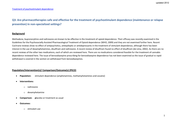
Q3: Are pharmacotherapies safe and effective for the treatment of psychostimulant dependence (maintenance or relapse prevention) in non-specialized settings?
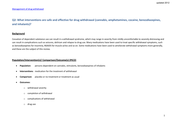
Q2: What interventions are safe and effective for drug withdrawal (cannabis, amphetamines, cocaine, benzodiazepines, and inhalants)?
Miscellaneous
Child and adolescent psychiatric emergencies
Chapter J.1
