
Filter
1203
Text search:
food
contamination
Featured
161
346
Language
Document type
630
211
169
83
51
21
18
11
4
3
2
Countries
59
37
37
31
27
26
23
23
22
22
21
20
18
16
16
14
14
14
14
11
11
11
11
11
11
10
10
9
8
8
7
7
6
6
6
5
5
5
5
4
4
4
4
3
3
3
3
3
3
3
3
3
2
2
2
2
2
2
2
2
2
2
2
2
2
2
2
2
1
1
1
1
1
1
1
1
1
1
1
1
1
1
1
1
1
1
1
1
1
1
1
1
1
Authors & Publishers
Publication Years
Category
414
133
87
55
45
25
20
1
1
Toolboxes
107
99
90
78
71
46
46
45
45
41
28
27
26
19
19
14
11
7
6
5
4
2
1
1
The Quadripartite Organizations – the Food and Agriculture Organization of the United Nations (FAO), the United Nations Environment Programme (UNEP), the World Organisation for Animal Health (WOAH, founded as OIE), and the World Health Organizatio
...

Maternal, Infant and Young Child Nutrition Strategic Actions:
1 Endorse and disseminate key policies and regulations
2 Improve maternal nutrition
3 Protect, promote, and support optimal infant and young child feeding practices
4 Support optimal infant and young child feeding in ...
1 Endorse and disseminate key policies and regulations
2 Improve maternal nutrition
3 Protect, promote, and support optimal infant and young child feeding practices
4 Support optimal infant and young child feeding in ...
At its 48th session of Codex Committee on Food Hygiene (CCFH), the Committee noted the importance of water quality and safety in food production and processing. CCFH requested the
...
Cholera is an acute diarrhoeal disease caused by the ingestion of food or water contaminated with the bacterium V.
cholerae. It has a short incubation period of a few hours to 5 days. It is endemic in some countries, frequently
showing seasonal va
...
World Health Organization, Food and Agriculture Organization of the United Nations & World Organisation for Animal Health. (2021). Antimicrobial resistance and the United Nations sustainable development cooperation framework: guidance for Unit
...
PlosOne https://doi.org/10.1371/journal.pone.0165797; Food production is a major driver of greenhouse gas (GHG) emissions, water and land use, and dietary risk factors are contributors to non-communicable diseases. Shifts in dietary patterns can the
...
This report of the EFSA and ECDC presents the results of zoonoses monitoring activities carried out in 2020 in 27 EU Member States (MS) and nine non-MS. Key statistics on zoonoses and zoonotic agents in humans, food, animals and feed are provided an
...
Although Shiga toxin-producing Escherichia coli (STEC) have been isolated from a variety of food production animals, they are most commonly associated with ruminants from which we derive meat and milk. Because of the widespread and diverse nature of
...
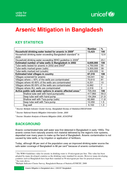
Arsenic contaminated tube well water was first detected in Bangladesh in early 1990s. The arsenic comes from naturally arsenic-rich material delivered by the region's river systems, deposited over many years to make up the land of Bangladesh. Arsenic conta
...

Antimicrobial agents play an indispensable role in animal health and welfare management. At the same time, the need for prudent use is obvious to ensure good food safety outcomes and to manage the potential risk of antimicrobial resistance. The emer
...
The authors conduct an integrated survey of Antimicrobial Resistant Organisms (AMR) in drinking water, wastewater and surface water in three settings in Bangladesh: rural households, rural poultry farms, and urban food markets. Results show that unt
...
Guidelines for drinking-water quality: Fourth edition incorporating the first and second addenda
recommended
Guidance has been updated on a number of chemicals: asbestos, bentazone, chromium, iodine, manganese, microcystins, nickel, silver, tetrachloroethene and trichloroethene. Guidance has also been added for chemicals not previously assessed in the Guidelines: anatoxin-a and analogues, cylindrospermopsi
...
This report aims to support countries in the necessary transition toward healthier, more sustainable diets by integrating biodiversity in food-based interventions to support nutrition and health. It is intended to help guide decision-makers in the h
...
Oxfam Water Supply Scheme for Emergencies. This manual is part of a series of guides devised by the Oxfam Public Health Engineering Team to help provide a reliable water supply for populations affected by conflict or natural disaster. Wherever possible, water supplies in emergency conditions should
...
FANTA provided technical support to Haiti’s Ministry of Public Health and Population for the development of national guidelines and an accompanying flipchart, which provide practical solutions to nutrition problems for people living with HIV, as well as guidance on nutritionally managing the sympt
...
Application of a One Health approach .
The present guidance was developed with the support of the WHO Advisory Group on Integrated Surveillance of Antimicrobial Resistance (AGISAR) to assist countries and other stakeholders in the establishment and development of programmes of integrated surveillan
...
This is the 19th annual Landmine Monitor report. It is the sister publication to the Cluster Munition Monitor report, first published in November 2010.
Landmine Monitor 2016 provides a global overview of the landmine situation. Chapters on developments in specific countries and other areas are ava
...
(August 28 – October 10, 2017)
A nutrition and mortality assessment using SMART methodology was applied and the survey covered 15 statistical (14 districts plus 1) domains countrywide. The main objective of the survey was to assess the current nutrition status of the population, especially ch ...
A nutrition and mortality assessment using SMART methodology was applied and the survey covered 15 statistical (14 districts plus 1) domains countrywide. The main objective of the survey was to assess the current nutrition status of the population, especially ch ...
Despite improvements in recent years, the prevalence of undernutrition among women and children in Myanmar remains unacceptably high. One in three children are stunted and about 8% are acutely malnourished. Micronutrient deficiencies are common among infants, young children and pregnant women. In fa
...
In order to better understand the contributing factors of undernutrition in LIFT program areas and the links between child nutritional status and independent variables of programmatic importance to LIFT (such as income, livelihoods, food security, a
...
