
Filter
486
Filtered Results: 486
Text search:
The
Alliance
for
Children
Protection
in
Humanitarian
Action
Featured
Recommendations
58
New Publications
126
Language
Document type
No document type
237
Studies & Reports
100
Guidelines
65
Strategic & Response Plan
30
Manuals
28
Situation Updates
11
Resource Platforms
5
Fact sheets
4
Training Material
2
Infographics
2
App
1
Online Courses
1
Countries / Regions
Global
35
Syria
20
Uganda
13
South Sudan
12
Myanmar / Burma
12
Congo, Democratic Republic of
11
Kenya
10
Nepal
8
Liberia
7
Ethiopia
7
Haiti
7
Lebanon
6
Latin America and the Carribbean
6
India
5
Somalia
5
Bangladesh
5
Ukraine
5
Yemen
5
Venezuela
5
Russia
5
Sierra Leone
4
Nigeria
4
Jordan
4
Zambia
4
Cambodia
4
Mozambique
4
Central African Republic
4
Brazil
4
Colombia
4
Lesotho
4
Africa
4
Senegal
3
Niger
3
Iraq
3
Afghanistan
3
Indonesia
3
Western and Central Europe
3
Asia
3
Guinea
2
Mali
2
Zimbabwe
2
Philippines
2
Germany
2
Turkey
2
Egypt
2
Tanzania
2
China
2
Rwanda
2
South Africa
2
Malawi
2
Sudan
2
Angola
2
Mexico
2
Chile
2
West and Central Africa
2
Western Pacific Region
2
Eastern Europe and Central Asia
2
Italy
2
Laos
2
Canada
2
Iran
2
Vietnam
2
Japan
2
Portugal
2
Burkina Faso
1
Morocco
1
Saudi Arabia
1
Cameroon
1
Ghana
1
Pakistan
1
Thailand
1
Malaysia
1
Mauritania
1
Ireland
1
Singapore
1
Papua New Guinea
1
Argentina
1
Dominican Republic
1
Namibia
1
Cuba
1
Honduras
1
Ecuador
1
El Salvador
1
Bolivia
1
Greece
1
Libya
1
Guatemala
1
Nicaragua
1
Sri Lanka
1
East and Southern Africa
1
Middle East and North Africa
1
South–East Asia Region
1
Paraguay
1
Poland
1
Eastern Europe
1
Palestine
1
North Korea
1
Djibouti
1
Southern Africa
1
Timor Leste/ East Timor
1
Romania
1
Moldova
1
Uruguay
1
Tunisia
1
Spain
1
South Korea
1
Authors & Publishers
Publication Years
Category
Countries
138
Women & Child Health
59
Key Resources
26
Public Health
22
Clinical Guidelines
18
Capacity Building
10
Toolboxes
COVID-19
96
Disability
47
Mental Health
47
Conflict
45
HIV
28
Refugee
23
Global Health Education
16
Ebola
14
Planetary Health
13
Health Financing Toolbox
13
Natural Hazards
12
Rapid Response
10
NTDs
7
Cholera
6
Caregiver
4
Zika
2
TB
2
Specific Hazards
2
Pharmacy
2
Polio
1
South Sudan
1
AMR
1
NCDs
1
In the present report, the Special Rapporteur on the sale and sexual exploitation of...
n Autumn 2013, HHI Executive Director, Vincenzo Bollettino, traveled to the Philippines to participate in an assessment of civil-military engagement in...
This regional action plan provides a broad framework for the regional level to assist governments in...
The Sustainable Development Goals (SDGs) call for major societal transformations that will require significant fiscal outlays as well as private investments. ... fiscal outlays cover public investments, the public provision of social services, and social protection for vulnerable populations. The key message of this paper, building on recent reports by the IMF and SDSN (IMF, 2019b; SDSN, 2018) is that the governments of Low-Income Developing Countries (LIDCs) will require a substantial increase in fiscal (budget) revenues, far beyond what they can achieve by their own fiscal reforms. For this reason, SDG financing will require substantial international cooperation to enable the LIDCs to finance their SDG fiscal outlays. One important source of increased revenues should be the globally coordinated taxation of ultra-high-net worth assets. Today’s ultra-rich should help to pay for the survival and basic needs of the world’s poorest people.
In an ambitious new era for health development under the 2030 Agenda for Sustainable Development...
This operational guidance on MHPSS provides a practical orientation and tools for UNHCR country operations. It covers specific points of good practice to consider when developing MHPSS programming and offers advice on priority issues and practical d...

To complement the Global Strategy progress reporting, this report provides a detailed look at country leadership and action toward the Every Newbor...
Clinical management standard operating procedures.
Ebola virus disease (EVD) is a life-threatening multisystem illness associated with fever and gastrointestinal (GI) symptoms that frequently leads to hypovolaemia, metabolic acidosis, hypoglycaemia, and multi-organ failure. ... prolonged 2013–2016 EVD outbreak in West Africa allowed for an evolution of care such that by outbreak end many patients received individualized and optimized supportive care (oSoC), including volume resuscitation, symptom control, laboratory and bedside monitoring of glucose, electrolyte levels and organ dysfunction, as well as rapid detection and treatment of co-infections, potentially contributing to the downward trend in the case fatality rate (CFR).
This guidance should serve as a foundation for oSoC that should be followed to ensure both the best possible chance for survival and allow for reliable comparison of investigational therapeutic interventions as part of a randomized controlled trial. This guideline provides recommendations for the management of adults and children.
This updated Comprehensive Mental Health Action Plan 2013-2030 builds upon its predecessor and sets out clear actions for Member States, ... WHO Secretariat and international, regional and national partners to promote mental health and well-being for all, to prevent mental health conditions for those at-risk and to achieve universal coverage for mental health services. While the updated action plan includes new and updated indicators and implementation options, the original four major objectives remain unchanged: more effective leadership and governance for mental health; the provision of comprehensive, integrated mental health and social care services in community-based settings; implementation of strategies for promotion and prevention; and strengthened information systems, evidence and research.
In English, French, Spanish, Arabic and Russian available

Every year, an estimated 15 million babies are born preterm – before 37 weeks of pregnancy. That is more than 1 in 10 live births. Approximately 1 million children die each year worldwide due to c...
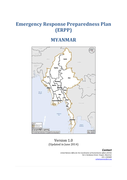
Myanmar is prone to various natural hazards that include earthquakes, floods, cyclones, droughts, fires, tsunamis, some of whichhave the potential to impact large numbers of people. In ... event that large numbers of people are affected (such as was the case in 2008 following cyclone Nargis), the government may decide to request international assistance to respond to the disaster.
The overall goal of the ERPP is to mitigate the impact of disasters and save as many lives as possible from preventable causes. It aims to ensure that effective and timely assistance is provided to people in need through effective coordination and communication on emergency preparedness and humanitarian response between members of the HCTin Myanmar. The approach has been developed in collaboration with the Government, to facilitate a coordinated and effective support to people affected by humanitarian crises.
The overall goal of the ERPP is to mitigate the impact of disasters and save as many lives as possible from preventable causes. It aims to ensure that effective and timely assistance is provided to people in need through effective coordination and communication on emergency preparedness and humanitarian response between members of the HCTin Myanmar. The approach has been developed in collaboration with the Government, to facilitate a coordinated and effective support to people affected by humanitarian crises.

The 2012 NDRMP lays out the Disaster Risk Management (DRM) architecture of the country and provides guidance ... DRM intervention at all levels. However, implementation has been slow and resource challenges exist throughout the government.
The PNG government’s policy and institutional framework for DRM still faces numerous obstacles. The main challenges in moving towards a more proactive and systematic approach to manage risks and build resilience include 1.) the limited coordination between DRM and Climate Change Adaptation agencies; 2.) the slow migration from emphasis on response to risk reduction and management; 3.) the limited institutional capacity for planning and design of risk informed investments; and 4.) the lack of available historic natural hazard data, which hinders the assessment of risks.
The PNG government’s policy and institutional framework for DRM still faces numerous obstacles. The main challenges in moving towards a more proactive and systematic approach to manage risks and build resilience include 1.) the limited coordination between DRM and Climate Change Adaptation agencies; 2.) the slow migration from emphasis on response to risk reduction and management; 3.) the limited institutional capacity for planning and design of risk informed investments; and 4.) the lack of available historic natural hazard data, which hinders the assessment of risks.
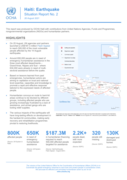
On 25 August, UN agencies and partners launched a US$187.3 million Flash Appeal to reach 500,000 of the most vulnerable people affected by the 14 August earthquake.
Around 650,000 people are ... need of emergency humanitarian assistance in the three most affected departments – Grand’Anse, Nippes and Sud – where 634,000 were already in need of multisectoral assistance before the quake.
Based on lessons learned from past emergencies, humanitarian actors are aiming to capitalize on local and national level expertise, capacities and knowledge to promote a rapid and effective response tailored to the expressed needs of affected people.

Timor-Leste’s vulnerability to natural hazards means if particular care is not taken in the development of the country’s infrastructure, it wil...

Myanmar has made significant progress in its disaster management policies, plans, and procedures since 2008, when Cyclone Nargis impacted the country leaving devastation ... its aftermath. The Government of Myanmar (GoM) has modified the government structure and created new authorities and plans to improve the effectiveness of disaster management at all levels. While this progress is encouraging and shows the determination of the government to make necessary adjustments, the resources to implement the policy changes have been slower to develop. Myanmar has made significant progress in its disaster management policies, plans, and procedures since 2008, when Cyclone Nargis impacted the country leaving devastation in its aftermath. The Government of Myanmar (GoM) has modified the government structure and created new authorities and plans to improve the effectiveness of disaster management at all levels. While this progress is encouraging and shows the determination of the government to make necessary adjustments, the resources to implement the policy changes have been slower to develop.
Every five minutes a child dies as the result of violence, according to a ground-breaking report from Unicef UK. The report reveals that the vast m...
Recently, Sri Lanka has been impacted by multiple natural disasters. Sri Lanka experienced a landslide in October 2014, and flooding in December 2014.8 Sri Lanka withstood ... worst drought conditions witnessed in four decades in 2016; the extreme drought conditions extended into 2017 and produced substantial economic and social effects. The drought was responsible for an increase in national poverty levels, due to reduced cultivation income, especially for rural farmers. ... In May 2017, Sri Lanka experienced continuous rains causing flash floods and extreme devastation. However, despite natural disasters and challenges posed by a complex political environment, Sri Lanka’s financial performance remained largely satisfactory in the first half of 2017.

In Control. A Practical Handbook for Professionals Working in Health Emergencies Internationally
recommended
In Control imparts knowledge, provokes reflection and triggers curiosity. The first half of the book provides an overview of ... organisations, principles, frameworks and themes that every professional deploying to health emergencies should be aware of. The second half of the book provides practical advice to help professionals survive and thrive during their mission – from staying healthy, protecting oneself from cyber-attacks and coping with stress to building trust among the host community or dealing with language barriers and the press.
This handbook is free of charge and can be made available in small quantities as long as supply lasts. To order, please send this form to: incontrol-handbook@rki.de
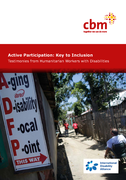
Testimonies from Humanitarian Workers with Disabilities.
By reading the first-hand accounts, we hear how persons with disabilities, not through any particular talent or skill but from unique knowle...
For practitioners in humanitarian and development contexts
