
Filter
1253
Text search:
Antimicrobial
resistance
Featured
140
252
Language
Document type
340
304
249
92
77
70
31
21
19
15
13
12
9
1
Countries
48
41
34
31
30
26
24
20
16
13
11
11
10
10
9
9
8
8
8
8
7
7
7
7
6
6
6
6
6
5
5
5
4
4
4
4
3
3
3
3
3
3
3
3
3
3
3
3
2
2
2
2
2
2
2
2
2
2
2
2
2
2
2
2
2
2
2
1
1
1
1
1
1
1
1
1
1
1
1
1
1
1
1
1
1
1
1
1
1
1
1
1
1
1
1
1
1
1
1
1
1
1
1
1
1
1
1
1
1
1
1
Authors & Publishers
Publication Years
Category
296
91
73
45
36
18
16
3
Toolboxes
551
79
77
58
53
51
47
42
33
23
19
17
16
15
8
7
6
5
2
1
1

This fourth WHO report on neglected tropical diseases (NTDs) reviews the progress made towards achieving the Roadmap targets for 2020, noting the remaining challenges, then looks beyond 2020 to evaluate the changing global health and development landscape, considering the implications of integrating
...
Hand hygiene is vital for safe health care delivery, yet practices at the point of care remain suboptimal worldwide. A comprehensive research agenda is therefore necessary to improve our understanding of factors influencing hand hygiene behaviour and to strengthen appropriate interventions. This age
...
At its 48th session of Codex Committee on Food Hygiene (CCFH), the Committee noted the importance of water quality and safety in food production and processing. CCFH requested the Food and Agriculture Organization of the United Nations
(FAO) and the World Health Organization (WHO) to provide guidan
...
While there has been real progress in addressing the burden of disease in the WHO African region, the COVID-19 pandemic has highlighted the link between health, economics and security, as the region saw decades of progress threatened, including positive trends in decreasing inequality. In the Africa
...
The Infection prevention and control in the context of coronavirus disease 2019 (COVID-19): a living guideline consolidates technical guidance developed and published during the COVID-19 pandemic into evidence-informed recommendations for infection prevention and control (IPC). This living guideline
...
The response to a cholera outbreak must focus on limiting mortality and reducing the spread of the disease. It should be comprehensive and multisectoral, including epidemiology, case management, water, sanitation and hygiene, logistics, community engagement and risk communication. All efforts must b
...
Buruli ulcer (BU) is a bacterial skin infection that is caused by Mycobacterium ulcerans and mainly affects people who reside in the rural areas of Africa and in suburban and beach resort communities in Australia.
Diabetes mellitus, commonly known as diabetes, is a group of metabolic disorders characterized by the presence of hyperglycaemia in the absence of treatment. The heterogeneous aetiopathology includes defects in insulin secretion, insulin action, or both. The long-term specific complications of diabe
...
The European Respiratory Society (ERS)/American Thoracic Society (ATS) Task Force on severe asthma includes an updated definition of severe asthma, a discussion of severe asthma phenotypes in relation to genetics, natural history, pathobiology and physiology, as well as sections on evaluation and tr
...
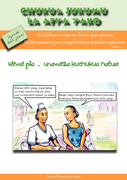
Ujumbe kwa jamii: "kukabiliana na usugu wa dawa za kuua vijasumu- hadithi zinazohusu jamii inavyoshiriki kwa kutekeleza wajibu wake".
Данный Национальный план в области Устойчивости к противомикробным пре- паратам (УПП) с компонентом потребления противомикробных препаратов (ППП), для секторов здÑ
...
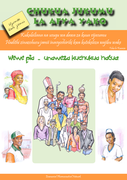
Ujumbe kwa jamii: "kukabiliana na usugu wa dawa za kuua vijasumu- hadithi zinazohusu jamii inavyoshiriki kwa kutekeleza wajibu wake".
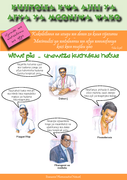
Ujumbe kwa jamii: "kukabiliana na usugu wa dawa za kuua vijasumu- Masimulizi ya watalaamu wa afya wanaofanya kazi kwa mujibu yao"
Brochure for Patients and General Public
Q & A Guide for Parents - Factsheet
Antibiotics only fight infections caused by bacteria. Like all drugs, they can be harmful and should only be used when necessary. Taking antibiotics when you have a virus can do more harm than good: you will still feel sick and the antibiotic could give you a skin rash, diarrhea, a yeast infection,
...
Do I really need antibiotics? - Fact Sheet for Patients
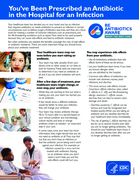
Your healthcare team has decided you or your loved one has an infection that requires antibiotics, or needs antibiotics to prevent an infection in certain circumstances, such as before surgery - Fact Sheet for Patients
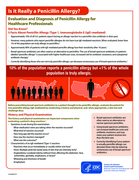
Evaluation and Diagnosis of Penicillin Allergy for Healthcare Professionals
