
Filter
1323
Text search:
multisectoral
approach
Featured
129
343
Language
Document type
626
288
153
143
63
13
13
10
4
4
3
1
Countries
95
46
32
31
31
29
26
26
25
24
22
21
20
19
18
17
17
15
15
14
14
13
12
12
11
11
10
10
10
10
9
8
8
8
7
7
6
6
6
6
6
6
5
5
5
5
5
5
4
4
4
4
4
4
4
3
3
3
3
3
3
2
2
2
2
2
2
2
2
2
2
1
1
1
1
1
1
1
1
1
1
1
1
1
1
1
1
1
1
1
1
1
1
1
1
1
1
1
1
Authors & Publishers
Publication Years
Category
448
122
74
64
60
15
4
2
Toolboxes
124
97
89
88
80
64
54
49
41
38
34
33
23
22
17
15
14
8
7
4
3
1
1
1

At the threshold of Sustainable Development Goals (SDG) era, this document captures the remarkable achievements by Member States towards achieving MDGs 4 and 5. It acknowledges new opportunities in the post-2015 phase shaped by the SDGs and the Global Strategy for women’s, children’s and adoles
...

The Global vector control response 2017–2030 (GVCR) provides a new strategy to strengthen vector control worldwide through increased capacity, improved surveillance, better coordination and integrated action across sectors and diseases.
In May 2017, the World Health Assembly adopted resolutio ...
In May 2017, the World Health Assembly adopted resolutio ...

Advances have been made through expanded interventions delivered through five public health approaches: innovative and intensified disease management; preventive chemotherapy; vector ecology and management; veterinary public health services; and the provision of safe water, sanitation and hygiene. I
...

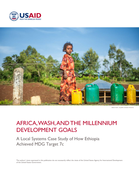
Ethiopia met the MDG target for drinking water access with a unique and high degree of success. The magnitude of the country’s success in providing improved drinking water to nearly half of its population in 25 years despite its diversity, size, and challenges cannot be overstated. This case study
...

Every year, around 830 000 children die from unintentional or "accidental" injuries. The vast majority of these injuries occur in low-income and middle-income countries. However, dozens of prevention strategies and programmes exist. If they were integrated into other child survival programmes and im
...

In April and May 2015, Nepal was hit by two major earthquakes killing around 9,000 people and leaving many thousands more injured and homeless.
To optimize the speed and volume of critical humanitarian assistance, the HCT has developed this Plan to:
1. Reach a common understanding of earth ...
To optimize the speed and volume of critical humanitarian assistance, the HCT has developed this Plan to:
1. Reach a common understanding of earth ...

The guidance aspires
• To emphasize the 'need' to mainstream disaster risk reduction (DRR) in the health sector initiatives.
• To identify key approaches for mainstreaming DRR in the health sector in Myanmar, particularly in rural areas, based on the good practices, innovative approach ...
• To emphasize the 'need' to mainstream disaster risk reduction (DRR) in the health sector initiatives.
• To identify key approaches for mainstreaming DRR in the health sector in Myanmar, particularly in rural areas, based on the good practices, innovative approach ...

The study analyses the current situation of children with disabilities in relation to realizing their rights and accessing basic services, as well as their life experiences in their communities. It also focuses on identifying the barriers created by society that prevent children with disabilities fr
...
Lancet Glob Health 2018 Published Online September 12, 2018 http://dx.doi.org/10.1016/S2214-109X(18)30407-8
In many humanitarian emergencies, there is a serious lack of access to even the most basic materials needed for managing the blood in addition to a lack of appropriate sanitation facilities (including water), which are critical for addressing menstrual hygiene. Privacy in emergencies is often scarc
...

Inequality of access to palliative care and symptom relief is one of the greatest disparities in global health care (1). Currently, there is avoidable suffering on a massive scale due to lack of access to palliative care and symptom relief in low- and middle-income countries (LMICs) (1). Yet basic p
...

Report on the symposium 26–28 May 2015, New Babylon Meeting Center, The Hague
The 2016-2017 Biennial report presents an overview of WHO Namibia's main achievements and challenges and highlights its vision for the next five years.

It provides insight into WHO’s work that aims to improve the health of the people of the United Republic of Tanzania in collaboration with key stakeholders.

Guidelines on sanitation and health
recommended
The new WHO Guidelines on Sanitation and Health summarize the evidence on the effectiveness of a range of sanitation interventions and provide a comprehensive framework for health-protecting sanitation, covering policy and governance measures, implementation of sanitation technologies, systems and b
...

In 2017, 3.6 million of the estimated 10 million people with TB worldwide were “missed” by national TB programmes (NTPs). Two thirds of them are thought to access TB treatment of questionable quality from public and private providers who are not engaged by the NTP. The quality of care provided i
...
