
Filter
315
Text search:
seguridad
alimentaria
Featured
27
99
Language
Document type
163
69
36
23
9
5
2
2
2
2
1
1
Countries / Regions
40
27
14
11
11
10
9
9
4
4
4
4
3
3
3
2
2
1
1
1
1
1
1
1
1
1
1
1
1
1
1
1
1
1
1
1
Authors & Publishers
Publication Years
Category
112
110
24
11
5
2
2
2
Toolboxes
44
32
15
15
14
11
9
8
3
3
3
3
2
2
2
2
2
2
2
1
1
Global Report on Food Crises 2023
recommended
The Global Report on Food Crises (GRFC) 2023 highlights that the number of people experiencing high levels of acute food insecurity and requiring urgent food and livelihood assistance increased for the fourth consecutive year in 2022. Over a quarter of a billion people were estimated to face acute h
...
There is growing international consensus that food systems transformation is important to address the challenges of malnutrition in all its forms, the burden of noncommunicable diseases (NCDs), environmental sustainability, increasing inequality and ensuring the welfare of workers and animals. In li
...
This report is the annual global monitoring report documenting progress towards Sustainable Development Goal (SDG) 2 targets 2.1 and 2.2. This year’s report explores the links between urbanization and changing food systems and how these changes are impacting the availability, affordability and des
...
In October 2022, President Biden signed the Global Malnutrition Prevention and Treatment Act (GMPTA) into law, which directs USAID to prevent and treat malnutrition globally. The GMPTA further codifies USAID’s leadership on nutrition, with a focus on evidence-based interventions across health syst
...
Climate-induced water insecurity poses one of the biggest threats to humanity and will lead to more hunger, disease and displacement
Oxfam water engineers are having to drill deeper, more expensive and harder-to-maintain water boreholes used by some of the poorest communities around the world, mo
...
Complementary feeding, defined as the process of providing foods in addition to milk when breast milk or milk formula alone are no longer adequate to meet nutritional requirements, generally starts at age 6 months and continues until 23 months of age. This is a developmental period when it is critic
...
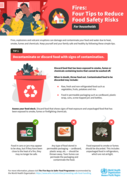
Fires, explosions and volcanic eruptions can damage and contaminate food and water due to heat, smoke, fumes and chemicals. These flyers include tips to reduce food safety risks during a fire incident for households, food suppliers, vendors, food industry inspectors and workers.
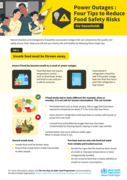
Natural disasters and emergencies frequently cause power outages that can compromise the quality and safety of food. These flyers include tips to reduce food safety risks during a power outage for households, food suppliers, vendors, food industry inspectors and workers.
Food inspection is crucial for ensuring food safety, using risk-based approaches to target high-risk products and businesses. This guidance aids national authorities in designing and implementing risk-based systems, offering step-by-step instructions, examples, and tools for prioritization and inspe
...
The Food and Agriculture Organization of the United Nations has launched a new Compendium of forgotten foods in Africa which is a first-of-its-kind comprehensive collection of 100 African forgotten food crops.
Also referred to as neglected, underutilized or orphan crops, these species offer valua
...

WHO TEchnical REport SEries No. 849
Directives opérationnelles à l’intention du personnel et des
administrateurs de programmes
Harmonising proven strategies beyond the emergency phase. Zero Hunger Phase 2

Versión 1.2 13-07-2020 .
La finalidad de los siguientes lineamientos del protocolo, es presentar las medidas adicionales que se pueden adoptar para preservar la integridad de la cadena alimentaria y garantizar el acceso de los consumidores a alime
...
La Región de las Américas constituye un territorio extremadamente rico desde el punto de vista de la diversidad cultural, en la cual se presentan una variedad de desafíos relacionados con el reconocimiento y el respeto de los derechos humanos de los miembros de los pueblos indígenas, los afrodes
...
América Latina y el Caribe se ha convertido en el epicentro de la pandemia de enfermedad por coronavirus (COVID-19) y encabeza las estadísticas mundiales de casos. La pandemia ha devenido en una inédita crisis económica y social y, si no se toman medidas urgentes, podría transformarse en una cr
...
Nos enfrentamos a la mayor desaceleración económica de la que se tenga memoria. El sistema humanitario se está preparando para un drástico aumento de los conflictos, la inseguridad alimentaria y la pobreza a medida que las economías se contraen
...
a pandemia COVID-19, y las medidas tomadas por los gobiernos de América Latina y el Caribe (ALC) en respuesta a ella, han generado efectos económicos y sociales muy adversos en la población. La CEPAL estima que la contracción del Producto Interno Bruto (PIB) de la región será de 5.3% en 2020,
...
