Filter
156
Text search:
ownership
of
ITNs
Featured
11
76
Language
Document type
130
13
7
4
1
1
Countries / Regions
13
12
12
12
11
10
10
10
10
8
7
5
4
4
3
3
2
2
1
1
1
1
1
1
1
1
1
1
1
1
Authors & Publishers
Publication Years
Category
136
9
6
2
1
Toolboxes
2
2
1
1
1
1
1
1
1
This report is one of the first major products of the newly established Precision Public Health Metrics unit of the UCN cluster
...


(African Development Bank policy research document 1)
The report examines financing in the battle against malaria, focusing on the role of foreign aid. It analyzes whether or not a disease such as malaria can be controlled or eliminated in Afri ...
The report examines financing in the battle against malaria, focusing on the role of foreign aid. It analyzes whether or not a disease such as malaria can be controlled or eliminated in Afri ...

For the Fiscal Year 2014-2015, the Health Sector continued to implement interventions and strategies meant to improve the availability, accessibility and utilization of quality healthcare services across public and private health facilities; and to
...
2015-16 Demographic and Health Survey and Malaria Indicator Survey

Massoda Tonye et al. Malar J (2018) 17:156
https://doi.org/10.1186/s12936-018-2284-7
Background: In 2011, the demographic and health survey (DHS) in Cameroon was combined with the multiple indicator
cluster survey. Malaria parasitological data were collected, but the survey period did not overl
...
This report provides an overview of the Key findings of the Rwanda 2014-2015 Demographic and Health Survey (RDHS). The 2014-15 Rwanda Demographic and Health Survey (RDHS) was designed to provide da
...
The World Health Organization (WHO) recommends the use of insecticide-treated nets (ITNs) and intermittent preventive treatment in pregnancy (IPTp) as a cost-effective intervention for the preventio
...
Results from the 2008 Ghana Demographic and Health Survey
Senegal’s substantial and sustained progress against malaria is an inspiring public health success story, and a source of potential lessons for other countries on the path to elimination. This case study describes three major success factors—(1)
...
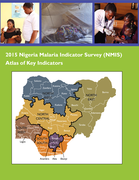
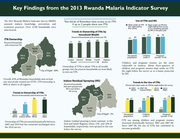
Key Findings (in booklet form) from the 2013 Rwanda Malaria Indicator Survey. The 2013 Rwanda Malaria Indicator Survey (RMIS) assessed malaria knowledge, prevention, and treatment practices. Over 4,700 households were interviewed.