
Filter
461
Text search:
ecology
Featured
36
93
Language
Document type
176
161
43
32
17
12
12
3
1
1
1
Countries
36
10
9
9
9
8
7
6
5
5
5
5
5
4
4
4
3
3
3
3
2
2
2
2
2
2
2
2
2
1
1
1
1
1
1
1
1
1
1
1
1
1
1
1
1
1
1
1
1
1
1
1
1
1
1
1
1
1
1
1
1
1
1
1
1
1
1
Authors & Publishers
Publication Years
Category
78
39
39
8
7
4
3
Toolboxes
136
49
34
32
22
17
17
14
14
11
9
7
7
6
5
5
4
3
3
2
1
1
Human activities are driving fundamental changes to the biosphere and disrupting many of our planet’s natural systems. There is increasing scientific evidence that the unfolding climate crisis, global pollution, unprecedented levels of biodiversity loss, and pervasive changes in land use and cover
...

The leishmaniases are a group of diseases caused by Leishmania spp., which occur in cutaneous, mucocutaneous and visceral forms. They are neglected tropical diseases (NTDs), which disproportionately affect marginalized populations who have limited access to health care. HIV co-infected patients with
...
In Westafrika wird die Bevölkerung in den nächsten Jahrzehnten noch stark
wachsen. Bis 2050 dürfte sich die Einwohnerzahl der 16 Staaten von heute 402 auf
rund 797 Millionen Menschen nahezu verdoppeln. Der Grund dafür sind vor allem
hohe Geburtenraten: Frauen bekommen zwischen Mauretanien und
...
This profile is part of a series of Climate Risk Country Profiles developed by the World Bank Group (WBG). The country profile
synthesizes most relevant data and information on climate change, disaster risk reduction, and adaptation actions and policies
at the country level. The country profile se
...
Lancet Planet Health 2022;6: e760–68
The emergence of COVID-19 has drawn the attention of health researchers sharply back to the role that food systems can play in generating human disease burden. But emerging pandemic threats are just one dimension of the complex relationship between agriculture
...
Current Tropical Medicine Reports (2018) 5:247–256 https://doi.org/10.1007/s40475-018-0166-2 .Purpose of the Review Buruli ulcer (BU) is a necrotizing and disabling cutaneous disease caused by Mycobacterium ulcerans, one of the skin-related neglected tropical diseases (skin NTDs). This article aim
...

The document explains why vector control is important in national programmes and describes the preparation of a tailor-made vector control plan for national programmes. It outlines entomological procedures for regular and specific vector control and how data should be analysed for better overall und
...
Buruli ulcer caused by Mycobacterium ulcerans is a neglected tropical disease characterized by extensive ulceration involving predominantly the upper and lower limbs of patients. The disease is common in rural tropical communities in West and Central Africa, where access to proper health care is lim
...
Many countries have made significant progress in the implementation of World Health Organization recommended preventive chemotherapy strategy, to eliminate lymphatic filariasis (LF). However, pertinent challenges such as the existence of areas of residual infections in disease endemic districts pose
...
The Strategy to respond to antimalarial drug resistance in Africa is a technical and advocacy document, grounded in the best available evidence to date and aimed at minimizing the threat and impact of antimalarial drug resistance of Plasmodium falciparum parasites in Africa. Its objectives are to: i
...
Canadian Journal of Microbiology 25 June 2021 https://doi.org/10.1139/cjm-2020-0572
Although Shiga toxin-producing Escherichia coli (STEC) have been isolated from a variety of food production animals, they are most commonly associated with ruminants from which we derive meat and milk. Because of the widespread and diverse nature of ruminant-derived food production, coupled with the
...
The Arab region in the Middle East and North Africa (MENA) represents a substantial area of the terrestrial landmass encompassing several countries and ecosystems. This area is generally drier and warmer compared to the rest of the world and has extreme resource limitations that are highly vulnerabl
...
Travailler avec les dirigeants communautaires pour lutter contre la VBG est une très bonne et prometteuse approche, car les dirigeants communautaires sont les gardiens de toutes nos croyances et coutumes. Étant donné que la VBG est enracinée dans les croyances et les coutumes, essayer de sâ€
...

Despite the significant role of vector control in national leishmaniasis control programmes, the programmatic community perceives vector control as the weakest component of leishmaniasis control strategies in terms of resources, scientific evidence of the usefulness of interventions and capacity for
...

Trypanosoma cruzi is the etiological agent of Chagas disease (CD), considered one of the most important parasitic infections in Latin America. Between 25 and 90 million humans are at infection risk via at least one of multiple infection mechanisms. Under natural conditions, the principal transmissio
...
This document compiles the recommendations made by the World Health Organization (WHO) and the Pan American Health Organization (PAHO) to help professionals in charge of vector control programs in Latin America and the Caribbean at the national, subnational, and local level update their knowledge in
...
El presente documento reúne un conjunto de recomendaciones formuladas por la Organización Mundial de la Salud (OMS) y la Organización Panamericana de la Salud (OPS) para ayudar, a los profesionales encargados de los programas de control de vectores de Latinoamérica y el Caribe a nivel nacional,
...
This guideline for the prevention and control of chikungunya fever
(CF) is intended for use by all peripheral health workers in the Region and
is based on the strategy outlined above. This document will focus mainly
on preventing, predicting and detecting outbreaks, and after detection,
investig
...

Schistosomiasis is widely recognized as a disease that is socially determined. An understanding of the social and behavioural factors linked to disease transmission and control should play a vital role in designing policies and strategies for schistosomiasis prevention and control. To this must be a
...
The sub-Saharan African region, carries 90% of the over 250 million cases of schistosomiasis occurring worldwide. In this region, after Nigeria, Tanzania is second country having the highest cases of schistosomiasis and approximately 51.5%0 of the Tanzanian population is either exposed or live in ar
...
Schistosomiasis is a neglected tropical disease of global medical and veterinary importance. As efforts to eliminate schistosomiasis as a public health problem and interrupt transmission gather momentum, the potential zoonotic risk posed by livestock Schistosoma species via viable hybridisation in s
...
Human African trypanosomiasis (HAT) has been an alarming global public health issue. The disease affects mainly poor and marginalized people in low-resource settings and is caused by two subspecies of haemoflagellate parasite, Trypanosoma brucei and transmitted by tsetse flies. Progress made in HAT
...

An interregional meeting on leishmaniasis among neighbouring endemic
countries in the Eastern Mediterranean, African and European regions was organized by the World Health Organization (WHO) Regional Office for the Eastern
Mediterranean in Amman, Jordan, from 23 to 25 September 2018. The meeting w
...
Chromoblastomycosis (CBM), represents one of the primary implantation mycoses caused by melanized fungi widely found in nature. It is characterized as a Neglected Tropical Disease (NTD) and mainly affects populations living in poverty with significant morbidity, including stigma and discrimination.
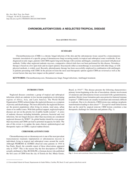
Chromoblastomycosis (CMB) is a chronic fungal infection of the skin and the subcutaneous tissue caused by a transcutaneous traumatic inoculation of a specific group of dematiaceous fungi occurring mainly in tropical and subtropical zones worldwide. If not diagnosed at early stages, patients with CBM
...
Scabies is a skin infection that is a result of direct skin to skin contact and is primarily mediated by close and extended contact with scabies infested person. Scabies occurs worldwide among people of all ages, races, genders and social classes and has been identified as a neglected tropical infec
...
The objectives of the meeting were:
1. To step up the commitment of national authorities and technical and financial partners toWHO’s elimination objective for g-HAT.
2. To share achievements, challenges and views on the elimination goal among countries and implementing partners.
3. To assess t
...
Snakebite envenoming is a potentially life-threatening disease that typically results from the injection of a mixture of different toxins (“venom”) following the bite of a venomous snake. Envenoming can also be caused by venom being sprayed into a person’s eyes by certain species of snakes tha
...
Burden of T. solium: Neurocysticercosis is a disease induced by T. solium larvae penetrating human tissues, especially the nervous system. Neurocysticercosis burdens economies, societies and individuals because of the impact of epilepsy on wages, health costs and social stigmatization of sufferers.
...
Schistosomiasis is widely recognized as a disease that is socially determined. An
understanding of the social and behavioural factors linked to disease transmission and
control should play a vital role in designing policies and strategies for schistosomiasis
prevention and control. To this must b
...
Accessed on 07.03.2023
A – Z of Rabies – A guide to the world´s deadliest disease
Mission Rabies
The epidemiology of the disease is mediated by the interaction of the parasite (trypanosome) with the vectors (tsetse flies), as well as with the human and animal hosts within a particular environment. Related to these interactions, the disease is confined in spatially limited areas called “fociâ€
...

Rabies is a fatal viral zoonosis and serious public health problem.1 All mammals are believed to be susceptible to the disease, and for the purposes of this document, use of the term animal refers to mammals. The disease is an acute, progressive encephalitis caused by viruses in the genus Lyssavirus
...
Rabies is a disease of animals but too often the outcome is gauged in terms of human suffering and
death. Despite this, in areas of the world where rabies is endemic there is often a lack of communication between veterinary and medical professionals, to the extent that the disease continues to thri
...
Rabies has an enormous impact on both agriculture and conservation biology, but its greatest burden is undeniably on public health. As such, routine methods for rapid risk assessment after human exposures to rabies as well as applications for laboratory-based surveillance, production of biologicals
...
PLoS Negl Trop Dis 16(10): e0009774. Although the practice of communication is often called upon when intervening asn involgvingcommunties affected by NTD's, the disciplinary framewokr of healt communication research has been largely absent from NTD strategies. To illustrate how practices conceptual
...
J Glob Health Sci. 2020 Jun;2(1):e3. A group of enzootic and zoonotic protozoan infections, the leishmaniases constitute among the most severely neglected tropical diseases (NTDs) and are found in all continents except Oceania. Representing the most common infectious diseases, NTDs comprise an open-
...

Violence against women and girls is widespread in the Region of the Americas, resulting in enormous consequences for the health and wellbeing of women and girls, their families and communities. These costs are unacceptable and they can be prevented through evidence-based action, including the health
...
The longlist of knowledge gaps is based on existing research agendas published in 2015 or later and expert input from reviewers of the first draft of the longlist. It only includes knowledge gaps focussing on a better
understanding of the relationship between global environmental change and human h
...

Forests, trees and green spaces, hereinafter ‘forests and trees’ for short, provide multiple goods and services that contribute to human health. These include medicines, nutritious foods and other non-wood forest products (NWFPs). Globally, at least 3.5 billion people use NWFPs, including medici
...
Rabies remains an under-reported neglected zoonosis with a case-fatality rate of almost 100% in humans and animals. Dog-mediated human rabies causes tens of thousands of human deaths annually despite being 100% preventable. More than 95% of human cases are caused by the bite of a rabies-infected dog
...
В дорожной карте по борьбе с забытыми тропическими болезнями на 2021–2030 гг. («дорожная карта») определены глобальные цели и основные этапы в отношении борьбы с 20 болÐ
...
Vector-borne diseases are responsible for 17% of the global burden of communicable diseases and more than 500 000 deaths annually. The ambitious global targets for the control of vector-borne diseases come in the context of the (re-)emergence of diseases, increasing resistances to insecticides and u
...
The Advancing Climate-Resilient Education Technical Guidance builds on the USAID 2022–2030 Climate Strategy and the 2018 USAID Education Policy to support USAID Missions and partners who seek to integrate climate action and awareness into education programs and are committed to achieving climate-r
...
MOBILISIERUNG INLÄNDISCHER ÖFFENTLICHER RESSOURCEN FÜR GESUNDHEIT
This guide presents a basis for understanding how diarrhoeal diseases are currently influenced by climate and weather, and may be further exacerbated by climate change. It is a technical guide on how to conduct a Vulnerability & Adaptation assessment for diarrhoeal diseases and climate change, and p
...
This document presents the World Health Organization Operational framework for building climate resilient and low carbon health systems*. ***The framework's goal is to increase the climate resilience of health systems to protect and improve the health of communities in an unstable and changing clima
...
Many features of the environment have been found to exert an important influence on cardiovascular disease (CVD) risk, progression, and severity. Changes in the environment due to migration to different geographic locations, modifications in lifestyle choices, and shifts in social policies and cultu
...
In 2014, the World Heart Federation (WHF) launched
an initiative to develop a series of Roadmaps [1e6]. Their
aim is to identify potential roadblocks on the pathway to
effective prevention, detection, and management of cardiovascular disease (CVD), along with evidence-based
solutions to overcome
...
Buruli ulcer (BU) is a bacterial skin infection that is caused by Mycobacterium ulcerans and mainly affects people who reside in the rural areas of Africa and in suburban and beach resort communities in Australia.
This document contains guidance for strengthening the disability inclusiveness of MHPSS responses and programmes in emergency settings. It is intended to supplement the IASC Guidelines on Mental Health and Psychosocial Support in Emergency Settings (2007).
Overall Objective
To consider and add
...

A sanitary inspection is a simple, on-site evaluation (traditionally using a checklist) to help identify and support the management of priority risk factors that may lead to contamination of a drinking-water supply. Sanitary inspections are a well-established and widely-applied practice. They can su
...
The article explores the underlying factors influencing unhealthy diets and sedentary lifestyles among adolescents in Kilifi County, Kenya. Using a qualitative approach, the study involved interviews and focus group discussions with adolescents, stakeholders, and young adults. Key findings include a
...
Mpox continues to affect people around the world. A new framework released today by WHO will guide health authorities, communities and other stakeholders in preventing and controlling mpox outbreaks, eliminating human-to-human transmission of the disease, and reducing spillover of the virus from ani
...
For thousands of years, humans have been using wildlife for commercial and subsistence purposes. Wildlife trade takes place at local, national and international levels, with different forms of wildlife, such as live animals, partly processed products and finished products. Wildlife is a vital source
...
The target audience of this document (and the associated online companion tool) includes WHO country offices
in Member States of the African Region; Member States’ ministries of health and their public health emergency
operation centres; relevant external assessment teams; and partners looking
...
Every day, schools engage in numerous activities that help promote the health and well-being of students, families, and communities. There is clear evidence of the benefits of the health-promoting schools (HPS) approach, not only for improving overall health outcomes (physical, mental, and social) i
...
testestestestse
This Study presents the key results of a research that analyses the implications of an ambitious agroecological transition across Europe, following the TYFA scenario. Published in 2018, what it proposes by 2050 is fully aligned with the objectives that the European Farm to Fork and Biodiversity stra
...
The Lancet Planetary Health 2022: 6:e371-379
