
Filter
1997
Text search:
donor
funding
Featured
130
674
Language
Document type
1323
354
102
95
68
18
15
10
5
4
1
1
Countries
116
65
60
59
58
57
57
54
51
48
45
44
42
31
28
28
28
28
27
27
26
26
26
22
20
19
19
18
18
17
17
16
15
13
13
12
11
11
11
9
9
9
9
9
7
7
7
7
6
6
6
6
5
5
5
5
4
4
4
4
4
4
4
3
3
3
3
2
2
2
2
2
2
2
2
2
2
2
2
2
2
1
1
1
1
1
1
1
1
1
1
1
1
1
1
1
1
1
1
1
1
1
1
1
Authors & Publishers
Publication Years
Category
852
99
87
86
55
20
10
7
Toolboxes
190
125
96
89
85
75
61
60
51
45
42
37
32
31
29
24
19
18
16
6
4
3
3
2
2
The Leonard Cheshire Disability and Inclusive Development Centre | University College London | 4 Taviton Street | London WC1H OBT | United Kingdom| Principal Investigator: Dr Raymond Lang | Email: r.lang@ucl.ac.uk | Tel: +44 (0)207 679 1519 | Research Commissioned by the Southern African Federation
...

“towards quality health and social welfare services”
Overcoming Barriers to TB Control
Training Curriculum
August 2011


Project Paper to provide an additional grant for: Human Development Systems Strengthening Project (HDSSP)(P145965, H9360)
LESOTHO COPDAM BASELINE STUDY 2013
Further Analysis of the 2000, 2005, and 2011 Demographic and Health Surveys. DHS Further Analysis Reports No. 83
Further analysis of the Nepal Demographic and Health Surveys, 2001-2011

DHS Working Papers No. 120
A systematic literature review of education systems in low-and middle income countries commissioned by CBM


IN THE AMOUNT OF SDR 21.8 MILLION (US$30 MILLION EQUIVALENT) WITH AN ADDITIONAL GRANT FROM THE GLOBAL FINANCING FACILITY (GFF) IN THE AMOUNT OF US$ 10 MILLION TO THE DEMOCRATIC REPUBLIC OF CONGO FOR A HUMAN DEVELOPMENT SYSTEMS STRENGTHENING PROJECT
Knowledge based upon a descriptive literature review of applied research
First Edition~ This self advocacy toolkit for persons with mental, neurological and substance abuse disorders, developed by Basic Needs and CBM, is the end product of an action research intervention that tracked and documented processes for Self Advocacy in low resourced communities of Uganda. Th
...
This revision covers the main non-communicable diseases in Mozambique as well as the National Strategic Plan's aim to create a positive environment to minimize or eliminate the exposure to risk factors and guarantee access to care.
This report presents the findings of the Estimating the Size of Populations through a Household Survey (ESPHS) study that took place in 2011. The study utilized a single household survey to estimate the size of several key populations, including sex workers, men who have sex with men (MSM), injectin
...
An historic opportunity to end AIDS as a public health threat by 2030 and launch a new era of sustainability
A decade of progress has inspired the once unthinkable—that the AIDS epidemic can be ended as a public health threat. The global community has embraced the bold idea to end the AIDS ep ...
A decade of progress has inspired the once unthinkable—that the AIDS epidemic can be ended as a public health threat. The global community has embraced the bold idea to end the AIDS ep ...
The Monitoring Report, which covers the first two months of the response from 25 August to 31 October, highlights the work of the Government of Bangladesh, in cooperation with humanitarian partners who are working to provide relief services for the refugee population and Bangladeshi host communities
...

Conducted November 2011 to February 2012: Summary Report
This summary report has five sections. Following the introduction (Section 1), Section 2 sets out summary findings and recommendations of the assessment team. Section 3 describes the context in which artemisinin resistance is being tackle ...
This summary report has five sections. Following the introduction (Section 1), Section 2 sets out summary findings and recommendations of the assessment team. Section 3 describes the context in which artemisinin resistance is being tackle ...

The Kabeho Mwana project (2006–2011) supported the Rwanda Ministry of Health (MOH) in scaling up integrated community case management (iCCM) of childhood illness in 6 of Rwanda’s 30 districts. The project trained and equipped community health workers (CHWs) according to national guidelines. In p
...

The toolkit is a collection of assessment tools and checklists that describe the key considerations to be taken into account when transitioning to Option B/B+. The toolkit provides a roadmap to support the planning and implementation of Option B/B+, and to help countries scale up more effective inte
...

In many of Myanmar’s contested regions, healthcare services are provided through two parallel governance systems – by the government’s Ministry of Health, and by providers linked to ethnic armed organizations. Building upon efforts to build trust between these two actors following ceasefires s
...
The Pocket Guide to Managing Contraceptive Supplies addresses one of
the most important components of any program that provides family
planning services—the logistics system that manages the delivery,
quality, and storage of contraceptive supplies. These supplies are
essential; without them, f
...
In July 2016, the government of Myanmar shared the following update on progress toward achieving its Family Planning 2020 commitment during the 2015-2016 time period (commitment included below for reference). The government added new information to this update in April 2017.

The study collected data on the impact of HIV-related diseases on income, revenues, economic dependency, consumption, education, health, food security, stigma, discrimination, quality of life, and migration. The study also assessed people living with chronic diseases in order to compare the impact o
...
EVALUATION OF UNICEF PROGRAMMES TO PROTECT CHILDREN IN EMERGENCIES: Synthesis Report
The recruitment and use of children violates their rights and causes them physical, developmental, emotional, mental, and spiritual harm. The impact on their mental and physical well-being breaches the most fundamental human rights and represents a grave threat to durable peace and sustainable deve
...
Department of Behavioural Medicine, Lagos State University College of Medicine Ikeja, Lagos Nigeria
Global Mental Health (2015), 2, e5, page 1 of 12. doi:10.1017/gmh.2015.8;
Received 29 January 2015; Revised 8 April 2015; Accepted 15 April 2015
The Joint Response Plan sets out a comprehensive programme shaped around three strategic objectives – deliver protection, provide life-saving assistance and foster social cohesion. The Plan covers all humanitarian sectors and addresses key cross-cutting issues, including protection and gender main
...
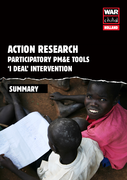
This case description elaborates on the pilot implementation of the innovative, participatory PM&E tools of War Child Holland’s psychosocial life skills intervention ‘ I DEAL’. The action research aimed to identify ways that work best for I DEAL facilitators to learn and act on basis of their
...
Guiding framework for development cooperation, Working paper 2017.
This document was drawn up on the basis of expert publications and inputs from partners in the
GIZ regional programme Psychosocial Support for Syrian and Iraqi Refugees and Internally
Displaced People1 in order to serve as guidanc
...
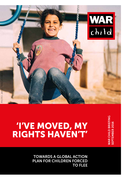
War child: "I´ve moved, my rights haven't" (Towards a global action plan for children forced to flee)
recommended
We live in a world in which 28 million children have been driven from their
homes as a result of conflict, persecution and insecurity¹. If current trends
continue, more than 63 million children could be forced to flee by 2025², of
which over 25 million will cross borders and become refugees. At
...
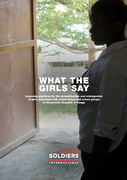
This report presents the findings of research conducted by Child Soldiers International to assess the effectiveness of release, psychosocial recovery and reintegration interventions (commonly referred to as ‘DDR’) for girls associated with armed groups in eastern Democratic Republic of Congo (DR
...
You can also register into a free online course
https://www.open.edu/openlearncreate/course/view.php?id=13
After almost eight bloody years, the war in Syria finally appears to be reaching the endgame. The Assad regime controls some two-thirds of the country. In the northwest, the regime of Syrian President Bashar al-Assad has launched an offensive against opposition-controlled Idlib governorate under the
...
This working paper aims to provide a rough over-view of existing rules and guidelines on the coopera-tion between the UN and the private sector – at least as they are publicly available. It will describe com-mon features and discuss advances and shortcomings of the most prominent a
...
10 years after the UN general assembly special session on drugs
Single TB and HIV Concept Note Albania 2016-2018 27 April 2015
PLOS ONE | https://doi.org/10.1371/journal.pone.0203986 October 3, 2018
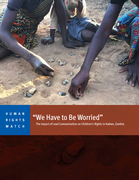
Children in Kabwe are especially at risk because they are more likely to ingest lead dust when playing in the soil, their brains and bodies are still developing, and they absorb four to five times as much lead as adults. The consequences for children who are exposed to high levels of lead and are no
...
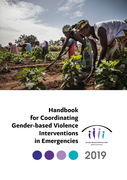
This handbook is a quick-reference tool that provides practical, field-level guidance to establish and maintain a GBV sub-cluster in a humanitarian emergency. It provides the foundations for coordination. More in-depth information can be pursued through resources referenced in this handbook. The GBV
...
16 January 2008
Global Health Advocacy and Activism Department of Global Health, George Washington University
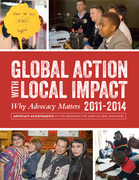
Advocacy achievements of the bridging the gaps global partners
Accessed: 17.11.2019
A practical toolkit for young people who are passionate about advancing HIV and sexual and reproductive health and rights through national advocacy in the post-2015 agenda.
PLOS Medicine | DOI:10.1371/journal.pmed.1002088 August 23, 2016

African Evaluation Journal
ISSN: (Online) 2306-5133, (Print) 2310-4988
Background: For some years, non-governmental organisations (NGOs) and civil society have
become increasingly involved in the fight against the HIV/AIDS pandemic in Africa. But even
though their role is well appreciated, the
...
Senegal’s substantial and sustained progress against malaria is an inspiring public health success story, and a source of potential lessons for other countries on the path to elimination. This case study describes three major success factors—(1) outstanding leadership and partner engagement, (2)
...
This note provides a few ideas to a challenging problem of reaching survivors who cannot easily access phone-based GBV support. It is very much a living document given the evolving nature of the pandemic and may be adapted as more evidence, insights and lessons become available. It is intended to sp
...
As a result of Russia’s invasion of Ukraine, the people of Ukraine, especially the most vulnerable, are paying an enormous price. Lives and livelihoods are being lost, with more than ten million people forced from their homes— and their country—in search of safety. The war has unleashed catast
...
This document summarizes preparedness and response activities to address the coronavirus disease (COVID-19) outbreak in South Sudan through the end of 2020. The addendum includes the activities and financial requirements of the updated National COVID-19 Response Plan. Originally issued in March prio
...
Part 2: Part 2 Beyond the evidence: Implications for innovation and practice
Part 2 of the Gap Analysis presents the insights from individuals working in humanitarian response, disability inclusion and older age inclusion. This report begins by looking at how an agenda for the inclusion of people
...
In 2016, the risk of premature mortality1 from noncommunicable diseases (NCDs) in Ethiopia was 18.3%. The economic costs of NCDs are significant and are due principally to their impact on the non-health sector (reduced workforce and productivity). In this study, it is estimated that NCDs cost Ethiop
...
The well-being of children in sub-Saharan Africa is under siege from all directions since the advent of the COVID-19 pandemic. The region is now suffering its first-ever economic recession, pushing about 50 million people into extreme poverty, a majority of whom are children.
More than 8 million children have access to distance learning thanks to partnerships with 322 radio stations and 23 TV channels
1.2 million community masks distributed
25 million people reached with key messages on how to prevent COVID-19 through mass media channels (300 radio stations and
...
These Blended Learning Modules cover the full range of health promotion, disease prevention, basic management and essential treatment protocols to improve and protect the health of rural communities in Ethiopia. A strong focus is on enabling Ethiopia to meet the Millennium Development Goals to reduc
...
J of Pharm Policy and Pract 14, 27 (2021). https://doi.org/10.1186/s40545-021-00309-8
A wide range of potential enablers and barriers were identified for influencing progress for the scale-up of severe wasting services within national health systems. Findings were categorised according to the six pillars of WHO’s health system strengthening framework.
Recommendations and Summary
This report explores the impact of COVID-19 on humanitarian access in the initial months of the crisis, including both the delivery of assistance and performance of protection activities. It examines the varying crisis responses, including the shift to a more localized a
...
Internal displacement at all-time high after unprecedented year of crises
The total number of people living in internal displacement reached a record 55 million by the end of 2020. During a year marked by intense storms and persistent conflict, 40.5 million new displacements were triggered across
...
Handbook of Hospital Care for Newborn Infants
recommended
Updated June 2021
Nature | Vol 600 | 2 December 2021 |
Information for policy-makers and planners on conducting deworming as part of an integrated
school health program
New displacements by conflict and disasters in 2020
27 April 2022 Chronic land degradation: UN offers stark warnings and practical remedies in Global Land Outlook 2. GLO2 offers hundreds of examples from around the world that demonstrate the potential of land restoration.
The way land resources – soil, water and biodiversity – are currently mi
...
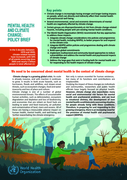
We need to be concerned about mental health in the context of climate change
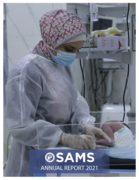
SAMS team rose to meet these challenges, delivering world class COVID treatment with four newly established COVID hospitals complete with 100 ICU beds and state of the art equipment like ventilators, monitors, and oxygen generators. By using innovative technologies, SAMS’ physicians were able to s
...
The recommendations in this guideline are intended to inform development of national and subnational health policies, clinical protocols and programmatic guides. The target audience includes national and subnational public health policy-makers, implementers and managers of maternal, newborn and chil
...
First and foremost, Ukraine’s priority is winning the war and ensuring the safety and security of its people. Ukraine is facing a harsh winter and needs urgent aid and solutions including power generators, heating, and temporary housing to withstand freezing temperatures, ice, and snow. In additio
...

This new guidance aims to support programme implementers, coordinators and others in humanitarian settings in their actions to counter suicide and self-harm in humanitarian contexts and to save lives.

This document provides an overview of strategic purchasing of nutrition services within primary health care. It introduces key terms and payment methods for countries to use in preparing to transform their health financial systems to scale up nutrition services. It does so by introducing nutritional
...
The Global Action Plan for Healthy Lives and Well-being for All (SDG3 GAP) is a set of commitments by 13 multilateral agencies to strengthen their collaboration. For this purpose several accelerators were created and an invitation for public comment was started. This document focuses on Accelerator
...
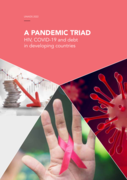
This report analyses the intersection of HIV, COVID-19 and public debt in developing countries. The collision between COVID-19 and a crippling debt crisis have reversed decades of progress - putting present and future investments in health and HIV at risk. Pragmatic options to address the pandemic t
...
The present information document supplements the WHO audited financial statements for 2018. It contains information on WHO's voluntary contributions by fund and by contributor in the year 2018.
This paper introduces a new dataset of official financing—including foreign aid and other forms of concessional and non-concessional state financing—from China to 138 countries between 2000 and 2014. We use these data to investigate whether and to what extent Chinese aid affects economic growth
...
