Filter
485
Text search:
World
Health
Organization,
IASC
Featured
108
100
Language
Document type
250
74
45
44
25
22
9
8
5
1
1
1
Countries
27
20
20
16
14
13
13
10
9
9
9
8
7
7
6
5
5
5
5
5
5
4
4
4
4
4
4
4
4
3
3
3
3
3
3
3
3
2
2
2
2
2
2
2
2
2
2
2
2
2
2
2
2
2
2
1
1
1
1
1
1
1
1
1
1
1
1
1
1
1
1
1
1
1
1
1
1
1
1
1
1
1
1
1
1
1
1
1
1
1
1
1
1
1
Authors & Publishers
Publication Years
Category
119
48
37
19
14
12
3
1
Toolboxes
98
88
62
27
23
22
16
12
8
7
7
4
2
2
2
2
1
1
1
UNFPA launches Journalist’s Handbook: Reporting on Gender-Based Violence in Syria Crisis
Amman, 9 March 2015 – Under the patronage of Her Royal Highness Princess Rym Ali, UNFPA launched a handbook on Reporting on Gender-Based Violence in the Syria Crisis to help journalists better understand
...
ПРактИЧеское РукоВодстВо для соВместных меРоПРИятИй.
Many countries are taking strict measures to prevent the spread of COVID-19 with lockdowns, curfews, and closure of public spaces and services. As a result of stress and uncertainty caused by these strict measures, women and girls are at even greater risk of violence at a time when their access to s
...
MEDBOX Issue Brief No. 4
The primary audience of this report with the compendium of resources are youth engagement practitioners in the Red Cross Red Crescent National Societies as well as technical experts and policy makers across the humanitarian landscape that thrive for meaningful interventions with and for children, ad
...
National guidelines for the provision of psychosocial support for gender based violence victims survivors
recommended
Psychosocial support is a very important component in Gender Based Violence response that provide appropriate care, protection and social integration. Psychological aspects affect thoughts, emotions, behavior, memory, learning ability, perceptions and understanding. While the social aspects have ef
...
New funding requirements: CHF 2.8 billion IFRC-wide of which CHF 670 million is channelled through the IFRC Emergency Appeal in support of National Societies
Summary of key informant interviews with representatives of organizations providing, funding, or supporting WASH services to refugee populations
This study aims to analyze national and international stakeholders and their initiatives in Early Warning Systems in Myanmar, to identify priority gaps that need to be addressed by all stakeholders. It is presented as a first step towards supporting GoUM in information-gathering under the Myanmar Ac
...
This paper has been commissioned by RedR to identify gaps in skills, technology, and knowledge in urban humanitarian response in order to inform RedR’s project Ready to Respond which is looking to address these gaps in two specific areas:
Water supply, sanitation, and hygiene; Shelter res
...

The report provides an overview of the disaster risk reduction and management in Nepal, a country under threat of multiple natural hazards: earthquakes, floods, landslides, fires, storms, the epidemics, and others. It presents background information on the country, its disaster profile, its legal an
...


This guidance aims to assist leaders in the development or revision of humanitarian-sector contributions to district-level pandemic preparedness and response planning. It is directly linked to H2P guidance for national-level planning.
Ce document a été élaboré par Peter Ventevogel, consultant, sous la supervision de Marian Schilperoord. Les versions préliminaires de cette publication ont grandement bénéficié de la contribution de plusieurs personnes au sein de l’UNHCR et d’organisations partenaires. Nous voudrions tou
...
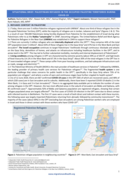
As of 12June 2020, there are 667confirmed COVID-19 casesin the OPT (565 of which are recovered cases), and 48% of which (320 cases) are in East Jerusalem and its suburbs. Additionally, there have been 5 reported COVID-19 deaths (1 in the West Bank, 1 in Gaza and 3 in East Jerusalem)
Indonesia, Malaysia, Myanmar, and Pakistan
Spetember 2020
This document is the third iteration of the Flash Appeal for Ukraine, which was originally published on 1 March 2022 and revised once in mid-April. This updated Flash Appeal covers the period of 10 months following the onset of the war in Ukraine that started on 24 February 2022 (i.e., from March to
...
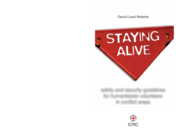
With its expert practical advice on security in situations of armed conflict, this updated set of guidelines will prove invaluable to humanitarian personnel working at the operational level. Following on from the success of the first edition, published in 1999, it addresses new and developing threat
...
In an effort to improve the capabilities and accountability of humanitarian and economic practitioners, the SEEP (Small Enterprise Education and Promotion) Network's Minimum Economic Recovery Standards focus on minimum industry standards for facilitating economic recovery in crisis situations.
Th
...
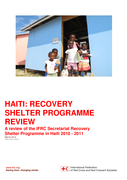
A Review of the IFRC (International Federation of Red Cross and Red Cresent Societies) Secretariat Recovery Shelter Programme in Haiti 2010-2011
Needs assessment is essential for programme planning, monitoring and evaluation, and accountability, however needs assessment is still a critical weakness of humanitarian response. Organisations need to improve how they do assessments. The Assessment Capacities Project (ACAPS) and the Emergency Capa
...
Disaster Recovery Toolkit
Disaster Recovery Toolkit
Disaster Recovery Toolkit
Disaster Recovery Toolkit
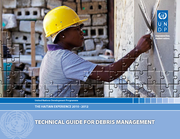
The building damage assessment, conducted between March 2010 and February 2011 by the Government of Haiti and the United Nations system, showed that more than 400,000 buildings were damaged or destroyed, of which approximately 218,000 could be occupied without repairs (green category), 105,000 were
...
Sphere unpacked

National strategy on the management of disaster and climate induced internal displacement (NSMDCIID)
This strategy has been developed with a view to managing climate-induced internal displacement (CIID) in a comprehensive and rights-based manner. It is part of the action plan for the Government of Bangladesh (GoB) to implement the Sendai Framework.
The strategy focuses solely on internal disp ...
The strategy focuses solely on internal disp ...
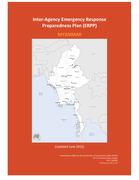
Myanmar is prone to various natural hazards that include earthquakes, floods, cyclones, droughts, fires, tsunamis, some of whichhave the potential to impact large numbers of people. In the event that large numbers of people are affected(such as was the case in 2008 following cyclone Nargis), the gov
...
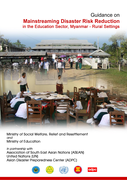
The scope of the Guidance is primarily the education in rural settings in Myanmar, but it covers some of the issues which have pan Myanmar implication and relevance. Considering the importance, complexity and vastness of the subject, similar type of initiatives on urban school and education system a
...
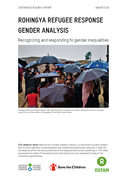
This gender analysis was conducted to understand the different risks and vulnerabilities but also opportunities and skills for Rohingya and host community women, men, boys and girls. Data collection was conducted over three weeks from 8 April to 29 April 2018. The work aimed to identify the differen
...
The steps reassert the sequence of the HPC, with needs analysis directly informing decisions about the response and monitoring, whether for the preparation of new plans or adjustments to existing ones. The steps of the HPC have a rationale and cannot be skipped. However, the depth of work under each
...
Operation update 01/04/2022
Esta guía trata de la primera ayuda psicológica, un modo práctico y humano para ayudar y apoyar a nuestros semejantes en graves situaciones de crisis. Se ha pensado para personas que se tienen la posibilidad de ayudar a
otras que han experimentado un hecho extremadamente angustiante. Proporciona
...
This companion to the ALNAP EHA Guide offers protection-specific insights for evaluators and evaluation commissioners across the humanitarian sector. It covers the planning, data management and analysis phases of evaluation and addresses a range of challenges that – whilst not all unique to protec
...
Looking forward, the 2019-2020 Regional Refugee Response Plan (RRRP) for the DRC situation aims at addressing the needs of new arrivals of Congolese refugees in the region, and those in protracted situations. By supporting livelihoods opportunities and through a resilience-based approach, refugees w
...
La Convención de los Derechos del Niño (Convención) de las Naciones
Unidas (ONU) y documentos relacionados tienen el potencial de mejorar
enormemente varias dimensiones de la vida de los niños (definidos como
desde el nacimiento hasta la los 18 años, dependiendo de la cultura), ofreciendo
p
...
Produced by UNICEF and IRC, with the support of the German Corporation for International Cooperation GmbH (GIZ) and the generous funding from the German Federal Ministry of Economic Cooperation and Development (BMZ), the Caring for Child Survivors of Sexual Abuse (CCS) Resource Package (Second Editi
...
The report offers an analysis of the broader challenges to securing humanitarian action and recommends areas for improvement. This study will contribute to improving the way humanitarians ‘do business’ in complex
security environments. Document also available in French, Arabic and Spanish.
Supplement October 2010
HIV/AIDS, security and conflict: making the connections
Global Report on Food Crises 2023
recommended
The Global Report on Food Crises (GRFC) 2023 highlights that the number of people experiencing high levels of acute food insecurity and requiring urgent food and livelihood assistance increased for the fourth consecutive year in 2022. Over a quarter of a billion people were estimated to face acute h
...
The Camp Managment Toolkit
recommended
Applicable to both IDP and refugee scenarios, the Toolkit incorporates a wide range of relevant information on managing displaced populations living in communal settings (collective centres, spontaneous sites, established camps, etc.). Large scale displacements caused by recent conflict and natural
...
Links to the Humanitarian Charter and international law
Version 2 (unedited). The Basic Needs Analysis (BNA) is a multi-sector needs analysis approach that can be applied in both sudden onset and protracted emergencies. The methodology comprises the Guidance (this document) presenting the conceptual BNA framework and related processes, and a Toolbox, whi
...
The CBDRR Manual is a practical ‘how-to’ guide on community-based disaster risk reduction for government and non-government agencies in Lao PDR. It is a commonly agreed document to be referred to by agencies working on CBDRR in Lao PDR. It provides guidance and support for systematic implementat
...
The devastating impacts of the 2015–16 El Niño will be felt well into 2017. This crisis was predicted, yet overall, the response has been too little too late. The looming La Niña event may further hit communities that are already deeply vulnerable. To end this cycle of failure, there is an urgen
...
Updated on 6 APRIL 2020
There are serious concerns that the situation might escalate in the next weeks modelling the epi curve of other regions. The interlinkages between human mobility and the current pandemic of COVID-19 are well established, and while international flights have been suspended i
...
Sudan has a long history of hosting refugees and asylum seekers with 991,787 individuals, 51 per cent female and 53 per cent children, expected to live in Sudan by the end of 2020.
The PS Centre has released three publications addressing the need for MHPSS tools and guidance in Ukraine and surrounding countries.
The Introduction to Psychological First Aid, presents a training module on basic psychological first aid skills for people affected by the international armed confl
...
Findings from this report reveal that, rates of early marriage are high, a significant percentage of children contribute to the household’s income or are its main source of income, and restrictions on the mobility of women and girls constrain their participation in social and economic activities a
...
The Minimum Standards for Age and Disability Inclusion in Humanitarian Action inform the design, implementation, monitoring and evaluation of humanitarian programmes across all sectors and phases of response, and in all emergency contexts, ensuring older people and people with disabilities are not e
...
Professional Standards for Protection Work
recommended
Carried out by humanitarian and human rights actors in armed conflict and other situations of violence
This guideline (third edition) constitutes a set of minimum but essential standards aimed at ensuring that protection work is safe and effective. The standards reflect shared thinking and common
...
The Call to Action on Protection from GBV in Emergencies, formally launched in 2013 by the United Kingdom and Sweden, aims to fundamentally transform the way GBV is addressed in humanitarian operations via the collective action of numerous partners, each bringing our various strengths and capacities
...
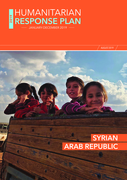
The 2019 Humanitarian Response Plan (HRP) sets out the framework within which the humanitarian community will respond to the large-scale humanitarian and protection needs in Syria throughout 2019, on the basis of the prioritization undertaken across and within sectors. The HRP, based on United Natio
...
Como respuesta al COVID-19 en la región, los ministerios de educación de 23 países y 12 estados independientes de América Latina y el Caribe (ALC) han cerrado las escuelas de forma progresiva a nivel de la educación preescolar, primaria y secundaria desde marzo de 2020. Como resultado, se estim
...
The ‘Toolkit’ is targeted at practitioners responsible for implementing recovery programmes, their objective to provide a ‘how to’ guide on development, implementing and managing complex post-disaster recovery programmes.
Disaster Recovery Toolkit
Disaster Recovery Toolkit

OECD Development Policy Tools
Recognising that donor policies and responses constantly evolve, this guidance recommends that donors operating in situations of forced displacement prioritise three broad areas of work, where they can best contribute to existing capacities at the national, regiona ...
Recognising that donor policies and responses constantly evolve, this guidance recommends that donors operating in situations of forced displacement prioritise three broad areas of work, where they can best contribute to existing capacities at the national, regiona ...
This guidelines is aimed at humanitarian and human rights actors engaged in protection work, and is intended to act as an easy reference to the minimum standards to be met and the recommended guidelines to be followed in such work.
The 45 standards and 15 guidelines are reproduced in full, together
...
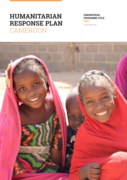
In 2021, the humanitarian community continued to support those in need, placing protection at the centre of its response. Learning from and building on past efforts, humanitarian actors will continue to respond and adapt their response to the various shocks impacting populations in Cameroon, such as
...