Filter
745
Text search:
WHO
Country
Office
for
Nepal
Featured
Recommendations
67
New Publications
242
Language
Document type
No document type
467
Studies & Reports
129
Guidelines
60
Manuals
48
Strategic & Response Plan
15
Training Material
8
Fact sheets
8
Situation Updates
7
Infographics
3
Countries / Regions
Nepal
129
Global
41
South–East Asia Region
36
Asia
28
India
26
Bangladesh
17
Myanmar / Burma
10
Pakistan
7
Indonesia
7
Ethiopia
6
Ghana
6
Uganda
6
Haiti
6
Zambia
6
Liberia
5
Philippines
5
Tanzania
5
Thailand
5
South Africa
5
Vietnam
5
Sierra Leone
4
Afghanistan
4
Lebanon
4
Cambodia
4
Malawi
4
Mozambique
4
Sri Lanka
4
Africa
4
Laos
4
Nigeria
3
Jordan
3
Syria
3
Kenya
3
Brazil
3
North Macedonia
3
Latin America and the Carribbean
3
Western and Central Europe
3
Bhutan
3
Russia
3
Congo, Democratic Republic of
2
Zimbabwe
2
South Sudan
2
Germany
2
Rwanda
2
East and Southern Africa
2
Western Pacific Region
2
Georgia
2
Guinea
1
Senegal
1
Morocco
1
Somalia
1
China
1
Central African Republic
1
Argentina
1
Namibia
1
Peru
1
Serbia
1
Hungary
1
Ukraine
1
Colombia
1
Ecuador
1
Mexico
1
Yemen
1
West and Central Africa
1
Middle East and North Africa
1
Eastern Europe and Central Asia
1
Other region
1
Venezuela
1
Eastern Europe
1
North Korea
1
Armenia
1
Timor Leste/ East Timor
1
Romania
1
Kyrgyzstan
1
Jamaica
1
Belgium
1
Norway
1
Portugal
1
Belarus
1
Authors & Publishers
Publication Years
Category
Countries
218
Key Resources
70
Women & Child Health
59
Clinical Guidelines
57
Public Health
42
Capacity Building
12
Pharmacy & Technologies
3
Toolboxes
HIV
73
Disability
71
Mental Health
50
COVID-19
37
Planetary Health
31
TB
28
Natural Hazards
27
NTDs
23
Global Health Education
22
Conflict
20
AMR
16
Rapid Response
15
Caregiver
13
Refugee
12
NCDs
11
Pharmacy
10
Health Financing Toolbox
6
Specific Hazards
4
Ebola
3
Cholera
3
Polio
3
Typhoon
2
Zika
1
The framework is to be used as a reference guide, applied according to local priorities and needs, and targeted at academic institutions, educators, accreditation bodies, regulatory agencies and other users. The ultimate aim is to ensure that all health workers are equipped with the requisite compet
...
The Assessment package has been developed for countries to evaluate the implementation of the WHO Standards for prosthetics and orthotics. It enabl
...
The results of the report clearly show that in 2020, a year dominated by the emergence of COVID-19 and its associated health and economic crises, governments around the world rose to the challenge. Sharp increases in government spending on health at all co
...

Snakebites are well-known medical emergencies in many parts of the world, especially in rural areas. Agricultural workers and children are the most affected. The incidence of snakebite mortality is particularly high in South-East Asia. Rational use of snake anti-venom can substantially reduce mortal
...
Monitoring is a crucial element in any successful programme. It is important to
know if health care facilities – and ultimately countries – are meeting the agreed
goals and objectives for preventing and managing cardiovascular diseases (CVD).
...
Рекомендации ВОЗ по оказанию дородовой помощи для формирования положительного опыта беременности
Hand hygiene is vital for safe health care delivery, yet practices at the point of care remain suboptimal worldwide. A comprehensive research agenda is therefore necessary to improve our understanding of factors influencing hand hygiene behaviour an
...
An in-depth analysis of the health-seeking behaviour of patients and health system response in seven countries of the Eastern Mediterranean Region

Water, sanitation and hygiene education in schools – WASH in Schools – provides safe drinking water, improves sanitation facilities and promotes lifelong health. WASH in Schools enhances the well-being of children and their families, and paves the way
...


During the first two years of the project (2019–2020), through a ‘One Health’ approach, comprehensive engagement was established with AMR coordinating committees, WHO regional and country offi
...
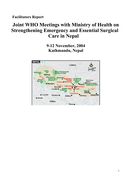
Due to Nepal’s difficult geographic structure, rapid urbanization, varied groundwater level, and increasing population the country is prone to earthquakes, floods, landslides, fires, l
...