Filter
1675
Text search:
Training
curriculum
Featured
89
521
Language
Document type
1148
169
129
93
58
51
13
5
5
1
1
Countries
87
86
56
54
44
42
41
39
36
35
35
35
33
32
32
30
28
25
23
20
19
19
18
15
15
15
14
14
13
10
9
9
9
8
8
8
8
8
7
7
7
7
7
7
6
6
6
5
5
5
5
4
4
4
4
4
3
3
3
3
3
3
3
3
2
2
2
2
1
1
1
1
1
1
1
1
1
1
1
1
1
1
1
1
1
1
1
1
1
1
1
1
1
1
1
1
1
1
1
Authors & Publishers
Publication Years
Category
786
132
119
74
70
44
10
2
1
Toolboxes
161
106
94
81
62
41
40
38
29
29
22
20
20
20
19
15
13
7
6
4
4
3
1
Since independence (1961) the Government through the Department of Social welfare has been providing services to people with disabilities without a comprehensive policy. The adoption of the National Policy on Disability (NPD) is the outcome of many years of consultations among disability stakeholder
...
The Demographic Dividend study on Rwanda assessed the socio-economic and human development potential of our country in the short, medium and long-term period using a comprehensive approach. It generated relevant policy and programme information to guide a well-informed polciy required to propel Rwan
...
Aims of the CNS programme:
- To provide accessibility to quality nursing care and related services including clinical assessment and personalized care for persons enrolled/entitled to CNS services.
- To enhance the independence and health outcomes of entitled persons by avoiding early admi ...
- To provide accessibility to quality nursing care and related services including clinical assessment and personalized care for persons enrolled/entitled to CNS services.
- To enhance the independence and health outcomes of entitled persons by avoiding early admi ...
"Helping Traumatized Children Learn is the result of an extraordinary collaboration among educators, parents, mental health professionals, community groups, and attorneys determined to help children experiencing the traumatic effects of exposure to family violence succeed in school."

Today there are Community-based Rehabilitation (CBR) programmes in a large number of countries. In many countries, the CBR approach is a part of the national rehabilitation services. However, there is a lack of reliable data about persons with disabilities who benefit from CBR and the kind of benefi
...

A Guidebook for Medical and Professional Schools, Second Edition.
This book represents a significant step to engage health professions schools in addressing global health challenges
Our goal at Voices for Georgia’s Children is to help decision-makers craft and implement policies that ensure Georgia’s children grow up to be healthy, educated and productive citizens. To that end, we have developed a comprehensive policy agenda focused on early childhood, child health and disc
...
Communities can play a critical role in suicide prevention. Facilitating community engagement in suicide prevention is an important task. The toolkit is a step-by-step guide for communities to engage in suicide prevention activities and have ownership of the process and keep efforts sustained. It is
...
Survival, Health and Dignity for Refugees
Accessed March 13, 2019
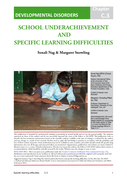
Developmental disorders
Chapter C.3
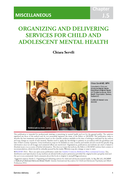
Miscellaneous
Chapter J.5
GMS Journalfor MedicalEducation2018, Vol. 35(3),ISSN 2366-5017

This is the first NAP on the Prevention and Containment of AMR in Kenya. It has been developed based on the National Policy on Prevention and Containment of AMR and the recommendations of the situation analysis on AMR conducted in 2011 and updated in 2016. This strategy provides a regulatory and imp
...
Revised Version 2011
The purpose of this document is to provide interim guidance for setting up of quarantine facilities
Accessed: 16.04.2020
Reusing a legacy interactive audio instruction (IAI) program to provide education in a humanitarian crisis is a quick solution and a smart use of previous investments (“Learning in the Time of Ebola”). This article highlights and advises on the issues that relate to adapting and updating previou
...
Guide de l'Animateur
Community health nurses have the potential to make significant contributions to meet the health care needs of various population groups in a variety of community settings. In order to assess the extent to which CHNs are achieving this potential, WHO conducted a study between 2010 and 2014 that exami
...
This document presents an evidence-informed Checklist for implementing rural pathways to train and support the rural
health workforce in low and middle income countries (LMIC). Rural areas are the most underserviced around the world.
Shortages of healthcare workers is detrimental to the health of communities, especially children. This paper describes the process of capacity building Community Health Volunteers (CHVs) to deliver integrated preventive and curative package of care of services to manage common childhood illness in h
...
A implementation Matrix approved by the Cabinet of the Government of South Africa
Le secteur de la santé a beaucoup évolué au cours des 20 dernières années. Les innovations technologiques ainsi que notre connaissance des maladies ont contribué à allonger l’espérance de vie au 20ème siècle. Cependant, l’un des plus grands défis
aujourd’hui n’est pas de rester a
...

2nd edition
Guidelines for State Health Society and District Health Society

The resources provide both the older as well as the updated Operational Guidelines for antiretroviral therapy centres, including administrative issues, functions and establishment of centres, reporting and recording tools, measures to improve retention in HIV care, supply chain management of drugs a
...

The long-term goal of AIDSFree is to improve the quality and effectiveness of high-impact, evidence-informed HIV and AIDS interventions. This semiannual performance report (SAPR) summarizes AIDSFree's achievements for the period October 1, 2015–March 31, 2016

Making education more inclusive requires schools and education authorities to remove the barriers to education experienced by the most excluded children - often the poorest, children with disabilities, children without family care, girls, or children from minority groups. Also included in the text a
...

The purpose of the situation assessment was to execute a situation analysis for Autism and Neurodevelopment Disorder (NDD) in Bangladesh. The situation assessment covers the following areas: a review of the scale and prevalence of NDD with trends of the disorder in the recent past in Bangladesh (see
...

This document provides a systematic approach in developing a coordinated, standardized, reliable, efficient, cost-effective, and sustainable specimen transport and referral system to support IVHD and VL testing networks. This document provides technical and programmatic recommendations on the approp
...
This report presents the findings from the Community Based Volunteers Skill Audit Survey that was carried out in 11 districts in Zambia as part of the Millennium Development Goal Acceleration Initiative.
Morbidity and Mortality Weekly Report (MMWR) October 4, 2019 / 68(39);851–854

The Government of Kenya, through the Ministry of Health, has the
constitutional obligation to provide the highest level of health care for its
citizens. The Ministry of Health’s review of the 2015 Policy document
on infection prevention and control (IPC) is in line with that goal.
This Guideline, the first for the country, draws from national health sector reforms and integration agenda as outlined in the key national strategic documents. The Guide applies lessons learnt from the SRH/HIV Linkages project and its scale-up; other national experiences and from regional and globa
...
Malawi’s first National Community Health Strategy (NCHS, 2017-2022) defines a new community health system in which community health cadres, both formal and non-formal, deliver services of the Essential Health Package, with a focus on child and maternal health. It envisages an integrated approach t
...
The main goal of the National Health Plan (NHP) 2017-2021 is to extend access to a basic Essential Package of Health Services (EPHS) to the entire population while increasing financial protection. In order to extend service delivery to all communities, the NHP calls for all health workers (whether c
...
Key Messages and Recommendations.
The Report, Todos y todas sin excepción, produced by the Global Education Monitoring (GEM) Report and the Regional Bureau for Education in Latin America and the Caribbean (OREALC /UNESCO Santiago), along with the Laboratory of Education, Research and Innovation in
...
The Government of Botswana’s SRH Policy Guidelines and Service Standards document provides the framework for developing a responsive strategy and an implementation plan for SRHR and HIV&AIDS Linkages and Integration. The global call on governments to demonstrate commitments to intensify linkages b
...
Part of the CBM Prevention Toolkit on Cerebral Palsy
The importance of growing up in a nurturing and supportive family environment cannot be underestimated. Raising children in a warm, loving environment sets them on a positive developmental trajectory for later life success (Biglan et al, 2012). Conversely, children raised in homes with inconsistent
...

STAATSKOERANT, 5 MEI 2015 No. 38763
No. 38763 GOVERNMENT GAZETTE, 5 MAY 2015
General Notice
Notice 295 of 2015
Department of basic education
National education policy act, 1996 (Act No 27 of 1996)
Call for written submissions from stakeholder bodies and members of the public on Departmen
...
Practical Guide to Mental Health Problems
recommended
This 88 page book is designed to help primary care workers understand mental health problems and how they can be treated. Mental health problems from childhood to old age are examined. The book focuses primarily on the Afghan culture but is also relevant to a wider community
This manual provides guidance for policymakers on the issue of prehospital trauma care systems. The main areas covered include the organisation of the prehospital trauma care system, capacity development, data collection, transportation and communication, as well as ethical and legal considerations
...
Paper commissioned for the EFA Global Monitoring Report 2010, Reaching the marginalized

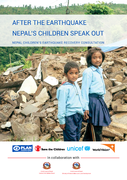
NEPAL CHILDREN’S EARTHQUAKE RECOVERY CONSULTATION - To better understand the consequences of the Nepal Earthquake for children, four child-centred agencies, in coordination with the Ministry of Federal Affairs and Local Development (MoFALD) and the Central Child Welfare Board (CCWB), conducted a C
...
The guide summarizes an assessment of War Child Canada’s three-pronged legal protection model as implemented with South Sudanese refugees in Northern Uganda and uses it to identify the most important lessons for ensuring legal protection mechanisms are in place at the onset of an emergency
20-22 July 2015, Monrovia, Liberia
J Nepal Health Res Counc 2013 May;11(24):198-204