Filter
1013
Text search:
Eradication
Featured
70
325
Language
Document type
604
177
99
54
33
15
9
7
5
3
1
1
Countries
65
51
35
31
30
28
24
23
21
21
18
14
14
13
13
13
13
12
12
11
11
10
10
9
9
9
9
9
8
8
8
7
7
7
6
6
5
5
5
5
5
5
4
4
4
3
3
3
3
3
2
2
2
2
2
2
2
2
2
2
2
2
2
2
2
2
2
2
1
1
1
1
1
1
1
1
1
1
1
1
1
1
1
1
1
1
1
1
1
1
1
1
Authors & Publishers
Publication Years
Category
400
92
66
57
28
15
7
1
Toolboxes
79
75
50
46
35
33
33
30
30
28
25
23
17
16
11
10
8
7
6
6
6
5
5
1
Further analysis of the 1996, 2001, and 2006 Demographic and Health Surveys Data
This helpdesk report seeks to establish what lessons have been learnt from the current and previous Ebola outbreaks. It recommends good practice and makes suggestions based on the evidence for good practice and preparedness to reduce transmission and prevent further risk and exposure in affected cou
...
WHO Guidelines for malaria
recommended
25 Nov 2022
The WHO Guidelines for malaria bring together the Organization’s most up-to-date recommendations for malaria in one user-friendly and easy-to-navigate online platform.
The WHO Guidelines for malaria supersedes 2 previous WHO publications: the Guidelines for the treatment of mala
...
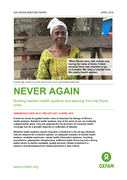
Oxfam Briefing Paper

The context of the Ebola epidemic presented extreme challenges for Oxfam, as it did for many organisations. At the onset of the epidemic, there was a general lack of understanding of the disease and how to respond to it effectively and safely. A pervasive and persistent climate of fear, coupled with
...
The Strategic Advisory Group of Experts (SAGE) on Immunization held a meeting on 3-6 October 2022. This report summarizes the discussions, conclusions and recommendations.
It covers the following items:
Global Reports
Immunization Agenda 2030 and Regional reports
Monkeypox
RSV
COVID-19 vacci
...
the Lancet : Published Online July 31, 2015 http://dx.doi.org/10.1016/S0140-6736(15)61117-5
The Facilitator's Guide provides instruction and suggestions for teaching the training modules for the Technical Guidelines for Integrated Disease Surveillance and Response in the Africa Region, 2nd edition. This training is intended for district level health officers who conduct IDSR activities. Th
...

Guide to monitoring and evaluating
Early detection, assessment and response to acute public health events:
Towards the Peoples Health Assembly Book - 4

The document will provide information for Ministries of Health and hospital sentinel sites on why and how to determine the denominator of at-risk children <5 years of age and rate of meningitis hospitalizations for a sentinel hospital site conducting IB-VPD surveillance. Such a methodology is currently unavailable and
...

A country Profile 2014

Accessed Febr. 6, 2020
This new publication presents the continuing and emerging challenges to children’s environmental health.
Interim Guidance.
A number of medical problems have been reported in survivors, including mental health issues. Ebola virus may persist in some body fluids, including semen. Ebola survivors need comprehensive support for the medical and psychosocial challenges they face and also to minimize the ...
A number of medical problems have been reported in survivors, including mental health issues. Ebola virus may persist in some body fluids, including semen. Ebola survivors need comprehensive support for the medical and psychosocial challenges they face and also to minimize the ...
This guideline provides global, evidence-informed recommendations on daily iron supplementation in infants and children, as a public-health intervention for the prevention of anaemia and iron deficiency. It includes recommendations for iron supplementation in countries where malaria is prevalent.
This report documents the secondary humanitarian problems and impacts of large-scale Ebola outbreak on the different humanitarian sectors, to provide a non-exhaustive plan to help future responders. A large scale Ebola outbreak, in this document, refers to an epidemic with an unprecedented scale, ge
...
This manual is designed primarily to assist managers of national malaria programmes and national reference laboratory responsible for quality assurance of malaria microscopy control. The information is also applicable to non-governmental organizations and funding agencies investing in quality manage
...
Methodological field approaches for scientists with a basic background in entomology to prepare and implement a yellow fever entomological assessment during outbreaks
Working document from an informal consultation of experts. A Protocol for risk assessment at the field level. The purpose of document is to provide guidance on the methodology to be used for assessing, at field level, the yellow fever virus circulation in areas at risk, and is primarily intended fo
...
The new five-year agenda of WHO in Africa, The Africa Health Transformation Programme, 2015–2020: a vision for universal health coverage, is the strategic framework that will guide WHO’s contribution to the emerging sustainable development platform in Africa. It articulates a vision for health a
...
Health Workers and Health Facilities under Attack 2015, and Early 2016

The ECDC Communicable Disease Threats Report (CDTR) is a weekly bulletin for epidemiolgists and health professionals on active public health threats. This issue covers the period 7-13 August 2016 and includes updates on Zika virus, yellow fever in Angola, polio, MERS CoV and West Nile virus.

WHO Secretariat Information paper July 2016
Globalization and Health201612:53 DOI: 10.1186/s12992-016-0194-4


6th edition, 2010. | Published in collaboration with World Health Organisation and Clinton Health Access Initiative.

Prices people pay for medicines.
This document presents a strategic framework, aimed towards the development of sustainable global, regional and national plans relating to laboratory biorisk management.
The Lancet. Published Online December 22, 2016 http://dx.doi.org/10.1016/S0140-6736(16)32621-6. Open Access
doi: 10.9745/GHSP-D-16-00226; Glob Health Sci Pract December 23, 2016 vol. 4 no. 4 p. 626-646

Towards Universal Access to Prevention, Diagnosis and Treatment
20-22 July 2015, Monrovia, Liberia

Accessed March 14, 2017
The limitation of a single sector approach. HNP Discussion Paper
Health Systems in Transition. Vol. 5 No.3 2015
Since the 1970s, voluntary contributions have become an increasingly important component of WHO's budget. As voluntary contributions tend to be earmarked for donor-specified programmes and projects, there are concerns that this trend has diverted focus away from WHO's strategic priorities, made coor
...