
Filter
1091
Text search:
Mali
Featured
63
272
Language
Document type
603
280
68
49
28
13
13
11
11
7
4
4
Countries
167
155
154
135
105
96
85
84
76
62
58
56
52
49
43
42
39
30
24
20
20
18
18
16
16
15
15
14
14
14
13
13
13
13
11
11
10
10
10
9
8
8
8
8
7
7
7
7
6
6
6
6
6
6
6
6
5
5
5
4
4
4
4
4
4
4
4
4
3
3
3
3
3
3
2
2
2
2
2
2
2
2
2
2
2
2
2
1
1
1
1
1
1
1
1
1
1
1
1
1
1
1
Authors & Publishers
Publication Years
Category
309
91
71
64
58
14
7
1
Toolboxes
207
84
52
52
48
42
39
37
33
33
28
28
20
14
11
11
9
6
6
6
4
2
2
1
The COVID-19 pandemic has created challenges for forcibly displaced persons and the humanitarian organizations working to support them. With restrictions on movement and limited access to refugees, asylum-seekers, internally displaced persons (IDPs) and stateless persons across the globe, UNHCR is s
...
A new reportshows that people in some 25 countries are set to face devasting levels of hunger in coming months due to the fallout from the COVID-19 pandemic. While the greatest concentration of need is in Africa, countries in Latin America and the Caribbean, and in the Middle East and Asia – inclu
...
High levels of storage iron may increase malaria susceptibility. This risk has not been investigated in semi-immune adolescents. We investigated whether baseline iron status of nonpregnant adolescent girls living in a high malaria transmission area in Burkina Faso affected malaria risk during the fo
...
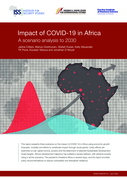
This report presents three scenarios on the impact of COVID-19 in Africa using economic growth forecasts, mortality and efforts to ameliorate impact through social grants. Likely effects are examined on per capita income, poverty and the attainment of selected Sustainable Development Goals targets.
...
It highlights how proven digital innovation can be replicated to curb the spread of COVID-19 in Africa. It also estimates investment required to implement such high impact solutions.
Previous pandemics have demonstrated that more people could die from the indirect consequences of an outbreak than from the disease itself. As the fight against the pandemic is pushing millions into poverty and hunger, COVID-19 will likely be no different.

It is often observed that educated women have lower birth rates than do the less educated, inviting a causal interpretation. However, educated women also differ from those who have never attended school in a
variety of other ways: the two factors are multiply related. This article analyzes the rela
...
Special Focus on COVID-19
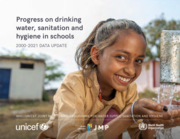
The report provides updated estimates for drinking water, sanitation and hygiene in schools including progress from 2015 to 2019. It highlights the rapid improvement needed to ensure students have access to handwashing facilities with soap and water during the COVID-19 pan
...
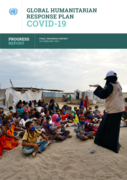
2020 was a year like no other. Amidst on-going humanitarian crises, largely fuelled by conflict and violence but also driven by the effects of climate change – such as the largest locust infestation in a generation – the world had to contend with a global pandemic. In less than one year (March-D
...
Web annex 5: Oxytocin and ergometrine versus placebo or no treatment
Evidence to decision framework
Ainsi, le présent profil peint le faciès épidémiologique du pays pour l’année 2015
avec un clin d’œil sur le niveau de réalisation des Objectifs du millénaire pour le
développement (OMD) et un focus particulier sur l’appropriation des Objectifs de
développement durable (ODD). Il e
...
Small drinking-water supplies commonly experience operational, managerial, technical and resourcing challenges that impact their ability to deliver safe and reliable services. The needs and opportunities associated with these supplies therefore warrant explicit consideration in policies and regulati
...
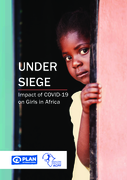
The COVID-19 pandemic has exacerbated and added yet another layer of vulnerability to an already dire web of vulnerabilities of girls in the African continent, which constitute about 49% of the total child population. Critically, gender equality and girls’ multidimensional vulnerability have been
...
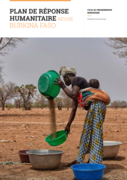
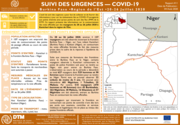
Au cours des derniers mois, la situation sécuritaire et humanitaire s'est rapidement détériorée dans les régions du Nord, du CentreNord, du Sahel, de la Boucle du Mouhoun et de l’Est du Burkina Faso. Cette dégradation a entraîné un accroissement substantiel des déplacements internes et ag
...
La pandémie causée par le coronavirus s’est propagée au Niger le 19 mars, date de la notification du premier cas. A la date du 21 juillet 2020, le pays avait enregistré 1 113 cas, dont 1 1018 guéris, 26 sous traitement et 69 décès. Selon l’analyse des données effectuée par le Ministère
...
Le Plan de réponse humanitaire (PRH) 2020 a été révisé et publié en mai 2020 afin d’intégrer l’impact de l’épidémie de COVID-19 sur les besoins humanitaires existants et sur les activités des partenaires humanitaires.
Dans le contexte de l’épidémie de COVID-19, la portée de lâ€
...
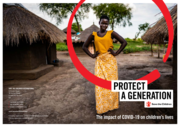
An estimated 99% of children worldwide – or more than 2.3 billion children – live in one of the 186 countries that have implemented some form of restrictions due to COVID-191. Although children are not at a high risk of direct harm from the virus, they are disproportionately affected by its hid
...
The reports bring together the latest findings and conclusions about the state of resistance to artemisinins and artemisinin-based combination therapy (ACT), summarize WHO’s current policy and treatment recommendations, and highlight areas of concern.
Le Burkina Faso est un pays sahélien sans littoral d’une superficie de 274 000 km2 et une
population estimée à 17,4 millions d’habitants en 2013 avec une croissance démographique de
3,1%. C’est l’un des pays les plus pauvres du monde avec un Produit intérieur brut par tête de
684 US
...
