
Filter
2384
Filtered Results: 2384
Text search:
World
Health
Organization
(South-East
Asia)
Featured
Recommendations
200
New Publications
588
Language
Document type
No document type
1243
Studies & Reports
601
Guidelines
238
Manuals
111
Strategic & Response Plan
78
Fact sheets
32
Training Material
29
Situation Updates
23
Resource Platforms
15
Infographics
9
Online Courses
3
Brochures
2
Countries / Regions
Global
171
India
96
South–East Asia Region
87
Myanmar / Burma
84
Nepal
64
Bangladesh
50
Asia
50
Indonesia
39
Philippines
38
Africa
36
Western and Central Europe
31
Cambodia
29
Ethiopia
23
South Africa
23
Kenya
22
Uganda
21
Nigeria
19
Syria
19
Middle East and North Africa
18
Thailand
16
Western Pacific Region
16
Tanzania
15
Pakistan
14
Latin America and the Carribbean
14
Liberia
13
Congo, Democratic Republic of
13
Zambia
13
West and Central Africa
13
East and Southern Africa
12
Ghana
11
Afghanistan
11
Malawi
11
Mozambique
11
Eastern Europe
11
Haiti
10
China
10
Ukraine
10
Yemen
10
Rwanda
9
Russia
9
Vietnam
9
Zimbabwe
8
South Sudan
8
Brazil
8
Sierra Leone
7
Laos
7
Senegal
6
Somalia
6
Sri Lanka
6
Eastern Europe and Central Asia
6
Cameroon
5
Sudan
5
Burkina Faso
4
Jordan
4
Malaysia
4
Central African Republic
4
Madagascar
4
Venezuela
4
Timor Leste/ East Timor
4
Moldova
4
Iran
4
Japan
4
Guinea
3
USA
3
Egypt
3
Papua New Guinea
3
Namibia
3
North Macedonia
3
Botswana
3
Albania
3
Georgia
3
Bosnia and Herzegovina
3
Mali
2
Iraq
2
Lebanon
2
Turkey
2
Eswatini/ Swaziland
2
Serbia
2
Croatia
2
Colombia
2
Mexico
2
North Korea
2
Italy
2
Tajikistan
2
Kyrgyzstan
2
Kazakhstan
2
Turkmenistan
2
Belarus
2
Morocco
1
Saudi Arabia
1
Niger
1
Singapore
1
Benin
1
Vanuatu
1
Argentina
1
Peru
1
Hungary
1
Honduras
1
Ecuador
1
Bolivia
1
Greece
1
Libya
1
Angola
1
Lesotho
1
Other region
1
Paraguay
1
Solomon Islands
1
Bhutan
1
Poland
1
Palestine
1
Djibouti
1
Armenia
1
Mongolia
1
Canada
1
Qatar
1
Romania
1
Gabon
1
Belgium
1
Maldives
1
Tunisia
1
Portugal
1
Spain
1
Azerbaijan
1
Authors & Publishers
Publication Years
Category
Countries
583
Clinical Guidelines
260
Public Health
176
Women & Child Health
161
Key Resources
122
Capacity Building
51
Pharmacy & Technologies
29
Toolboxes
HIV
237
Mental Health
211
Planetary Health
170
COVID-19
151
TB
115
NTDs
104
AMR
95
Rapid Response
85
Disability
84
Global Health Education
76
NCDs
58
Refugee
53
Caregiver
51
Natural Hazards
40
Conflict
39
Health Financing Toolbox
39
Pharmacy
33
Zika
28
Ebola
21
Polio
16
Cholera
14
Specific Hazards
9
Typhoon
3
Social Ethics
2
Health Financing
1
Vitamin D deficiency is thought to be common among pregnant women, particularly during the winter months, and has been found to be associated with an increased risk of pre-eclampsia, gestational diabetes mellitus, preterm birth, and other tissue-specific conditions.
This guideline is intended for ...

The plan contains the latest available evidence on the extent of insecticide resistance around the world, and puts forward a strategy for global and country levels, identifying clear roles and timelines for all stakeholders. The GPIRM also summarize...
Effective malaria prevention is threatened by widespread and increasing vector insecticide resistance. Failure to mitigate this threat will likely result in an increased burden of disease, with significant cost implications. This new framework provides support for the development of a national insec...
Recent systematic reviews and meta-analysis of the impact of chemical-based mollusciciding (King et al., 2015, Sokolow et al., 2016) have concluded that regular mollusciciding is likely to contribute significantly towards elimination of schistosomiasis in high-risk areas. The WHO roadmap’s new foc...

The purpose of this handbook is to provide guidance to Member States on the practical aspects of maintaining sanitary standards at international borders at ports, airports, and ground crossings (points of entry) as set out in the International Health...

Water, sanitation and hygiene (WASH) are critical in the prevention and care for all of the 17 neglected tropical diseases (NTDs) scheduled for intensified control or elimination by 2020.
Provision of safe water, sanitation and hygiene is one of the five key interventions within the global NTD ...
Provision of safe water, sanitation and hygiene is one of the five key interventions within the global NTD ...

The objectives of these guidelines are to provide recommendations outlining a public health approach to managing people presenting with advanced HIV disease, and to provide guidance on the timing of initiation of antiretroviral therapy (ART) for all...

To complement the Global Strategy progress reporting, this report provides a detailed look at country leadership and action toward the Every Newborn National Milestones by 2020. Countries have taken the initiative to show the way forward and have demonstrated significant progress. As part of monitor...

A review of proactive risk assessment and risk management practices to ensure the safety of drinking-water
Based on information gathered from 118 countries representing every region of the globe, this report provides a picture of WSP uptake worldwide. It presents information on WSP implementati...
Based on information gathered from 118 countries representing every region of the globe, this report provides a picture of WSP uptake worldwide. It presents information on WSP implementati...
2nd edition. The 2018 Roadmap incorporates an additional critical population: adolescents. Despite making up 1 in 6 of the world’s people, adolescents have been largely overlooked as global momentum to address TB has grown. Spanning the ages of 10...

Outstanding child and adolescent TB priorities include the need to: find the missing children with active TB and link them to TB care; prevent TB in children who are in contact with infectious TB cases (through implementation of active contact investigation and provision of preventive treatment); an...
This document aims to provide concrete, pragmatic guidance for how TB modelling and related technical assistance is undertaken to support country decision-making. The target audience for this document are the participants and stakeholders in country-level TB modelling efforts, including the individu...
Guidelines for malaria vector control
recommended
these guidelines are updated on 16 February 2021
Please check the new guideline here
https://medbox.org/document/who-guidelines-for-malaria#GO
This user guide is designed to provide national malaria control programmes with general information on glucose-6-phosphate dehydrogenase (G6PD) deficiency. Individuals with this condition may be at risk of adverse effects from medicines commonly used to cure Plasmodium vivax malaria, as well as from...
Second edition
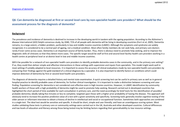
Q6: Can dementia be diagnosed at first or second level care by non-specialist health care providers? What should be the assessment process for the diagnosis of dementia?
Version 1.1
Department of Mental Health and Substance Abuse
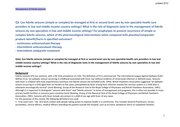
Q3: Can febrile seizures (simple or complex) be managed at first or second level care by non-specialist health care providers in low and middle income country settings? What is the role of diagnostic tests in the management of febrile seizures by no...

The goal of the strategy is to prevent seasonal influenza, control the spread of influenza from animals to humans, and prepare for the next influenza pandemic.
The new strategy is the most comprehensive and far-reaching that WHO has ever developed for influenza. It outlines a path to protect popul...
