Filter
667
Text search:
earthquake
Featured
67
207
Language
Document type
435
62
55
39
21
17
14
8
6
3
3
2
1
1
Countries
51
46
45
22
21
19
16
12
11
9
8
7
5
5
4
4
4
4
4
4
3
3
3
3
3
3
2
2
2
2
2
2
2
2
2
2
2
1
1
1
1
1
1
1
1
1
1
1
1
1
1
1
1
1
1
1
1
1
Authors & Publishers
Publication Years
Category
204
73
28
27
18
16
7
2
1
1
Toolboxes
138
74
51
35
35
21
15
13
12
12
11
9
9
5
4
3
3
3
2
2
1
1
1

front cover © Hannah Maule-Ffinch/Save the Children
Reduce Risk, Protect Health Facilities, Save Lives

Disaster Preparedness Training Programme
A broad range of UNHCR’s key priorities overlap with MHPSS issues – for example, child protection and sexual and gender-based violence [SGBV] prevention and response.
Despite all these existent synergies, UNHCR’s current policies and guidelines do not sufficiently link with MHPSS principles.
...
The Multi-Cluster/Sector Initial Rapid Assessment (MIRA) is a joint needs assessment tool that can be used in sudden onset emergencies, including IASC System-Wide Level 3 Emergency Responses (L3 Responses).
Disaster Management Reference Handbook Series Overview.
Floods, storms, and wind account for large proportions of displacement compared to other disasters. Floods are the most frequent type of disaster whereas wind-related disasters constitute the biggest losses in terms of economic damage, displac
...
A process for improving community awareness and preparedness for technological hazards and environmental emergencies
The new Global Strategy aims to achieve the highest attainable standard of health for all women, children and adolescents, transform the future and ensure that every newborn, mother and child not only survives, but thrives.
Comprehensive public health action on population ageing is urgently needed. This will require fundamental shifts, not just in the things we do, but in how we think about ageing itself. The World report on ageing and health outlines a framework for action to foster Healthy Ageing built around the new
...
Global Health Science and Practice. First published online November 12, 2015
This provisional Facilitator's Kit provides a complete framework for a 3-day training on Community Preparedness for Reproductive Health and Gender. The goal is to build community capacity to prepare and respond to risks and inequities faced by women and girls during emergencies.
The document introduces a simple classification, minimums standards and a registration form for Foreign Medical Teams (FMTs) that may provide surgical and trauma care arriving within the aftermath of a sudden onset disaster. These can serve as tools to improve the coordination of the foreign medical
...
The English terminology, and its translations into Arabic, Chinese, French, Russian, and Spanish, are available on the UNISDR website at: www.unisdr.org/publications and on PreventionWeb at: www.preventionweb.net
The purpose of this Strategy is to set out the way to meet the needs of the rural populations for improved domestic water supply services, access to and use of improved sanitation with elimination of open defecation, and improved hygiene behaviour by the Year 2030. It also addresses water, sanitatio
...
The report covers possible developments in Indonesia over the next 10 months (to end 2016). Four scenarios are outlined:
Delayed Second Crop Harvest
Delayed and Reduced Second Crop Harvest
La Niña disrupts main rural sources of income
Soaring rice prices
The scenarios wer
...
The Handbook is primarily addressed to child protection coordination teams, which may include coordinators, co-leads and information managers, the guidance is equally valid for all members of the child protection coordination group, including national and international nongovernmental organizations
...
The intention of this document is to clarify and outline the steps to effective cholera surveillance. It discusses when,
where and why surveillance for cholera is needed and how to establish a useful and cost-effective surveillance
system for cholera. To make comments, corrections and additions,
...
Sphere for Monitoring and Evaluation
recommended
Sphere Unpacked
From Individual to Collective healing: A trainer’s manual
Conducting simulations and drills is the most effective way to evaluate and test disaster preparedness plans; these exercises are used widely by organizations and institutions working in development and in disaster response. Drills and simulations are also excellent tools for training, and for asses
...
C’est dans ce contexte particulièrement complexe qu’ONU Femmes et CARE, sous le leadership du Ministère à la Condition féminine et aux Droits des femmes (MCFDF) et en coordination avec la Direction Générale de la Protection Civile (DGPC), ont lancé l’Analyse Rapide Genre qui se veut une
...
Series on Disability-Inclusive Development. This publication introduces the key concepts for disability-inclusive development and highlights practical examples by CBM, to contribute to the dialogue on disability-inclusive development
BioMed Central DOI 10.1186/s12963-016-0096-y
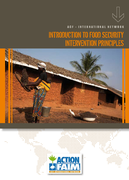
Reference book specifying the principles of intervention for all food security activities, from initial assessment to programme implementation.
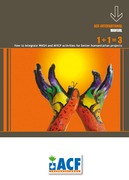
Integrating WASH and MHCP interventions will always require imagination and creativity to adapt the approach to specific conditions, opportunities and constraints in each context. The book is designed to stimulate reflection and encourage initiatives to seek opportunities for closer integration of t
...
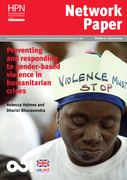
The aim of this paper is to map and critically analyse evidence of good practice in prevention and response to gender-based violence (GBV) in humanitarian contexts which can support humanitarian practitioners and policy makers to improve the quality of GBV programming in the field. The paper is stru
...
This EISF report provides an analysis of the issues surrounding the relationship between NGO’s and their local partners. It includes a section on the topic and its background, responsabilities towards the partner organisation and particularly in terms of security, how to enable and help the partne
...
Security Risk Management and Religion: Faith and secularism in humanitarian assistance examines the impact that religion has on security risk management for humanitarian agencies, and considers whether a better understanding of religion can improve the security of organisations and individuals in th
...
The report offers an analysis of the broader challenges to securing humanitarian action and recommends areas for improvement. This study will contribute to improving the way humanitarians ‘do business’ in complex
security environments. Document also available in French, Arabic and Spanish.

The guide summarizes an assessment of War Child Canada’s three-pronged legal protection model as implemented with South Sudanese refugees in Northern Uganda and uses it to identify the most important lessons for ensuring legal protection mechanisms are in place at the onset of an emergency
Guide to community engagement in WASH
recommended
A practioner's guide, based on lessons from Ebola.
This guide is a compilation of best practices and key lessons learned through Oxfam’s experience of community engagement during the 2014–15 Ebola response in Sierra Leone and Liberia. It aims to inform public health practitioners and programme
...
The magnitude of urban disasters, high population densities, and a complex social, political and institutional environment has challenged the manner in which humanitarian agencies are used to working. Humanitarian agencies are now grappling with how to change their approaches to this reality. This d
...
The Sphere standards in national humanitarian response discussion paper sets out to understand and describe opportunities for adapting international humanitarian standards to a regional, national or local level in preparing for, or responding to a disaster. The paper, which includes case studies and
...
La collaboration avec les autorités nationales de gestion des catastrophes
Entablar conversaciones con las Autoridades Nacionales de la Gestión de Desastres
Fills a gap in current guidance on how to implement humanitarian standards in urban situations. In Arabic, English, French and Spanish available

Operational guidance for managing programme quality.
These guidelines are about implementing the programme-quality standards of the Core Humanitarian Standard in limited access humanitarian response. They have been developed using approaches and tools tested by Oxfam, other INGOs and the UN in Afgh
...
A Formative Evaluation of UNICEF’s Child Protection System Building Approach in Indonesia
Managing stress in humanitarian workers
recommended
Guidelines for good practice. 3rd edition
The Guidelines for Good Practice are intended to help organizations define their own needs in relation to stress management and develop their own staff care system. The process will be different for each organization. National and international agencies, bi
...

This report is from the National study on living conditions among people
with disabilities carried out in Nepal in 2014-2015. The study was carried
out as a household survey with two-stage stratified sampling, including a screening/listing procedure using the Washington Group on Disability
Statis
...
Weekly Epidemiological Record (WER), 17 September 2021, Vol. 96, No. 37 (pp. 445-460)
- Pacific Possible Background Paper No.6
From policy to practice: how the TB-HIV response is working
“The HIV community must place much more focus on TB co-infection than
it has done to date. TB takes the lives of over 1000 people living with HIV
every day, a number which is absolutely unacceptable. This report highlights that
TB d
...
Version 2 (unedited). The Basic Needs Analysis (BNA) is a multi-sector needs analysis approach that can be applied in both sudden onset and protracted emergencies. The methodology comprises the Guidance (this document) presenting the conceptual BNA framework and related processes, and a Toolbox, whi
...
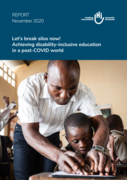
Humanity & Inclusion has published a report on November 20, on the difficulties children with disabilities face in accessing education in the world’s poorest countries.
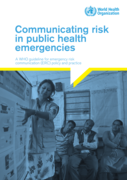
Communication Risk in Public Health Emergencies
recommended
A WHO Guideline for Emergency Risk Communication (ERC) policy and practice.
Recent public health emergencies, such as the Ebola virus disease outbreak in West Africa (2014–2015), the emergence of the Zika virus syndrome in 2015–2016 and multi-country yellow fever outbreaks in Africa in 2016, h
...