
Filter
6866
Text search:
Surveillance
Featured
593
1864
Language
5455
1180
200
175
106
97
63
44
8
8
6
5
4
4
3
3
3
3
3
2
2
2
2
2
2
2
2
2
1
1
1
1
1
1
1
1
1
1
1
1
1
1
1
1
1
1
1
1
1
1
1
1
Document type
3615
1123
998
365
277
199
128
83
27
22
12
11
1
Countries
248
215
208
153
152
145
142
138
136
132
121
119
108
100
97
95
93
92
91
77
73
71
68
68
67
65
64
63
63
55
54
52
52
51
49
48
48
47
46
44
42
41
40
40
39
36
36
35
33
30
29
25
24
23
23
21
21
20
19
18
17
17
17
17
16
16
14
13
13
12
12
11
10
10
9
9
9
9
9
9
8
8
8
8
8
8
8
8
7
7
7
6
6
6
6
6
6
6
5
5
5
5
5
5
5
5
4
4
4
4
4
4
4
3
3
3
3
3
3
3
3
3
3
3
3
2
2
2
2
2
2
2
2
2
2
2
2
2
1
1
1
1
1
1
1
1
1
1
1
1
1
1
1
1
1
Authors & Publishers
1052
420
245
238
217
131
106
87
80
78
77
67
58
57
47
44
40
39
38
36
32
31
31
31
29
27
27
27
26
26
25
24
23
23
23
22
21
21
20
20
19
19
18
18
18
18
17
17
17
16
16
16
16
16
16
16
16
15
15
15
15
14
14
14
13
13
13
13
13
13
13
13
13
12
12
12
12
12
12
11
11
11
11
11
11
11
11
11
10
10
10
10
10
10
10
9
9
9
9
9
9
9
9
9
9
9
9
9
9
8
8
8
8
8
8
8
8
8
8
8
8
8
8
7
7
7
7
7
7
7
7
7
7
7
6
6
6
6
6
6
6
6
6
6
6
6
6
6
6
6
6
6
6
6
5
5
5
5
5
5
5
5
5
5
5
5
5
5
5
5
5
5
5
5
5
5
5
5
5
5
5
5
5
5
5
5
5
5
5
5
5
5
5
5
5
5
5
5
5
5
4
4
4
4
4
4
4
4
4
4
4
4
4
4
4
4
4
4
4
4
4
4
4
4
4
4
4
4
4
4
4
4
4
4
4
4
4
4
4
4
4
4
4
4
4
4
4
4
4
4
4
4
4
4
4
4
4
4
4
4
4
4
4
4
4
4
4
4
4
4
4
4
3
3
3
3
3
3
3
3
3
3
3
3
3
3
3
3
3
3
3
3
3
3
3
3
3
3
3
3
3
3
3
3
3
3
3
3
3
3
3
3
3
3
3
3
3
3
3
3
3
3
3
3
3
3
3
3
3
3
3
3
3
3
3
3
3
3
3
3
3
3
3
3
3
3
3
3
3
3
3
3
3
3
3
3
3
3
3
3
3
3
3
3
3
3
3
3
3
3
3
3
3
3
3
3
3
3
3
3
3
3
3
3
3
3
3
3
3
3
3
3
3
3
3
3
3
3
3
3
3
3
3
3
3
3
3
3
2
2
2
2
2
2
2
2
2
2
2
2
2
2
2
2
2
2
2
2
2
2
2
2
2
2
2
2
2
2
2
2
2
2
2
2
2
2
2
2
2
2
2
2
2
2
2
2
2
2
2
2
2
2
2
2
2
2
2
2
2
2
2
2
2
2
2
2
2
2
2
2
2
2
2
2
2
2
2
2
2
2
2
2
2
2
2
2
2
2
2
2
2
2
2
2
2
2
2
2
2
2
2
2
2
2
2
2
2
2
2
2
2
2
2
2
2
2
2
2
2
2
2
2
2
2
2
2
2
2
2
2
2
2
2
2
2
2
2
2
2
2
2
2
2
2
2
2
2
2
2
2
2
2
2
2
2
2
2
2
2
2
2
2
2
2
2
2
2
2
2
2
2
2
2
2
2
2
2
2
2
2
2
2
2
2
2
2
2
2
2
2
2
2
2
2
2
2
2
2
2
2
2
2
2
2
2
2
2
2
2
2
2
2
2
2
2
2
2
2
2
2
2
2
2
2
2
2
2
2
2
2
2
2
2
2
2
2
2
2
2
2
2
2
2
2
2
2
2
2
2
2
2
2
2
2
2
2
2
2
2
2
2
2
2
2
2
2
2
2
2
2
2
2
2
2
2
2
2
2
2
2
2
2
2
2
2
2
2
2
2
2
2
2
2
2
2
2
2
2
2
2
2
2
2
2
2
2
2
2
2
2
2
2
2
2
2
2
2
2
2
2
2
2
2
2
2
2
2
2
1
1
1
1
1
1
1
1
1
1
1
1
1
1
1
1
1
1
1
1
1
1
1
1
1
1
1
1
1
1
1
1
1
1
1
1
1
1
1
1
1
1
1
1
1
1
1
1
1
1
1
1
1
1
1
1
1
1
1
1
1
1
1
1
1
1
1
1
1
1
1
1
1
1
1
1
1
1
1
1
1
1
1
1
1
1
1
1
1
1
1
1
1
1
1
1
1
1
1
1
1
1
1
1
1
1
1
1
1
1
1
1
1
1
1
1
1
1
1
1
1
1
1
1
1
1
1
1
1
1
1
1
1
1
1
1
1
1
1
1
1
1
1
1
1
1
1
1
1
1
1
1
1
1
1
1
1
1
1
1
1
1
1
1
1
1
1
1
1
1
1
1
1
1
1
1
1
1
1
1
1
1
1
1
1
1
1
1
1
1
1
1
1
1
1
1
1
1
1
1
1
1
1
1
1
1
1
1
1
1
1
1
1
1
1
1
1
1
1
1
1
1
1
1
1
1
1
1
1
1
1
1
1
1
1
1
1
1
1
1
1
1
1
1
1
1
1
1
1
1
1
1
1
1
1
1
1
1
1
1
1
1
1
1
1
1
1
1
1
1
1
1
1
1
1
1
1
1
1
1
1
1
1
1
1
1
1
1
1
1
1
1
1
1
1
1
1
1
1
1
1
1
1
1
1
1
1
1
1
1
1
1
1
1
1
1
1
1
1
1
1
1
1
1
1
1
1
1
1
1
1
1
1
1
1
1
1
1
1
1
1
1
1
1
1
1
1
1
1
1
1
1
1
1
1
1
1
1
1
1
1
1
1
1
1
1
1
1
1
1
1
1
1
1
1
1
1
1
1
1
1
1
1
1
1
1
1
1
1
1
1
1
1
1
1
1
1
1
1
1
1
1
1
1
1
1
1
1
1
1
1
1
1
1
1
1
1
1
1
1
1
1
1
1
1
1
1
1
1
1
1
1
1
1
1
1
1
1
1
1
1
1
1
1
1
1
1
1
1
1
1
1
1
1
1
1
1
1
1
1
1
1
1
1
1
1
1
1
1
1
1
1
1
1
1
1
1
1
1
1
1
1
1
1
1
1
1
1
1
1
1
1
1
1
1
1
1
1
1
1
1
1
1
1
1
1
1
1
1
1
1
1
1
1
1
1
1
1
1
1
1
1
1
1
1
1
1
1
1
1
1
1
1
1
1
1
1
1
1
1
1
1
1
1
1
1
1
1
1
1
1
1
1
1
1
1
1
1
1
1
1
1
1
1
1
1
1
1
1
1
1
1
1
1
1
1
1
1
1
1
1
1
1
1
1
1
1
1
1
1
1
1
1
1
1
1
1
1
1
1
1
1
1
1
1
1
1
1
1
1
1
1
1
1
1
1
1
1
1
1
1
1
1
1
1
1
1
1
1
1
1
1
1
1
1
1
1
1
1
1
1
1
1
1
1
1
1
1
1
1
1
1
1
1
1
1
1
1
1
1
1
1
1
1
1
1
1
1
1
1
1
1
1
1
1
1
1
1
1
1
1
1
1
1
1
1
1
1
1
1
1
1
1
1
1
1
1
1
1
1
1
1
1
1
1
1
1
1
1
1
1
1
1
1
1
1
1
1
1
1
1
1
1
1
1
1
1
1
1
1
1
1
1
1
1
1
1
1
1
1
1
1
1
1
1
1
1
1
1
1
1
1
1
1
1
1
1
1
1
1
1
1
1
1
1
1
1
1
1
1
1
1
1
1
1
1
1
1
1
1
1
1
1
1
1
1
1
1
1
1
1
1
1
1
1
1
1
1
1
1
1
1
1
1
1
1
1
1
1
1
1
1
1
1
1
1
1
1
1
1
1
1
1
1
1
1
1
1
1
1
1
1
1
1
1
1
1
1
1
1
1
1
1
1
1
1
1
1
1
1
1
1
1
1
1
1
1
1
1
1
1
1
1
1
1
1
1
1
1
1
1
1
1
1
1
1
1
1
1
1
1
1
1
1
1
1
1
1
1
1
1
1
1
1
1
1
1
1
1
1
1
1
1
1
1
1
1
1
1
1
1
1
1
1
1
1
1
1
1
1
1
1
1
1
1
1
1
1
1
1
1
1
1
1
1
1
1
1
1
1
1
1
1
1
1
1
1
1
1
1
1
1
1
1
1
1
1
1
1
1
1
1
1
1
1
1
1
1
1
1
1
1
1
1
1
1
1
1
1
1
1
1
1
1
1
1
1
1
1
1
1
1
1
1
1
1
1
1
1
1
1
1
1
1
1
1
1
1
1
1
1
1
1
1
1
1
1
1
1
1
1
1
1
1
1
1
1
1
1
1
1
1
1
1
1
1
1
1
1
1
1
1
1
1
1
1
1
1
1
1
1
1
1
1
1
1
1
1
1
1
1
1
1
1
1
1
1
1
1
1
1
1
1
1
1
1
1
1
1
1
1
1
1
1
1
1
1
1
1
1
1
1
1
1
1
1
1
1
1
1
1
1
1
1
1
1
1
1
1
1
1
1
1
1
1
1
1
1
1
1
1
1
1
1
1
1
1
1
1
1
1
1
1
1
1
1
1
1
1
1
1
1
1
1
1
1
1
1
1
1
1
1
1
1
1
1
1
1
1
1
1
1
1
1
1
1
1
1
1
1
1
1
1
1
1
1
1
1
1
1
1
1
1
1
1
1
1
1
1
1
1
1
1
1
1
1
1
1
1
1
1
1
1
1
1
1
1
1
1
1
1
1
1
1
1
1
1
1
1
1
1
1
1
1
1
1
1
1
1
1
1
1
1
1
1
1
1
1
1
1
1
1
1
1
1
1
1
1
1
1
1
1
1
1
1
1
1
1
1
1
1
1
1
1
1
1
1
1
1
1
1
1
1
1
1
1
1
1
1
1
1
1
1
1
1
1
1
1
1
1
1
1
1
1
1
1
1
1
1
1
1
1
1
1
1
1
1
1
1
1
1
1
1
1
1
1
1
1
1
1
1
1
1
1
1
1
1
1
1
1
1
1
1
1
1
1
1
1
1
1
1
1
1
1
1
1
1
1
1
1
1
1
1
1
1
1
1
1
1
1
1
1
1
1
1
1
1
1
1
1
1
1
1
1
1
1
1
1
1
1
1
1
1
1
1
1
1
1
1
1
1
1
1
1
1
1
1
1
1
1
1
1
1
1
1
1
1
1
1
1
1
1
1
1
1
1
1
1
1
1
1
1
1
1
1
1
1
1
1
1
1
1
1
1
1
1
1
1
1
1
1
1
1
1
1
1
1
1
1
1
1
1
1
1
1
1
1
1
1
1
1
1
1
1
1
1
1
1
1
1
1
1
1
1
1
1
1
1
1
1
1
1
1
1
1
1
1
1
1
1
1
1
1
1
1
1
1
1
1
1
1
1
1
1
1
1
1
1
1
1
1
1
1
1
1
1
1
1
1
1
1
1
1
1
1
1
1
1
1
1
1
1
1
1
1
1
1
1
1
1
1
1
1
1
1
1
1
1
1
1
1
1
1
1
1
1
1
1
1
1
1
1
1
1
1
1
1
1
1
1
1
1
1
1
1
1
1
1
1
1
1
1
1
1
1
1
1
1
1
1
1
1
1
1
1
1
1
1
1
1
1
1
1
1
1
1
1
1
1
1
1
1
1
1
1
1
1
1
1
1
1
1
1
1
1
1
1
1
1
1
1
1
1
1
1
1
1
1
1
1
1
1
1
1
1
1
1
1
1
1
1
1
1
1
1
1
1
1
1
1
1
1
1
1
1
1
1
1
1
1
1
1
1
1
1
1
1
1
1
1
1
1
1
1
1
1
1
1
1
1
1
1
1
1
1
1
1
1
1
1
1
1
1
1
1
1
1
1
1
1
1
1
1
1
1
1
1
1
1
1
1
1
1
1
1
1
1
1
1
1
1
1
1
1
1
1
1
1
1
1
1
1
1
1
1
1
1
1
1
1
1
1
1
1
1
1
1
1
1
1
1
1
1
1
1
1
1
1
1
1
1
1
1
1
1
1
1
1
1
1
1
1
1
1
1
1
1
1
1
1
1
1
1
1
1
1
1
1
1
1
1
1
1
1
1
1
1
1
1
1
1
1
1
1
1
1
1
1
1
1
1
1
1
1
1
1
1
1
1
1
1
1
1
1
1
1
1
1
1
1
1
1
1
1
1
1
1
1
1
1
1
1
1
1
1
1
1
1
1
1
1
1
1
1
1
1
1
1
1
1
1
1
1
1
1
1
1
1
1
1
1
1
1
1
1
1
1
1
1
1
1
1
1
1
1
1
1
1
1
1
1
1
1
1
1
1
1
1
1
1
1
1
1
1
1
1
1
1
1
1
1
1
1
1
1
1
1
1
1
1
1
1
1
1
1
1
1
1
1
1
1
1
1
1
1
1
1
1
1
1
1
1
1
1
1
1
1
1
1
1
1
1
1
1
1
1
1
1
1
1
1
1
1
1
1
1
1
1
1
1
1
1
1
1
1
1
1
1
1
1
1
1
1
1
1
1
1
1
1
1
1
1
1
1
1
1
1
1
1
1
1
1
1
1
1
1
1
1
1
1
1
1
1
1
1
1
1
1
1
1
1
1
1
1
1
1
1
1
1
1
1
1
1
1
1
1
1
1
1
1
1
1
1
1
1
1
1
1
1
1
1
1
1
1
1
1
1
1
1
1
1
1
1
1
1
1
1
1
1
1
1
1
1
1
1
1
1
1
1
1
1
1
1
1
1
1
1
1
1
1
1
1
1
1
1
1
1
1
1
1
1
1
1
1
1
1
1
1
1
1
1
1
1
1
1
1
1
1
1
1
1
1
1
1
1
1
1
1
1
1
1
1
1
1
1
1
1
1
1
1
1
1
1
1
1
1
1
1
1
1
1
1
1
1
1
1
1
1
1
1
1
1
1
1
1
1
1
1
1
1
1
1
1
1
1
1
1
1
1
1
1
1
1
1
1
1
1
1
1
1
1
1
1
1
1
1
1
1
1
1
1
1
1
1
1
1
1
1
1
1
1
1
1
1
1
1
1
1
1
1
1
1
1
1
1
1
1
1
1
1
1
1
1
1
1
1
1
1
1
1
1
1
1
1
1
1
1
1
1
1
1
1
1
1
1
1
1
1
1
1
1
1
1
1
1
1
1
1
1
1
1
1
1
1
1
1
1
1
1
1
1
1
1
1
1
1
1
1
1
1
1
1
1
1
1
1
1
1
1
1
1
1
1
1
1
1
1
1
1
1
1
1
1
1
1
1
1
1
1
1
1
1
1
1
1
1
1
1
1
1
1
1
1
1
1
1
1
1
1
1
1
1
1
1
1
1
1
1
1
1
1
1
1
1
1
1
1
1
1
1
1
1
1
1
1
1
1
1
1
1
1
1
1
1
1
1
1
1
1
1
1
1
1
1
1
1
1
1
1
1
1
1
1
1
1
1
1
1
1
1
1
1
1
1
1
1
1
1
1
1
1
1
1
1
1
1
1
1
1
1
1
1
1
1
1
1
1
1
1
1
1
1
1
1
1
1
1
1
1
1
1
1
1
1
1
1
1
1
1
1
1
1
1
1
1
1
1
1
1
1
1
1
1
1
1
1
1
1
1
1
1
1
1
1
1
1
1
1
1
1
1
1
1
1
1
1
1
1
1
1
1
1
1
1
1
1
1
1
1
1
1
1
1
1
1
1
1
1
1
1
1
1
1
1
1
1
1
1
1
1
1
1
1
1
1
1
1
1
1
1
1
1
1
1
1
1
1
1
1
1
1
1
1
1
1
1
1
1
1
1
1
1
1
1
1
1
1
1
1
1
1
1
1
1
1
1
1
1
1
1
1
1
1
1
1
1
1
1
1
1
1
1
1
1
1
1
1
1
1
1
1
1
1
1
1
1
1
1
1
1
1
1
1
1
1
1
1
1
1
1
1
1
1
1
1
1
1
1
1
1
1
1
1
1
1
1
1
1
1
1
1
1
1
1
1
1
1
1
1
1
1
1
1
1
1
1
1
1
1
1
1
1
1
1
1
1
1
1
1
1
1
1
1
1
1
1
1
1
1
1
1
1
1
1
1
1
1
1
1
1
1
1
1
1
1
1
1
1
1
1
1
1
1
1
1
1
1
1
1
1
1
1
1
1
1
1
1
1
1
1
1
1
1
1
1
1
1
1
1
1
1
1
1
1
1
1
1
1
1
1
1
1
1
1
1
1
1
1
1
1
1
1
1
1
1
1
1
1
1
1
1
1
1
1
1
1
1
1
1
1
1
1
1
1
1
1
1
1
1
1
1
1
1
1
1
1
1
1
1
1
1
1
1
1
1
1
1
1
1
1
1
1
1
1
1
1
1
1
1
1
1
1
1
1
1
1
1
1
1
1
1
1
1
1
1
1
1
1
1
1
1
1
1
1
1
1
1
1
1
1
1
1
1
1
1
1
1
1
1
1
1
1
1
1
1
1
1
1
1
1
1
1
1
1
1
1
1
1
1
1
1
1
1
1
1
1
1
1
1
1
1
1
1
1
1
1
1
1
1
1
1
1
1
1
1
1
1
1
1
1
1
1
1
1
1
1
1
1
1
1
1
1
1
1
1
1
1
1
1
1
1
1
1
1
1
1
1
1
1
1
1
1
1
1
1
1
1
1
1
1
1
1
1
1
1
1
1
1
1
1
1
1
1
1
1
1
1
1
1
1
1
1
1
1
1
1
1
1
1
1
1
1
1
1
1
1
1
1
1
1
1
1
1
1
1
1
1
1
1
1
1
1
1
1
1
1
1
1
1
1
1
1
1
1
1
1
1
1
1
1
1
1
1
1
1
1
1
1
1
1
1
1
1
1
1
1
1
1
1
1
1
1
1
1
1
1
1
1
1
1
1
1
1
1
1
1
1
1
1
1
1
1
1
1
1
1
1
1
1
1
1
1
1
1
1
1
1
1
1
1
1
1
1
1
1
1
1
1
1
1
1
1
1
1
1
1
1
1
1
1
1
1
1
1
1
1
1
1
1
1
1
1
1
1
1
1
1
1
1
1
1
1
1
1
1
1
1
1
1
1
1
1
1
1
1
1
1
1
1
1
1
1
1
1
1
1
1
1
1
1
1
1
1
1
1
1
1
1
1
1
1
1
1
1
1
1
1
1
1
1
1
1
1
1
1
1
1
1
1
1
1
1
1
1
1
1
1
1
1
1
1
1
1
1
1
1
1
1
1
1
1
1
1
1
1
1
1
1
1
1
1
1
1
1
1
1
1
1
1
1
1
1
1
1
1
1
1
1
1
1
1
1
1
1
1
1
1
1
1
1
1
1
1
1
1
1
1
1
1
1
1
1
1
1
1
1
1
1
1
1
1
1
1
1
1
1
1
1
1
1
1
1
1
1
1
1
1
1
1
1
1
1
1
1
1
1
1
1
1
1
1
1
1
1
1
1
1
1
1
1
1
1
1
1
1
1
1
1
1
1
1
1
1
1
1
1
1
1
1
1
1
1
1
1
1
1
1
1
1
1
1
1
1
1
1
1
1
1
1
1
1
1
1
1
1
1
1
1
1
1
1
1
1
1
1
1
1
1
1
1
1
1
1
1
1
1
1
1
1
1
1
1
1
1
1
1
1
1
1
1
1
1
1
1
1
1
1
1
1
1
1
1
1
1
1
1
1
1
1
1
1
1
1
1
1
1
1
1
1
1
1
1
1
1
1
1
1
1
1
1
1
1
1
1
1
1
1
1
1
1
1
1
1
1
1
1
1
1
1
1
1
1
1
1
1
1
1
1
1
1
1
1
1
1
1
1
1
1
1
1
1
1
1
1
1
1
1
1
1
1
1
1
1
1
1
1
1
1
1
1
1
1
1
1
1
1
1
1
1
1
1
1
1
1
1
1
1
1
1
1
1
1
1
1
1
1
1
1
1
1
1
1
1
1
1
1
1
1
1
1
1
1
1
1
1
1
1
1
1
1
1
1
1
1
1
1
1
1
1
1
1
1
1
1
1
1
1
1
1
1
1
1
1
1
1
1
1
1
1
1
1
1
1
1
1
1
1
1
1
1
1
1
1
1
1
1
1
1
1
1
1
1
1
1
1
1
1
1
1
1
1
1
1
1
1
1
1
1
1
1
1
1
1
1
1
1
1
1
1
1
1
1
1
1
1
1
1
1
1
1
1
1
1
1
1
1
1
1
1
1
1
1
1
1
1
1
1
1
1
1
1
1
1
1
1
1
1
1
1
1
1
1
1
1
1
1
1
1
1
1
1
1
1
1
1
1
1
1
1
1
1
1
1
1
1
1
1
1
1
1
1
1
1
1
1
1
1
1
1
1
1
1
1
1
1
1
1
1
1
1
1
1
1
1
1
1
1
1
1
1
1
1
1
1
1
1
1
1
1
1
1
1
1
1
1
1
1
1
1
1
1
1
1
1
1
1
1
1
1
1
1
1
1
1
1
1
1
1
1
1
1
1
1
1
1
1
1
1
1
1
1
1
1
1
1
1
1
1
1
1
1
1
1
1
1
1
1
1
1
1
1
1
1
1
1
1
1
1
1
1
1
1
1
1
1
1
1
1
1
1
1
1
1
1
1
1
1
1
1
1
1
1
1
1
1
1
1
1
1
1
1
1
1
1
Publication Years
1
2120
4187
523
32
1
1
1
Category
2697
535
331
243
225
85
78
3
1
Toolboxes
867
506
453
402
376
346
227
208
203
132
122
101
97
86
85
85
81
81
72
62
34
34
6
5
Guide du formateur sur la surveillance épidémiologique intégrée et communication communautaires
recommended
Cette formation a pour but de renforcer les capacités des acteurs communautaires sur la surveillance intégrée des maladies a potentiel épidémique.
Il s'avère nécessaire de former de manière adéquate les acteur communautaires et de mettre
...
en place un système performant de surveillance intégrée des maladies aux niveau communautaires soutenu par une communication appropriée avec les population aussi bien au milieu urbain que rural.
more
National Guideline on Maternal and Perinatal Death Surveillance an Response
Dr. Md. A. Hasan; Dr. S. A. J. Md. Musa; Dr. R. Mahmud et al.
Ministry of Health & Family Welfare Government of the Peoples Republic of Bangladesh; World Health Organization (WHO); Unicef; et al.
(2016)
C2
Pocket Guideline on Maternal and Perinatal Death Surveillance and Response (MPDSR) - (Bengali)
Government of the People's Republic of Bangladesh DGHS Directorate General of Health Services Ministry of Health and Family Welfare ; World Health Organization (Bangladesh); Unicef; et al.
Government of the People's Republic of Bangladesh DGHS Directorate General of Health Services Ministry of Health and Family Welfare ; World Health Organization (Bangladesh); Unicef; et al.
(2020)
C2
Accessed: 20.04.2020
March 2020
The number of African Union Member States reporting COVID-
19 cases is increasing and there is a likelihood of community transmission. The WHO recently modified the COVID-19 suspect case definition to include severe acute respiratory infection and advises testing of all severe acute res
...
piratory illness (SARI) cases.1 However, many Member States have not yet started implementing these changes, they are still focussing surveillance efforts on individuals with travel history to an area with local COVID-19 transmission. This means patients with similar symptoms, but no apparent contact, may not
be investigated.
more
March 2020
The number of African Union Member States reporting COVID-
19 cases is increasing and there is a likelihood of community transmission. The WHO recently modified the COVID-19 suspect case definition to include severe acute respiratory infection and advises testing of all severe acute r
...
espiratory illness (SARI) cases.1 However, many Member States have not yet started implementing these changes, they are still focussing surveillance efforts on individuals with travel history to an area with local COVID-19 transmission. This means patients with similar symptoms, but no apparent contact, may not
be investigated.
more
Centre Africain de contrôle et de prévention des maladies (CDC Afrique) protocole par la surveillance renforcée du syndrome respiratoire aigu sévère (SRAS) et du syndrome grippal pour COVID-19 en Afrique
Mars 2020
Le nombre d’États memb
...
res de l’Union signalant des cas de COVID-19 est en augmentation et il est probable que la transmission communautaire en Afrique se produira. L’OMS a récemment modifié la définition de cas suspect de COVID-19 pour inclure des infections respiratoires aiguës sévères et conseille de tester tous les cas de syndrome respiratoire aigu sévère (SRAS).1 Cependant, de nombreux États membres n’ont pas encore commencé à mettre en œuvre ces changements, ils concentrent toujours leurs efforts
de surveillance sur les personnes ayant des antécédents de voyage vers une zone de transmission locale de COVID-19. Cela signifie que les patients présentant des symptômes similaires, mais sans aucun contact apparent, peuvent ne pas être enquêtés.
more
This document aims to provide global guidance on poliomyelitis (polio) surveillance in the context of the COVID-19 pandemic. It comes as a technical complement to Polio eradication programme continuity, Immunization in the context of COVID-19 pandem
...
ic frequently asked questions, and is aligned with the Global Polio Eradication Initiative (GPEI) commitment to support the COVID-19 pandemic response.
It highlights the decision making framework to guide the level of polio surveillance activities at country level including; the measures to put in place to ensure a minimum level of polio surveillance in the field and in the laboratory, and the trigger to return to normal polio function.
more
9 June 2021
Since its launch, GLASS has expanded in scope and coverage and as of May 2021, 109 countries and territories worldwide have enrolled in GLASS. A key new component in GLASS is the inclusion of antimicrobial consumption (AMC) surveillance
...
at the national level highlighted in this fourth GLASS report.
The fourth GLASS report summarizes the 2019 data reported to WHO in 2020. It includes data on AMC surveillance from 15 countries and AMR data on 3 106 602 laboratory-confirmed infections reported by 24 803 surveillance sites in 70 countries, compared to the 507 923 infections and 729 surveillance sites reporting to the first data call in 2017.
The report also describes developments over the past years of GLASS and other AMR surveillance programmes led by WHO, including resistance to anti-human immunodeficiency virus and anti-tuberculosis medicines, antimalarial drug efficacy.
more
3rd edition. In 2001, Uganda adapted the Integrated Disease Surveillance and Response (IDSR) developed by World Health Organization (WHO) for member states in African region. The Ministry of Health has been implementing the IDSR strategy since then
...
with success across the country. This strategy provides the opportunity for rational use of resources and maximises investments in health surveillance systems. The 3rd edition IDSR guidelines incorporates lessons learnt from previous
epidemics, new frameworks like the Global Health Security Agenda (GHSA), One Health, Disaster Risk Management (DRM), the WHO regional strategy for health security and emergencies, and the rising non-communicable diseases, and aims to strengthen implementation of IHR (2005) core surveillance and response capacities. These guidelines have been adapted to reflect national priorities, policies and public health structures; and shall be used in conjunction with other similar
guidelines/strategies or initiatives.
Overall, the 3rd edition technical guidelines will incorporate the following:
• Strengthening Indicator Based Surveillance
• Strengthening Event Based Surveillance
• Improving community-based disease surveillance
• Improving Cross Border Surveillance and response
• Scaling up e-IDSR implementation
• Improving reporting and information sharing platforms
• Improved data sharing across sectors
• Tailoring IDSR to Emergency or Disaster contexts
The 3rd edition guidelines are intended for use as:
• A general reference for surveillance activities across all levels
• A set of definitions for thresholds that trigger some action for response
• A stand-alone reference for level-specific guidelines on surveillance and response
• A resource for developing training, supervision and evaluation of surveillance activities
• A guide for improving early detection and preparedness for outbreak response.
more
Here you can find the latest reports

The WHO Global Antimicrobial Resistance and Use Surveillance System (GLASS) was launched in 2015 to foster AMR surveillance and inform strategies to contain AMR. The system started with
...
surveillance of AMR in bacteria causing common human infections and has expanded its scope to include surveillance of antimicrobial consumption (AMC), invasive fungal infections, and a One Health surveillance model relevant to human health. To meet future challenges, it is in continuous evolution to enhance the quality and representativeness of data to inform the AMR burden accurately. As of the end of 2022, 127 countries, territories and areas participate in GLASS.
The fifth GLASS report, produced in collaboration with Member States, summarizes 2020 data on AMR rates in common bacteria from countries, territories, and areas. The report brings new features, including analyses of population testing coverage or AMR trends. For the first time, the report presents 2020 data on AMC at the national level. A new interactive dashboard allow users to explore AMR and AMC global data, country profiles and download the data.
This report marks the end of the early implementation phase of GLASS. In addition to presenting data collected through the latest data call, this report provides a summary of five years of national AMR surveillance data contributed to GLASS from its initiation, presents AMR findings in the context of progress of country participation in GLASS and in global AMR surveillance coverage and laboratory quality assurance systems at (sub)national level.
Patterns of antimicrobial consumption are presented by country with a particular focus on antibacterials. The report also presents the antimicrobial consumption according to the WHO AWaRe antibiotic classification, for penicillins and cephalosporines. From a One Health perspective, the report presents antimicrobial consumption data in the human sector expressed in tons to allow a comparison with antimicrobial consumption from other sectors (not included in this report).
more
Recency assays use one or more biomarkers to identify whether HIV infection in a person is recent (usually within a year or less) or longstanding. Recency assays have been used to estimate incidence in representative cross-sectional surveys and in epidemiological studies to better understand the pat
...
terns and distributions of new and longstanding HIV infections.
This technical guidance outlines best practices regarding the appropriate use of HIV recency assays for surveillance purposes and updates 2011 technical guidance from the World Health Organization (WHO) and the Joint United Nations Programme on HIV/AIDS (UNAIDS) on the use of HIV recency assays.
more
Un comité OMS d’experts sur la trypanosomiase humaine africaine (THA) : lutte et surveillance, s’est réuni à Genève (Suisse), du 22 au 26 avril 2013. Le Dr H. Nakatani, sous-directeur général pour le VIH/SIDA, la tuberculose, le paludisme
...
et les maladies tropicales négligées, a ouvert la réunion au nom du Dr M. Chan, directeur-général de l’OMS.
La THA est une maladie qui afflige les populations rurales de l’Afrique, là où prolifère la mouche tsé-tsé (ou glossine), vecteur des trypanosomes qui en sont la cause. On distingue deux formes de THA : la forme à T. b. gambiense ou forme gambienne, endémique en Afrique de l’Ouest et en Afrique centrale et qui
représente actuellement 95 % des cas, et la forme à T. b. rhodesiense ou forme rhodésienne, endémique en Afrique de l’Est et en Afrique australe, à laquelle sont dus les 5 % restants.
more

We developed an integrated vector surveillance (IVS) proposal for cutaneous leishmaniasis (CL) and visceral leishmaniasis (VL) in the Americas, based on eco-epidemiological studies conducted by researchers of the Leishmaniasis Research Network of Ar
...
gentina. For CL, the transmission was explained in the framework of the edge effect, the increase of vectors and risk of exposure at ecotones and environmental interfaces, and typified as ephemeral, transient, or permanent edges, supporting a cost-effective IVS strategy for early warning of CL outbreaks through an environmental modification alert network, which includes multiple sources of information and actors. In relation to VL, the earliest colonization sites and spatial distribution were explained by modeling and forecasting the most likely hotspots, persistent in time and space, and modulated by environmental variables. Therefore, for VL, a scalar strategy of critical site selection is proposed from a “city” scale based on secondary sources such as remote sensing for the definition of possible areas to monitor and intervene, a scale of restriction from possible to most likely areas through local knowledge, and a “focal site” scale of trap placement through field observation; in this way, IVS activities are carried out at a few sites of the urban landscape and allow a sustainable program.
more
Antimicrobial resistance (AMR) represents a major threat to human health with significant global economic and security implications. In 2015, WHO Member States unanimously approved a Global Action Plan to tackle AMR (GAP-AMR). The goal of GAP-AMR is “to ensure, for as long as possible, continuity
...
of successful treatment and prevention of infectious diseases with effective and safe medicines that are quality-assured, used in a responsible way, and accessible to all who need them”.
more
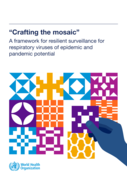
It is impossible to address the many complex needs of respiratory virus surveillance with a single surveillance system. Multiple systems, investigations and studies must each be fit-for-purpose to s
...
pecific priority surveillance objectives, and only together can they provide essential information to policy-makers. In essence, each surveillance approach fit together as “tiles in a mosaic” that provides a complete picture of respiratory viruses and the impact of associated illnesses and interventions at the country level. This mosaic framework demonstrates how surveillance approaches may be implemented as coordinated and collaborative systems, well-matched to specific priority objectives.
more
En 2014, la soixante-septième Assemblée Mondiale de la Santé a exprimé sa préoccupation croissante au sujet de la situation
de la RAM, et elle a exhorté les pays membres à renforcer leurs programmes d’action nationale ainsi que la collaboration
internationale. Dans sa résolution WHA67.25
...
l’Organisation Mondiale de la Santé (OMS) a recommandé que soit développé
un Plan d’Action Mondial pour lutter contre la RAM. Ce Plan a été adopté en mai 2015 et recommande notamment la mise en
place d’un système mondial de surveillance de la RAM (GLASS, Global Antimicrobial Résistance Surveillance System). L’objectif
de GLASS est de permettre la collecte, l’analyse et l’échange avec les pays de données standardisées, validées, comparables
sur la résistance aux antimicrobiens.
more
Antimicrobial resistance (AMR) is impacting our health, economies and development. Up to 5.2 million people may die because of resistant bacterial infections across the Western Pacific Region from 2020-2030. Childbirth, surgery, cancer treatment and other interventions will become impossibly d
...
angerous if bacterial infections no longer respond to available antibiotics.
more
interim guidance, 25 November 2024
Fiche Technique Ebola no.2
Global Health Science and Practice. First published online November 12, 2015
Research Article
BMC Infectious Diseases 2012, 12:262; doi:10.1186/1471-2334-12-262
Основная цель этого Руководства состоит в том, чтобы очертить рамки методов, используемых для оценки распространенности ВИЧ-инфекции среди больных туберкулезом и
...
способствовать осуществле-нию эпиднадзора за ВИЧ-инфекцией.
more
Consolidated Guidelines on person-centred HIV patient monitoring and case surveillance
World Health Organization
(2017)
C_WHO
Guidelines
June 2017
HIV strategic information for impact

Introduction to HIV, AIDS and Sexually Transmitted Infection Surveillance - Overview of the HIV/AIDS Epidemic with an Introduction to Public Health Surveillance
United States Department of Health and Human Services; Centers for Disease Control and Prevention (HHS-CDC); Global AIDS Program (GAP); et al.
United States Department of Health and Human Services; Centers for Disease Control and Prevention (HHS-CDC); Global AIDS Program (GAP); et al.
(2011)
C2
Participant Manual
February 2011
Edition 3.0
Note N°06 du 29.02.2020 relative aux renforcement de la surveillance du Coronavirus COVID-19 au niveau des points d'entree et des etablissements de santé
République Algérienne Démocratique et Populaire; Ministère de la Santé de la population et de la réforme hospitalière; Direction générale de la prevention et de la promotion de la santé
République Algérienne Démocratique et Populaire; Ministère de la Santé de la population et de la réforme hospitalière; Direction générale de la prevention et de la promotion de la santé
(2020)
C2
Accessed: 01.04.2020
Training of Trainer’s (ToT) Manual on Maternal and Perinatal Death Surveillance and Response (MPDSR)
Dr. Md. A. Hasan; Dr. A. Biswas; Dr. A. S. M. Sayem; et al.
Ministry of Health & Family Welfare Government of the Peoples Republic of Bangladesh; World Health Organization (WHO); Unicef; Health Economics Unit; et al.
(2016)
C2
Communicable Diseases: Part 4 Other Diseases of Public Health Importance and Surveillance.
HEAT, UNICEF, Open University, AMREF
Ministry of Health, Federal Democratic Republic of Ethiopia
(2015)
C1
Blended Learning Modulef or the Health Extension Programme
In this study session, you will learn about the general features of faeco-oraldiseases: the main types commonly found in Ethiopia, their general symptomsand signs, how to treat mild cases and when to refer patients with severeconditions for
...
specialised treatment, or laboratory tests to confirm thediagnosis. You will also learn about the importance of giving effective healtheducation to your community on ways to prevent and control faeco-oraldiseases.
more
22 July 2022. This document provides the case definitions for public health surveillance of COVID-19 in humans caused by SARS-COV-2 infection.
Epidemiologischen Bulletin 32/2021, 27 Juli 2021.Systematisches Testen auf SARS-CoV-2 in Kitas und Schulen kann einen wichtigen Beitrag leisten, um das dortige Infektionsgeschehen besser beurteilen zu können und das Übertragungsrisiko von Infektionen zu reduzieren. Die im Epidemiologischen Bulleti
...
n 32/2021 veröffentlichte Studie stellt die Validierung der Lolli-Methode und die Implementierung des Testkonzeptes in 32 Kölner Kitas im Zeitraum September 2020 bis März 2021 vor. Das Testkonzept Lolli-Methode basiert auf der Kombination einer einfachen Probenentnahme und anschließender PCR-Pooltestung. Es wird seit April 2021 an allen Kitas und Schulen der Stadt Köln und seit Mai 2021 an allen Grund- und Förderschulen in Nordrhein-Westfalen durchgeführt.
more
his guidance provides interim guidance for the integration of SARS-CoV-2 and influenza virologic and genomic surveillance, from sentinel site case enrolment and sampling to the eventual sharing of the virus sequence data, a process known as end-to-e
...
nd surveillance. This guidance builds on experiences and lessons learned as countries adapted their influenza surveillance systems in the context of the COVID-19 pandemic and reviews new evidence to provide guidance on end-to-end surveillance. The guidance includes new algorithms and strategies to adapt sentinel systems to make them resilient and agile for addressing global and national surveillance needs for influenza and COVID-19.covid-
more
A review of dengue diagnostics and implications for surveillance and control
Raafat, N.; S. D. Blacksell and R.J. Maude
Transactions of the Royal Society of Tropical Medicine and Hygiene
(2019)
CC
Transactions of the Royal Society of Tropical Medicine and Hygiene vik,113 no.11. Dengue is the world's most common arboviral infection, with almost 4 billion people estimated to be living at risk of dengue infection. A recently introduced vaccine is currently recommended only for seropositive indi
...
viduals in a restricted age range determined by transmission intensity.
more
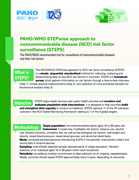
Noncommunicable diseases (NCDs) are responsible for 81% of all deaths in the region of the Americas, of which 34% befall prematurely in people between 30- 69 years old. The burden of theses diseases and their common risk factors jeopardize the health systems to provide adequate management, as well a
...
s to implement customized policies and interventions. The PAHO/WHO STEPwise approach to NCD risk factor surveillance (STEPS) is a simple, sequential, standardized method for collecting, analyzing, and disseminating data on key NCD risk factors in countries in adults from 18 to 69 years old. This survey covers key modifiable risk factors: tobacco use, alcohol use, physical inactivity, and unhealthy diet, as well as key biological risk factors: overweight and obesity, raised blood pressure, raised blood glucose, and abnormal blood lipids. STEPS is a household survey that gathers information on the risk factors through a face-to-face interview (step 1), simple physical measurements (step 2), and collection of urine and blood samples for biochemical analysis (step 3). Every step has a core set of questions, measurements, and expanded sets depending on the countries' needs and interests. It also has optional modules. Implementing STEPS allows the comparability of data within and between countries due to its standardized data collection. It also helps health services plan public health priorities and monitors and evaluates population-wide interventions. It is designed to help countries build and strengthen their capacity to conduct surveillance. STEPS captures 11 of the 25 indicators outlined in the NCD Global Monitoring Framework relating to 7 of the nine global targets.
more

Report of a global meeting on yaws eradication surveillance, monitoring and evaluation: Geneva, 29–30 January 2018. World Health Organization.
This document provides practical guidance on planning and implementing next-generation sequencing (NGS) technology for characterization of Mycobacterium tuberculosis complex (MTBC) bacteria. The aim is to detect mutations associated with drug resistance in the context of a
...
surveillance system for tuberculosis (TB).
more
This publication aims to provide updated guidance on the specific use of yellow fever laboratory assays in the context of surveillance to be used across the Global Yellow Fever Laboratory Network for disease
...
surveillance. In the recent years, new commercial assays became available and are now recommended for use by WHO and this publication will support national program on the use of compound laboratory assays as per the most recent recommended testing algorithms. This piece is aligned with the elimination effort set in the comprehensive global strategy to eliminate yellow fever epidemics (EYE) strategy 2017-2026 and where its advisory laboratory technical working group actively contributed to its development. The target audiences are policy-makers and health workers.
more
Africa CDC Institute of Pathogen Genomics (IPG) was launched in November 2019 and operates under the Division of Laboratory Systems and Networks.
IPG coordinate the implementation of molecular diagnostics, pathogen genomics and bioinformatics in National Public Health Institutions (NPHIs) and/or Re
...
fe-
-rence Laboratories (NRLs) across Africa.
Africa CDC and APHF are coordinating a continental initiative to maximize the benefits of molecular approaches and pathogen genomics for more effective
outbreak preparedness, prevention, response, and for the control and elimination of endemic diseases in Africa. One of Africa CDC’s flagship initiative is the Africa
Pathogen Genomics Initiative (Africa PGI), a partnership that aims to strengthen laboratory systems and enhance genomic surveillance by equipping the continent’s
public health institutions with the tools, training, and data infrastructure.
About the Project
In 2023, 166 outbreaks and public health events were reported in Africa. This calls for a resilient laboratory systems for timely detection and reporting of current and future outbreaks. This project aims to scale up molecular diagnostic and genomic sequencing-based detection and characterization of outbreaks.
Africa CDC is working with Member States to develop guidance, diagnostic algorithm, training and capacity building to enable outbreak detection, and reporting to inform public health response.
more
Since 1995, WHO has ensured a consistent approach to national, regional and global TB surveillance by providing standardized definitions, forms and registers for the recording and reporting of individual-level and aggregated data about people diagno
...
sed with and treated for TB, which are used worldwide. This standardization has facilitated the regular reporting of TB data to WHO from 215 countries and areas in annual rounds of global TB data collection, with findings published in an annual WHO global TB report since 1997 and data made publicly available via the online WHO global TB database.
more

Driving towards malaria elimination in Botswana by 2018: progress on case-based surveillance, 2013–2014
M. Motlaleng, J. Edwards, J. Namboze, et al.
The International Union Against Tuberculosis and Lung Disease
(2018)
PHA 2018; 8(S1): S24–S28
© 2018 The Union

Introduction to HIV, AIDS and STI Surveillance - HIV Clinical Staging and Case Reporting
United States Department of Health and Human Services; Centers for Disease Control and Prevention (HHS-CDC); Global AIDS Program (GAP); et al.
United States Department of Health and Human Services; Centers for Disease Control and Prevention (HHS-CDC); Global AIDS Program (GAP); et al.
(2009)
C2
Participant Manual September 2009
Antimalarial drug resistance has emerged as a threat to global malaria control efforts, particularly in the Greater Mekong subregion. Drawing on data collected through more than 1000 therapeutic efficacy studies as well as molecular marker studies of Plasmodium falciparum drug resistance, the Report
...
on antimalarial drug efficacy, resistance and response: 10 years of surveillance (2010–2019) presents a decade’s worth of data on drug efficacy and surveillance, as well as recommendations to monitor and protect the efficacy of malaria treatment in the decades to come.
more
Health ministries currently lack effective tools for monitoring and evaluation of schistosomiasis control programmes. Egg detection can be used, but the cost, challenges of obtaining samples, and the need for trained personnel and equipment limit the frequency of monitoring. The purpose of this TPP
...
is to guide the development of new diagnostic tools to reliably measure when prevalence is above or below a cut-off of 10% in school-aged children. Communities remaining above 10% require annual MDA, while communities below 10% can reduce MDA frequency as long as < 10% prevalence can be maintained. However, the lack of a reliable test has hindered the development of maintenance strategies. The test is also needed to track changes of prevalence > 10% to ensure that annual MDA is reducing overall prevalence.
more
OBJETIVO DE LA GUÍA
Describir los lineamientos técnicos de la vigilancia de tuberculosis por el laboratorio, así como los
procesos de obtención, recolección, procesamiento, transporte y conservación de muestras, y las
funciones que se realizan y articulan por todos los integra
...
ntes de la Red Nacional de Laboratorios.
more
Pour les établissements de santé généraux en Afrique de l'Ouest
Childhood multidrug-resistant tuberculosis in the European Union and European Economic Area: an analysis of tuberculosis surveillance data from 2007 to 2015
C. Ködmön; M. van den Boom; P. Zucs, et al.
European Centre for Disease Prevention and Control
(2017)
CC
15. Euro Surveill. 2017;22(47):pii=17-00103
Ethics in epidemics, emergencies and disasters: Research, surveillance and patient care
Global Health Training Centre
(2009)
This seven module course offers comprehensive training exploring the wide range of ethical issues faced by health professionals and policy makers working in the context of epidemics/pandemics and disaster situations, focusing primarily on the key areas of research,
...
surveillance and patient care. This free to access course aims to provide clear background knowledge of the key subject areas and uses case studies as an effective way to explore the topics via realistic scenarios.
more
Note n° 04 du 20.02.2020 relative à la mise à jour des des définitions et des modalités de surveillance, détection, notification et conduite à tenir devant un cas suspect ou confirmé d'infection...
République Algérienne Démocratique et Populaire; Ministère de la Santé de la population et de la réforme hospitalière; Direction générale de la prevention et de la promotion de la santé
République Algérienne Démocratique et Populaire; Ministère de la Santé de la population et de la réforme hospitalière; Direction générale de la prevention et de la promotion de la santé
(2020)
C2
Accessed: 01.04.2020
Note n° 04 du 20.02.2020 relative à la mise à jour des des définitions et des modalités de surveillance, détection, notification et conduite à tenir devant un cas suspect ou confirmé d'infection par le nouveau coronavir
...
us COVID-19.
more
Due to the particular Amazonian situation of vectorial transmission based mostly on the wild cycle of Trypanosoma cruzi with diversity of triatomine vectors involved in effective transmission, and the variety of eco-epidemiological situations that facilitate such transmission, the countries of the A
...
mazon agreed that the development and strengthening of preventive actions based on comprehensive surveillance and detection of effective vectorial transmission, based on mandatory notification of acute or chronic cases, was required. In addition, it was recommended that surveillance and prevention and/or vector control actioDue to the particular Amazonian situation of vectorial transmission based mostly on the wild cycle of Trypanosoma cruzi with diversity of triatomine vectors involved in effective transmission, and the variety of eco-epidemiological situations that facilitate such transmission, the countries of the Amazon agreed that the development and strengthening of preventive actions based on comprehensive surveillance and detection of effective vectorial transmission, based on mandatory notification of acute or chronic cases, was required.
more

Guidance on COVID-19 - Guidance for General Practitioners (GPs) Related to Self-Isolation of Patients with Respiratory Tract Infection in the Context of COVID-19
Health Protection Surveillance Centre (HSE); hpsc
Health Protection Surveillance Centre (HSE); hpsc
(2020)
C2
v3.0 19.03.2020
COVID-19 National Result Notification and Contact Management Programme (CMP)
Health Protection Surveillance Centre (HSE); hpsc
Health Protection Surveillance Centre (HSE); hpsc
(2020)
C2
V3 20th March 2020
Management of a close contact of a confirmed case of covid-19
Health Protection Surveillance Centre (HSE); hpsc
Health Protection Surveillance Centre (HSE); hpsc
(2020)
C2
Version 2 20.03.2020
Preliminary Guidance on Minimising Risk of Transmission of Respiratory Virus in GP Practice
Health Protection Surveillance Centre (HSE); hpsc
Health Protection Surveillance Centre (HSE); hpsc
(2020)
C2
v1.0, 10.03.2020

Advice for General Practitioners in relation to assessment and management of patients with suspected Novel Coronavirus infection
Health Protection Surveillance Centre (HSE); hpsc
Health Protection Surveillance Centre (HSE); hpsc
(2020)
C2
v1.0, 28.01.2020
Assessment and management of patients presenting to General Practitioner with possible 2019 novel Coronavirus (2019 nCoV), Middle East Respiratory Syndrome Coronavirus (MERS CoV) or Avian Influenza us
Health Protection Surveillance Centre (HSE); hpsc
Health Protection Surveillance Centre (HSE); hpsc
(2020)
C2
5/2/2020 Version 1.0

Rabies is a fatal viral disease, but is preventable in humans. The rabies virus is transmitted to humans through virus-laden saliva from a rabid animal, mostly dogs. The virus is shed in the saliva of an infected animal and can be introduced into another body through bites, scratches and any other
...
wounds that transect the skin. Contact of the infected saliva with mucous membranes is also thought to be a possible route of infection, whereas contact of infected saliva with intact skin is not considered an exposure. Rabies is preventable through pre-exposure prophylaxis (PrEP) for individuals at high and continual risk, and post-exposure prophylaxis (PEP).
more
Capturing the evidence on access to essential antibiotics in refugee and migrant populations
WHO TEAM Health and migration programme, Surveillance, Prevention and Control
World Health Organization WHO
(2022)
C_WHO
The GEHM series is an evidence-informed normative product of the WHO
Health and Migration Programme to inform policy-makers on migrationrelated public health priorities. These reviews aim to respond to policy questions identified as priorities by summarizing the best available evidence worldwide an
...
d proposing policy considerations. By addressing data gaps on the health status of refugees and migrants, the GEHM series aims to support evidenceinformed policy-making and targeted interventions that are impactful and make a difference in the lives of these populations.
This Report, the fourth in the GEHM series reviews the available evidence on barriers to antibiotic access and appropriate use in refugees and migrants. It finds that the available evidence on refugees’ and migrants’ access to and use of antibiotics is scarce and is largely constrained to high-income contexts.
more
Mise en oeuvre de l’alerte précoce et réponse notamment la surveillance fondée sur les évènements
The main objectives of the training module
- facilitate communication and understanding between the two disciplines of epidemiology and laboratory (medicine) for disease surveillance and outbreak investigation;
- provide the field epidemiolog
...
ist with a better understanding of basic microbiology techniques and analysis and interpretation of results;
- convey the laboratory perspective of public health investigations to field epidemiologists in order to improve collaboration between these two disciplines and to enhance.
more
The number of confirmed COVID-19 cases detected and reported in each country is influenced by
many factors including limited access and/or utilization of healthcare and COVID-19 testing, limited
surveillance, lack of knowledge amongst the populati
...
on about when to seek testing, an asymptomatic presentation, and other unknown issues. This is true in all countries of the world, and not Africa specific, however there are factors unique to Africa which may also affect the way the virus behaves there. COVID-19 prevalence data are critical for planning effective mitigation strategies and understandingthe true impact of the disease and relevant intervention measures in Africa, which might be quite different from regions with a different population age distribution or risk factor profile.
more
Эпидемиологический надзор за COVID-19
recommended
16 December 2020. This document summarizes current WHO guidance for public health surveillance of coronavirus disease 2019 (COVID-19) in humans caused by infection with severe acute respiratory syndrome coronavirus 2 (SARS-CoV-2) (hereafter referred
...
to as COVID19 surveillance).
more
orientaciones provisionales, 8 de noviembre de 2020
This interim guidance is most useful for countries interested in monitoring relative circulations of influenza and SARS-CoV-2 viruses. The document provides practical information to maintain surveillance
...
of influenza and monitor SARS-CoV-2 using existing surveillance systems. It contains updated considerations for addressing disruptions in the influenza sentinel surveillance and extending to include COVID-19 wherever possible. Updated algorithms for testing of both influenza and SARS-CoV-2 for surveillance are also included. This document is an update of Operational considerations for COVID-19 surveillance using GISRS and GISRS for the upcoming influenza seasons during the COVID-19 pandemic
more
This document summarizes current WHO guidance for public health surveillance of coronavirus disease 2019 (COVID-19) in humans caused by infection with severe acute respiratory syndrome coronavirus 2 (SARS-CoV-2).
New elements include:
upda
...
te of contact definitions, in line with latest contact tracing guidance
update of detection strategies in line with updated version of WHO SARS-CoV-2 testing guidance
reinfection evidence standardization and surveillance: molecular, genomic and immunological evidence of reinfection
inclusion of clinical case definition of Post COVID-19 condition as defined by WHO
definition of breakthrough infection
more
Surveillance Report
HIV testing and counselling in Estonian prisons, 2012 to 2013: aims, processes and impacts
The Estonian Ministry of Justice; Prison Department; Rehabilitation Division
European Centre for Disease Prevention and Control
(2014)
CC
Euro Surveillance 2014;19(47):pii=20970, p.31-37
Strengthening surveillance for Variant of Concern (VOC) Omicron (B.1.1.529): technical brief and priority actions for member states World Health Organization Headquarters, 28 November 2021
2nd Generation HIV Surveillance in Pakistan, Round 5
The Overall objective of this mapping study was to update population size estimates of selected key populations (PWID, FSWs, MSM & TGs) to create evidence for developing action plans for HIV ... prevention interventions in Pakistan. A total number of 23 cities/towns were selected for Mapping. This included 13 cities in Punjab province, 6 in Sindh Province and 2 cities each in KPK and Baluchistan provinces.
large file: 70,5 MB The preview/download includes only the pages 1 to 23. more
The Overall objective of this mapping study was to update population size estimates of selected key populations (PWID, FSWs, MSM & TGs) to create evidence for developing action plans for HIV ... prevention interventions in Pakistan. A total number of 23 cities/towns were selected for Mapping. This included 13 cities in Punjab province, 6 in Sindh Province and 2 cities each in KPK and Baluchistan provinces.
large file: 70,5 MB The preview/download includes only the pages 1 to 23. more
Antimicrobial Resistance Surveillance and Research Network | This document contains detail procedures on sample collection, transport, isolation, identification of fungi for the diagnosis of invasive fungal infections and antifungal susceptibility t
...
esting of yeast
more

Antimicrobial Resistance Surveillance and Research Network | This manual describes well accepted methods to carry out drug susceptibility testing on important gram positive and gram negative clinically relevant bacteria. Methods of specimen collecti
...
on, transport, culture, anti-microbial drug susceptibility testing (common, special phenotypic and
molecular techniques) as well as quality control and quality assurance have been described in a concise manner.
more
Actualisées dans « La surveillance de la santé publique dans le contexte de la COVID-19 », publié le 16 décembre 2020
Public Health Surveillance Protocol Tuberculosis
Manual for Death Surveillance in the Context of Pediatric Multisystemic Inflammatory Syndrome (SIM-P) Associated with Covid-19. Publication updated on 24/09/2021
Covid-19 Epidemiological Surveillance Guide: Public Health Emergency of National Importance for Coronavirus Disease 2019 - version 4
ECDC proposed case definition for surveillance of Zika virus infection
Integrated HIV Behavioral and Serologic Surveillance
Contents
305 Dracunculiasis eradication: global surveillance summary, 2017
The publication conveys the most recent quantitative surveillance results focusing on noncommunicable disease (NCDs)-related risk behaviours among adults from the WHO STEPwise approach to NCD risk factor s
...
urveillance (STEPS) and tobacco use among adults from the Global Adult Tobacco Survey (GATS) in Member States of the WHO South-East Asia Region. This publication contains selected indicators relating to tobacco use and other related risk behaviours of adults in Member States of the WHO South-East Asia Region. The tobacco indicators are taken from GATS or STEPS and other indicators relating to risk behaviours (history– dietary behaviours, physical activity, alcohol use, cervical cancer screening; physical measurements – body mass index, blood pressure, waist circumference; biochemical measurements – fasting blood glucose level, blood glucose level 2 hours after glucose load, total blood cholesterol, urine sodium and urine creatinine) are taken from STEPS. The latest findings from surveys conducted in Member States are presented in the publication.
more
The publication conveys the quantitative surveillance results focusing on tobacco use and noncommunicable disease (NCD) related behaviours among youth (13–15 years) in Member States of the WHO South-East Asia Region, namely, the Global School-base
...
d Student Health Survey (GSHS) and the Global Youth Tobacco Survey (GYTS). This publication contains selected indicators relating to tobacco use and other related risk behaviours of youth (aged 13–15 years) in Member States of the WHO South-East Asia Region. The tobacco indicators are mainly taken from GYTS and other indicators relating to risk behaviours (dietary behaviours, physical activity, alcohol use, drug use, mental health, violence and unintentional injury, sexual behaviours, protective factors and hygiene) are taken from GSHS. The latest findings from surveys conducted in Member States are presented in the publication.
more
Adapting and implementing new recommendations on HIV patient monitoring
World Health Organization
(2017)
C_WHO
Technical Brief
HIV patient monitoring and case surveillance
WHO/HIV/2017.12
Временные рекомендации
17 января 2020 г.
Цель настоящего документа – предоставить временные рекомендации лабораториям и субъектам, занятым в работах по лаборатор
...
ному тестированию пациентов в случаях, соответствующих определению подозрительных на пневмонию, ассоциированную с новым коронавирусом, выявленным в Ухане, Китай (см. Surveillance case definitions for human infection with novel coronavirus, Interim guidance (Эпиднадзор за случаями инфекции человека, вызванной новым коронавирусом, временные рекомендации (на английском языке)).
more
Public Health Risk Analysis and Surveillance
Public Health Surveillance Protocol Tuberculosis
This interactive map shows polio cases and disease surveillance indicators worldwide within the desired timeframe and available data, as well as environmental samples in endemic countries.
Find out the latest information on polio this week.
Epi Info™ is a public domain suite of interoperable software tools designed for the global community of public health practitioners and researchers. It provides for easy data entry form and database construction, a customized data entry experience, and data analyses with epidemiologic statistics,
...
maps, and graphs for public health professionals who may lack an information technology background. Epi Info™ is used for outbreak investigations; for developing small to mid-sized disease surveillance systems; as analysis, visualization, and reporting (AVR) components of larger systems; and in the continuing education in the science of epidemiology and public health analytic methods at schools of public health around the world.
more
The Ministry of Health conducted STEPS surveys on adult risk factors surveillance in Myanmar in 2003, 2009 and 2014. Amongst these three surveys, the 2014 one is the most comprehensive, providing an analysis of all States and Regions within Myanmar
...
through not only questionnaires and physical measurements – STEPs 1 and 2 of the survey – but also with data obtained through biochemical measurements (STEP 3).
The STEPS survey was initiated by the Ministry of Health in December 2014 with the technical support of WHO Headquarters, regional and country offices. more
The STEPS survey was initiated by the Ministry of Health in December 2014 with the technical support of WHO Headquarters, regional and country offices. more
Guidelines on Estimating the Size of Populations Most at Risk to HIV
UNAIDS; World Health Organization
(2010)
C_WHO
UNAIDS/WHO Working Group on Global HIV/AIDS and STI Surveillance
Monitoring HIV impact using population-based surveys
UNAIDS (Joint United Nations Programme on HIVAIDS); World Health Organization (WHO)
UNAIDS (Joint United Nations Programme on HIVAIDS); World Health Organization (WHO)
(2015)
C2
UNAIDS/WHO Working group
HIV/AIDS and STI surveillance 2015 / Reference
