
Filter
163
Text search:
Geburtshilfe
Featured
24
27
Language
Document type
60
59
16
7
6
5
3
3
2
2
Countries / Regions
16
6
2
2
1
1
1
1
1
1
1
1
1
Authors & Publishers
Publication Years
Category
125
64
13
5
4
2
1
Toolboxes
24
22
4
2
2
1
1
1
1
1
1
L’hémorragie du post-partum (HPP) est communément définie comme une perte
sanguine d’au moins 500 ml survenant dans les 24 heures qui suivent l’accouchement.
Elle est la première cause de mortalité maternelle dans les pays à revenu faible
et la cause principale de près d’un décès
...
Implications and Actions
Web annex 6: Injectable prostaglandins versus
placebo or no treatment
Evidence to Decision Framework
Web annex 5: Oxytocin and ergometrine versus placebo or no treatment
Evidence to decision framework
The recommendation in this document thus supersedes the previous WHO recommendation for the prevention of PPH as published in the 2012 guideline, WHO recommendations for the prevention and treatment of postpartum haemorrhage.
Web annex 2: Carbetocin versus placebo or no treatment
Evidence to decision framework
The recommendation in this document thus supersedes the previous WHO recommendation for the prevention of PPH as published in the 2012 guideline
The recommendation in this document thus supersedes the previous WHO recommendation for the prevention of PPH as published in the 2012 guideline, WHO recommendations for the prevention and treatment of postpartum haemorrhage.
WHO labour care guide: user’s manual
recommended
The WHO Labour Care Guide is a tool that aims to support good-quality, evidence-based, respectful care during labour and childbirth, irrespective of the setting or level of health care. This manual has been developed to help skilled health personnel to successfully use the WHO Labour Care Guide. The
...
The ISUOG President and Board of Trustees express their sympathy, encouragement and support towards all health professionals fighting the COVID-19 virus. A free webinar series and other clinical resources have been made available to provide learning opportunities and practical guidance for Ob/Gyn an
...
Pharmaceutical regulators are at the forefront of ensuring that only safe and effective medicines are authorized and available in the market. This document builds on the recommendations in the above publication and has been prepared to specifically assist national medicines regulatory authorities to
...
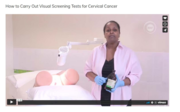
This film explains the importance of simple screening tests to identify cervical cancer. It shows how to carry out two visual inspection tests – they are called – Visual Inspection with Acetic Acid (or VIA) and Visual Inspection with Lugol’s Iodine (or VILI).
This film is for use in skilled h
...
A Book for Midwives > Chapter 20: The Pelvic Exam: how to examine a woman's vagina and womb > Cancer of the cervix
Where Women Have No Doctor > Chapter 24: Cancer and Growths > Problems of the Breasts

WHO recommendations on maternal and newborn care for a positive postnatal experience. Presentation
recommended
This guideline aims to improve the quality of essential, routine postnatal care for women and newborns with the ultimate goal of improving maternal and newborn health and well-being. It recognizes a “positive postnatal experience” as a significant end point for all women giving birth and their n
...
This recommendation is an update of one of the 49 recommendations that were published in the WHO recommendations on antenatal care for a positive pregnancy experience. The recommendation was developed initially using the standardized operating procedures described in the WHO handbook for guideline d
...
This guideline aims to improve the quality of essential, routine postnatal care for women and newborns with the ultimate goal of improving maternal and newborn health and well-being. It recognizes a “positive postnatal experience” as a significant end point for all women giving birth and their n
...
