
Filter
1326
Text search:
resource
platforms
Featured
109
365
Language
Document type
586
268
180
113
93
32
22
15
10
3
2
2
Countries
76
54
48
36
33
31
24
23
20
20
18
18
18
17
17
17
16
15
14
13
13
12
12
12
11
11
10
9
9
8
8
7
7
7
7
6
6
6
6
5
5
5
5
5
5
5
5
4
4
4
4
4
3
3
3
3
3
3
3
2
2
2
2
2
2
2
2
2
2
2
2
2
2
1
1
1
1
1
1
1
1
1
1
1
1
1
1
1
1
1
1
1
1
1
1
1
1
Authors & Publishers
Publication Years
Category
445
87
79
67
64
24
21
4
1
1
Toolboxes
204
116
83
64
60
47
41
40
35
32
28
27
23
22
21
18
18
12
10
7
5
1
1
1

The Republic of the Union of Myanmar is at a historic moment, with a new civilian government assuming power in 2016. The country graduated to lower-middle-income status in 2015, and has made significant progress in reducing poverty, improving food security and addressing malnutrition.
The remai ...
The remai ...
Background Paper prepared for the 2015 Global Assessment Report on Disaster Risk Reduction
The aim of this paper is to help bring voluntary standards into the toolbox of disaster risk reduction, including both by encouraging their use by business and by enhancing their role in legislation and ...
The aim of this paper is to help bring voluntary standards into the toolbox of disaster risk reduction, including both by encouraging their use by business and by enhancing their role in legislation and ...

The guide book provides a set of tools and methods to assess existing structures and capacities of national, district and local institutions with responsibilities for Disaster Risk Management (DRM) in order to improve their effectiveness and the integration of DRM concerns into development planning,
...

In April and May 2015, Nepal was hit by two major earthquakes killing around 9,000 people and leaving many thousands more injured and homeless.
To optimize the speed and volume of critical humanitarian assistance, the HCT has developed this Plan to:
1. Reach a common understanding of earth ...
To optimize the speed and volume of critical humanitarian assistance, the HCT has developed this Plan to:
1. Reach a common understanding of earth ...
Planning and Implementation Training. Myanmar
This training module on resilient development planning in Myanmar consists of a 2.5 hours session, at the end of which, the participants will:
a) Have a common understanding on development and disaster linkages.
b) Be able to identify the ...
This training module on resilient development planning in Myanmar consists of a 2.5 hours session, at the end of which, the participants will:
a) Have a common understanding on development and disaster linkages.
b) Be able to identify the ...
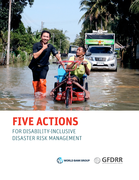
A recent survey of the literature and experience identified five broad actions that development institutions and governments, as well as their partners and stakeholders, can take to improve disability-inclusive disaster risk management. Those five actions are:
- Include persons with disabilitie ...
- Include persons with disabilitie ...

Asia-Pacific Disaster Report 2017
The report looks at the extent and impact of natural disasters across the region and how these intersect with poverty, inequality and the effects of violent conflict. But it also shows how scientific and other advances have increased the potential for building di ...
The report looks at the extent and impact of natural disasters across the region and how these intersect with poverty, inequality and the effects of violent conflict. But it also shows how scientific and other advances have increased the potential for building di ...
Lack of satisfactory progress in mainstreaming disaster risk reduction within development is attributed to various factors. One of the important factor that is often not much appreciated is the inadequate comprehension of mainstreaming and the absence of clear, cogent and practical guidelines, tools
...

Africa CDC Non Communicable Diseases, Injuries Prevention and Control and Mental Health Promotion Strategy
recommended
Non-communicable diseases (NCDs) & injuries and mental health conditions constitute a serious impediment to achieving the vision of Agenda 2063 to build an integrated, prosperous, and peaceful Africa driven by its own citizens. Each year, these conditions cause millions of premature deaths and disab
...

With the goal of ending viral hepatitis as a public health threat by 2030, the Regional Action Plan will provide an actionable framework for implementing evidence-based interventions at scale. It will be informed through strategic monitoring of the response, that must be equitable and sustainable an
...
The primary audience for the guideline is policy makers and health programme managers of MNCH and immunization programmes in ministries of health where decisions are made and policies created on the use and implementation of homebased records.
The guideline is also aimed at health providers who use
...

Inequality of access to palliative care and symptom relief is one of the greatest disparities in global health care (1). Currently, there is avoidable suffering on a massive scale due to lack of access to palliative care and symptom relief in low- and middle-income countries (LMICs) (1). Yet basic p
...

People younger than 20 years comprise 35% of the global population and 40% of the global population of least-developed nations. The number of children - neonates, infants, children, and adolescents up to 19 years of age - who need pediatric palliative care (PPC) each year may be as high as 21 millio
...

Rehabilitation in health systems provides recommendations for Member States and other relevant stakeholders to strengthen and expand the availability of quality rehabilitation services. Currently, there is a significant unmet need for rehabilitation services and it is frequently undervalued in the h
...
"This is the final report of the six-year collaboration between the WHO Department of Mental Health and Substance Abuse and the Gulbenkian Global Mental Health Platform, an initiative of the Calouste Gulbenkian Foundation aimed at reducing the global burden of mental health through the development a
...
Risk Communication and Community Engagement (RCCE) is an essential part of any disease outbreak response. Risk communication in the context of an Ebola outbreak refers to real time exchange of information, opinion and advice between frontline responders and people who are faced with the threat of Eb
...
