
Filter
1556
Text search:
vital
signs
Featured
195
408
Language
Document type
928
230
187
105
38
35
19
6
4
2
2
Countries
92
68
55
46
41
40
39
36
33
32
30
30
28
24
22
22
20
20
19
17
16
15
15
13
13
11
11
9
8
8
8
8
7
7
7
7
6
6
6
6
6
5
5
5
5
5
5
4
4
4
4
4
4
4
4
3
3
3
3
3
3
2
2
2
2
2
2
2
2
2
2
2
1
1
1
1
1
1
1
1
1
1
1
1
1
1
1
1
1
1
1
1
1
1
1
1
1
1
1
1
1
Authors & Publishers
Publication Years
Category
609
199
108
88
49
45
10
1
Toolboxes
128
110
77
75
70
60
54
49
48
36
34
28
26
25
22
14
14
12
9
9
9
8
7
A Trainings Curriculum
The Core Set of Indicators and respective Indicator Data Sheets aim to pave the way towards a common understanding, greater consistency and comparability across countries and alignment of results chains of German Development Cooperation in the field of health and social health protection with the in
...
Joint WHO/ILO guidelines on post-exposure prophylaxis (PEP) to prevent HIV infection.
Accessed April 2014
Over the past 50 years, dengue has spread from nine to over a hundred countries, making it the most rapidly spreading vector-borne disease. Yet, dengue continues to have a low profile among policy-makers and donors and does not receive the media attention it deserves. While there is no vaccine or cu
...
With this World Health Day, WHO is drawing attention to a group of diseases that are spread by insects and other vectors, the heavy health and economic burdens they impose, and what needs to be done to reduce these burdens. Many of these diseases have been historically confined to distinct geographi
...
In the context of the Support to National Malaria Control Programme (SuNMaP), demand creation is the strategic combination of advocacy, communication and mobilisation approaches that seek to achieve increased community awareness of, and demand for, effective malaria prevention and treatment services
...
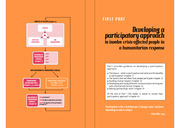
The Participation Handbook for humanitarian field workers contains detailed practical advice on the participation of affected people in humanitarian action. It has three sections:
Developing a participatory approach (main issues, key factors, building mutual respect, communication methods and
...
Available in: English, French, Chinese, Spanish, Russian, Arabic, Thai, Korean, Tajik, Vietnamese, Uzbek
http://www.who.int/disabilities/cbr/guidelines/en/
This guide supports the low-dose, high-frequency practice of scenerios needed to maintain competency in prevention and management of postpartum hemorrhage. The document is learner centered and is directly linked to service delivery standards. It is part of the Helping Mothers Survive Bleeding After
...
The guidelines acknowledge that overcrowding, unhygienic conditions and high inmate turn over contribute to the spread of infectious diseases within correctional facilities. The document states that voluntary HIV counselling and testing must be offered to all inmates when they enter facilities, duri
...
This report sets out ways to make pre-hospital care and ambulance services operating in areas of armed violence safer. Written by the Norwegian Red Cross with support from the ICRC and the Mexican Red Cross, the report summarizes field experience in over 20 countries.
The publication of the Second Edition of the Emergency Drug Guidelines represents the culmination of the efforts of the National Drugs and Therapeutics Committee (NDTC) to publish clinical drug guidelines for common diseases seen in Fiji. These guidelines are targeted for health care professionals w
...
As knowledge on Ebola-related safety measures accumulates, this guidance is provisional. This guide focuses on psychological first aid, which involves humane, supportive and practical help to follow human beings suffering serious crisis events. The guidance has been written for people who help othe
...
Guidelines for planning and provision of pastoral and social support services
