Filter
1261
Text search:
weather
Featured
106
365
Language
Document type
617
325
91
84
46
35
24
20
10
5
3
1
Countries
83
62
46
33
26
25
23
23
17
16
16
15
15
14
13
12
11
11
11
11
11
11
10
10
10
10
10
9
9
9
8
8
8
8
8
7
7
6
6
6
6
6
5
5
5
4
4
4
4
4
3
3
3
3
3
3
3
3
3
3
2
2
2
2
2
2
2
2
2
2
2
2
2
1
1
1
1
1
1
1
1
1
1
1
1
1
1
1
1
1
1
1
1
1
1
1
1
1
1
1
1
Authors & Publishers
Publication Years
Category
440
114
64
37
36
26
6
2
Toolboxes
260
101
66
66
58
57
45
32
29
22
20
18
16
14
14
13
11
10
9
8
6
5
3
3
2
"This Code provides practical guidance on how to manage health and safety risks associated with hazardous
chemicals for persons conducting a business or undertaking who use chemicals in their workplace."

This guide is intended to assist
state, local, and tribal public health
professionals in the initiation of
response activities during the
first 24 hours of an emergency
or disaster. It should be used in
conjunction with existin
...
"The handbook is intended for use by the first responders
of the emergency services from the moment they
receive an alarm up to the first 30 minutes on scene at
an incident.
The handbook is envisaged to function as a checklist
and decision-support for personnel with existing knowledge
of emerg
...
Project on Minimum Standards and Non-Binding Guidelines for First Responders Regarding Planning, Training, Procedure and Equipment for Chemical, Biological, Radiological and Nuclear (CBRN) Incidents

Reducing the humanitarian impact of the use of explosive weapons in populated areas is a key priority for the United
Nations, the International Committee of the Red Cross (ICRC), civil society and an increasing number of Member States.
The United Nations Secretary-General has expressly called on
...
Key Features:
• Module Users: Disaster Management Trainers
• Training Targets: State Government and District
officials / Disaster Management Authorities / Disaster
Management Planners and Responders
• Training Duration: 5 working days (one week)
• Trainers Input: Multi-disciplinary
â€
...
"National Disaster Management Guidelines: Management
of Chemical (Terrorism) Disasters (are intended to
focus on all aspects of the disaster management
cycle, including prevention measures such as
surveillance and intelligence, mitigation of direct
and indirect risks, preparedness in terms of
...

The roundtable provided a forum that allowed communicators across a number of Federal agencies to share information, strategies, and challenges in developing and providing communication messages and materials to the public in preparation for, and in response to, a radiation
...
States, the United Nations and civil society organisations continue to raise concerns about the humanitarian impact caused by the use of explosive weapons in populated areas (EWIPA). This issue is currently being examined from political, legal, socio-economic and humanitarian perspectives. The GICHD
...
The report covers: drivers of humanitarian crises in the region, particularly the intensification of violence in the DRC; manifestations of humanitarian needs, including record levels of displacement and food insecurity; and constraints to meeting humanitarian needs, including obstacles to humanitar
...
2nd edition
WASH FIT is a risk-based, continuous improvement framework with a set of tools for undertaking water, sanitation and hygiene (WASH) improvements as part of wider quality improvements in health care facilities. It is aimed at small primary, and in some instances secondary, health care fa
...

The purpose of the WHO Manual for the Public Health Management of Chemical Incidents is to provide a comprehensive overview of the principles and roles of public health in the management of chemical incidents and emergencies. While this information is provided for each phase of the emergency cycle,
...
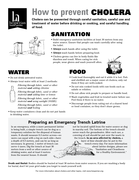
The Cholera Fact Sheet is available in English, Spanish, Arabic, French, and Haitian Kreyol. This heavily-illustrated, easy-to-read handout provides information for preventing, diagnosing and treating cholera with limited resources. It offers instructions for purifying drinking water and prepari
...
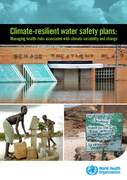
Long-term planning for an adequate and safe supply of drinking-water should be set in the context of growing external uncertainties arising from changes in the climate and environment. The water safety plan (WSP) process offers a systematic framework to manage these risks by considering the implica
...

The training manual consists of: (i) Tools for communication, reassurance and comfort for staff working directly with distressed children; (ii) Advice and guidance for staff working with parents and primary care-givers; (iii) Suggestions for ways to support a distressed child. It provides a non-i
...
Staying safe in spite of a disaster. What can you do for your safety in the event of a disaster?
In spring 2013, after weeks of rain, whole areas of southern, eastern and northern Germany were beset by catastrophic floods. Settlements vanished in th
...
Pan African Medical Journal 2017;27:215. doi: 10.11604/pamj.2017.27.215.12994
Background paper prepared for the Education for All Global Monitoring Report 2012
Reports from Kenya, Sierra Leone, China and Sri Lanka