Filter
940
Filtered Results: 940
Text search:
Ministry
of
Health
(The
Republic
of
Uganda)
Featured
Recommendations
89
New Publications
298
Language
Document type
No document type
573
Studies & Reports
196
Guidelines
76
Strategic & Response Plan
41
Manuals
29
Situation Updates
11
Fact sheets
5
Training Material
4
Infographics
3
Brochures
1
App
1
Countries / Regions
Uganda
145
Kenya
47
Global
46
Rwanda
39
Africa
37
Congo, Democratic Republic of
36
South Sudan
31
Ethiopia
28
Liberia
24
Sierra Leone
22
Tanzania
20
Zambia
19
East and Southern Africa
14
Nigeria
13
Malawi
12
Guinea
11
South Africa
10
Ghana
8
Namibia
8
West and Central Africa
8
Cameroon
7
Mozambique
7
Zimbabwe
6
Central African Republic
6
Latin America and the Carribbean
6
India
5
Bangladesh
5
Burundi
5
Western and Central Europe
5
Senegal
4
Somalia
4
Syria
4
Sudan
4
Botswana
4
Nepal
3
Jordan
3
Afghanistan
3
Lebanon
3
Colombia
3
Angola
3
Lesotho
3
Burkina Faso
2
Mali
2
Côte d’Ivoire / Ivory Coast
2
Togo
2
Philippines
2
Pakistan
2
Iraq
2
Germany
2
Chad
2
Cambodia
2
Indonesia
2
Peru
2
Eswatini/ Swaziland
2
Brazil
2
Madagascar
2
Myanmar / Burma
2
Yemen
2
Eastern Europe and Central Asia
2
Southern Africa
2
Iran
2
Vietnam
2
Morocco
1
Saudi Arabia
1
Haiti
1
Egypt
1
Thailand
1
Papua New Guinea
1
Benin
1
Vanuatu
1
Argentina
1
Ukraine
1
Ecuador
1
Bolivia
1
Greece
1
Chile
1
Middle East and North Africa
1
South–East Asia Region
1
Western Pacific Region
1
Solomon Islands
1
Venezuela
1
North Korea
1
Albania
1
Djibouti
1
Laos
1
Russia
1
Georgia
1
North America
1
Gabon
1
Mauritius
1
Tunisia
1
Authors & Publishers
Publication Years
Category
Countries
351
Clinical Guidelines
60
Women & Child Health
57
Public Health
53
Key Resources
44
Capacity Building
11
Pharmacy & Technologies
8
Annual Report MEDBOX
1
Toolboxes
HIV
115
Ebola
63
COVID-19
57
Mental Health
51
TB
49
Rapid Response
42
Disability
34
Conflict
27
Planetary Health
27
NTDs
27
Caregiver
26
AMR
22
Refugee
17
Global Health Education
16
Pharmacy
12
Zika
10
NCDs
8
Health Financing Toolbox
6
Cholera
4
Natural Hazards
4
Polio
2
South Sudan
2
Specific Hazards
2
Social Ethics
2
Learning from the Use of Data, Information, and Digital Technologies in the West Africa Ebola Outbreak Response
Global UNIDO Project: Strengthening the local production of essential medicines in least developed and developing countries
Every five minutes a child dies as the result of violence, according to a ground-breaking report from Unicef UK. The report reveals that ... vast majority of children are killed outside warzones and that physical, sexual and emotional abuse is widespread with millions of children unsafe in their homes, schools and communities. Some 345 children could die from violence each day in the next year, unless governments act.
The report also finds that:
(1) Children who are victims of violence have brain activity similar to soldiers exposed to combat;
(2) A third of children who are victims of violence are likely to develop long-lasting symptoms of post-traumatic stress disorder;
(3) Those living in poverty are more likely to be victims of violence, wherever they live in the world;
(4) Over 7% of child deaths due to violence each day are the result of interpersonal violence, rather than conflict.
For close to 15 years, the Monitor has tracked the impact of victim assistance on ... lives of victims of landmines, cluster munitions,
and other explosive remnants of war (hereafter “mine/ERW victims”). Over this time, the international community has strengthened its resolve to promote the rights and address the needs of victims through programs and services that are accessible and adequate in quantity, quality, availability, and consistent with the high standards set by human rights as well as other international humanitarian law.
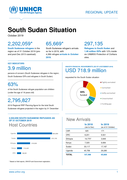
2,202,059* South Sudanese refugees in the region as of 31 October 2019 (preand post-Dec 2013 caseload).
65,669* South Sudanese refugee’s arrivals so far in 2019, with 4,389 refugee arrivals in ...
The report and an accompanying series of studies show the global uptake of ... World Health Organization (WHO) Surgical Safety Checklist in its first ten years since its launch and recommend ways the Checklist can be more effectively used to improve surgical safety for millions at risk.
The report found that uptake has been remarkably positive: the Checklist has been adopted in almost 90% of operating rooms in countries with a high Human Development Index (HDI), a country-level measure of health, education, and standard of living. It was referenced by at least 139 (70%) of the world's countries and is included as a national standard by the health ministries of at least 20 countries. The Checklist has also had beneficial qualitative impact, introducing a culture of safety and improved communication within surgical teams, increasing patient trust, and improving job satisfaction.
With a focus on Pakistan and Nigeria’s most vulnerable communities, this report provides insight about the role that community push-back is playing in the transmission ... the polio virus and how the Global Polio Eradication Initiative (GPEI) can mitigate these social risks to reach every missed child.
Global Report on Food Crises 2023
recommended
The Global Report on Food Crises (GRFC) 2023 highlights that the number of people experiencing high levels ... acute food insecurity and requiring urgent food and livelihood assistance increased for the fourth consecutive year in 2022. Over a quarter of a billion people were estimated to face acute hunger, with economic shocks and the Ukraine war contributing to the increase. In 2022, around 258 million people across 58 countries and territories faced acute food insecurity at crisis or worse levels (IPC/CH Phase 3-5), up from 193 million people in 53 countries and territories in 2021.

Robust clinical research capacity in low- and middle-income countries is key to stemming the spread of epidemics, according to a new report from the...
A resource for improving menstraul hygiene around the world.
Comprehensive guidance with examples of good practice, information for colleagues and pupils in class and tips on how to break ... taboo
This research is one case in a study commissioned by the World Food Programme to investigate the participation of recipient community in ... targeting and management of humanitarian food assistance in complex emergencies. The study involved a substantial desk review of existing documentation, and three weeks of field work in February and March 2008. The purpose of the study was to understand the ways in which participatory or community-based approaches to targeting have been attempted, within the definition of community-based targeting suggested by WFP. The study was not an evaluation of targeting methods, although some critical examination of targeting was necessary in order to understand the constraints on community participation.
Related resources
This report reviews the latest evidence on what works to reduce HIV-related stigma and discrimination through key programmes to reduce stigma and discrimination and increase access to justice in the...
The Education 2030 Incheon Declaration and Framework for Action specifies that the mandate of the...
This regional action plan provides a broad framework for the regional level to assist governments in accelerating the implementation of existing in...
Advance Family Planning - Advocacy Portfolio
recommended
Adapted from well-established decision-making concepts and honed through practical application in resource-limited settings, the AFP Advocacy Portfolio includes:
1. Advocate for Family Planning, an introduction to AFP’s approach.
2. Develop a St...
In Danger: UNAIDS Global AIDS Update 2022
recommended
Progress in prevention and treatment is faltering around the world, putting millions of people in grave danger. Eastern Europe and central Asia, Latin America, and ... Middle East and North Africa have all seen increases in annual HIV infections over several years. In Asia and the Pacific, UNAIDS data now show new HIV infections are rising where they had been falling. Action to tackle the inequalities driving AIDS is urgently required to prevent millions of new HIV infections this decade and to end the AIDS pandemic
Global and Regional Data 1 December 2021; The 90–90–90 targets were missed, but not by much. At the end of 2020, 84% ... people living with HIV knew their HIV status, 87% of people living with HIV who knew their HIV status were accessing antiretroviral therapy, and 90% of people on treatment were virally suppressed.
Key Considerations
This brief focuses on cross-border movement in Eastern and Southern Africa (ESA) and its implications for development of risk communication and community engagement (RCCE) strategies aimed at preventing transmission ... COVID-19 in the ESA region. Given the extensive risk of cross-border transmission of the virus and the imminent reopening of borders, such strategies are essential to containment efforts
This guide is an introduction on how to integrate logistics management information systems (LMIS) with geographic information systems (GIS). It covers the value of integrating these two systems, ... steps in assessing if it is currently viable to link the systems, how to set the linkage, the processes for using LMIS within a GIS platform, and finally how to sustain the linkage. The aim of this guide is to assist logistics managers, decisionmakers and technical experts in understanding the value of integrating GIS and of the process involved in integrating these two systems.