
Filter
865
Text search:
Ministry
de
la
Santé
Featured
Recommendations
45
New Publications
338
Language
Document type
No document type
565
Studies & Reports
128
Guidelines
52
Training Material
41
Manuals
36
Fact sheets
18
Strategic & Response Plan
16
Situation Updates
5
Infographics
2
Online Courses
1
Videos
1
Countries / Regions
India
89
Kenya
54
Nepal
43
Rwanda
43
Tanzania
35
Nigeria
34
Uganda
32
Malawi
32
Ethiopia
30
Sierra Leone
27
Bangladesh
26
Senegal
25
Myanmar / Burma
24
Zambia
20
Congo, Democratic Republic of
18
Indonesia
16
Burkina Faso
15
Haiti
14
Ghana
13
Namibia
13
Liberia
12
Cameroon
12
Cambodia
11
Global
11
Zimbabwe
9
Benin
8
Syria
7
Lesotho
7
Mali
5
Pakistan
5
Afghanistan
5
Mozambique
5
Africa
5
South–East Asia Region
4
Latin America and the Carribbean
4
Guinea
3
South Sudan
3
South Africa
3
Ukraine
3
Botswana
3
Western and Central Europe
3
Togo
2
Eswatini/ Swaziland
2
Sri Lanka
2
Asia
2
Tajikistan
2
Guinea-Bissau
1
Niger
1
Somalia
1
Germany
1
Chad
1
Central African Republic
1
Argentina
1
North Macedonia
1
Yemen
1
East and Southern Africa
1
Paraguay
1
Venezuela
1
Eastern Europe
1
Southern Africa
1
Russia
1
Estonia
1
Romania
1
Iran
1
Kyrgyzstan
1
North America
1
Jamaica
1
Belarus
1
Latvia
1
Authors & Publishers
Publication Years
Category
Countries
667
Women & Child Health
98
Capacity Building
50
Public Health
35
Clinical Guidelines
32
Key Resources
9
Pharmacy & Technologies
1
Toolboxes
Mental Health
35
Caregiver
26
COVID-19
22
Conflict
12
Refugee
10
Disability
9
Rapid Response
9
TB
9
Ebola
8
HIV
8
Planetary Health
8
Global Health Education
7
Cholera
5
AMR
5
Pharmacy
4
Health Financing Toolbox
4
Natural Hazards
3
Zika
3
NTDs
3
NCDs
3
Polio
1
Female Genital Mutilation in Mali: Insights from a statistical analysis Mali is home to nearly 8 million girls and women who have experienced FGM. Overall, 89 per cent of girls and women aged 15 to 49 years have undergone the practice, ranging from 96 per cent in Sikasso region to 1 per cent or less
...
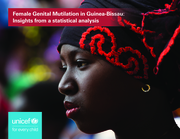
Over 400,000 girls and women in Guinea-Bissau alive today have experienced FGM. Overall, 52 per cent of girls and women aged 15 to 49 years have undergone the practice, varying from 96 per cent in Gabu region to 8 per cent in Biombo
Kenya is home to 4 million girls and women who have experienced FGM. Overall, 21 per cent of girls and women aged 15 to 49 years have undergone the practice, varying from 98 per cent in the North Eastern region to 1 per cent in the Western region
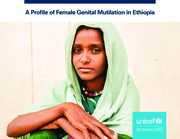
Ethiopia is home to 25 million girls and women who have experienced FGM. More than half are in the regions of Oromia and Amhara. Overall, 65 per cent of girls and women aged 15 to 49 have undergone FGM. The highest prevalence is in the Somali (99 per cent) and Afar (91 per cent) regions
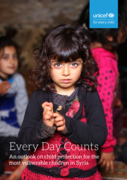
UNICEF Syria’s series of think pieces. Every day counts. An outlook on child protection for the most vulnerable children in Syria.To navigate the complex and continuously changing context and attain sustainable results for children, UNICEF – along with other UN agencies - seeks to make a shift i
...
Further analysis of the 1996, 2001, and 2006 Demographic and Health Surveys Data
A toolkit for Implementation. Module 3: Participatory community assessment in maternal and newborn health
A Toolkit for Implementation. Module 4: Training guide for facilitators of the participatory community assessment in maternal and newborn health
A Toolkit for Implementation. Module 5: Finalizing, monitoring and evaluating the IFC action plan
DHS Analytical Studies No. 44 Rockville, Maryland, USA: ICF International.
DHS Working Paper No. 136
A total of 1,222 children age 6-23 months were included in this analysis. Twenty percent of children were stunted and 43% were moderately anemic. Regarding IYCF practices, only 16% of children received a minimum acceptable diet, 25% received diverse food groups, 58% were ...
A total of 1,222 children age 6-23 months were included in this analysis. Twenty percent of children were stunted and 43% were moderately anemic. Regarding IYCF practices, only 16% of children received a minimum acceptable diet, 25% received diverse food groups, 58% were ...
This study is a theory-driven analysis of the socio-demographic determinants of maternal care seeking in Kenya. Specifically, it examines predisposing, enabling, and need factors potentially associated with use of antenatal care (ANC), health facility delivery, and timely postnatal care (PNC).This s
...
The purpose of adding the books to the website of MCAI for download, is to make this life-saving, up-to-date information available to all who need it. Fill in a short registration field and you can download the pdf-files.
If you work in a hospital in a low income country - providing free care - y
...
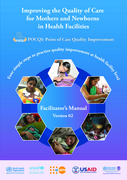
WHO-SEARO in partnership with WHOCC AIIMS, UNICEF, UNFPA and USAID has prepared a training package for building capacity of healthcare teams in health facilities for continous quality improvement of maternal and newborn healthcare. The focus is on the care of mothers and newborns at the time of chil
...
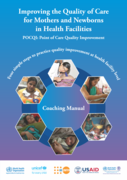
Four simple steps to practice quality improvement at health facility level
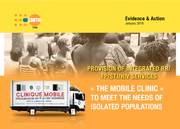
Provision of integrated RH/FP/STI/HIV services
In Togo, the limited access of populations, especially women, young girls and children to Reproductive Health (RH), Family Planning, treatment of sexually transmissible infections (STI) and struggle against HIV quality services is responsible for t ...
In Togo, the limited access of populations, especially women, young girls and children to Reproductive Health (RH), Family Planning, treatment of sexually transmissible infections (STI) and struggle against HIV quality services is responsible for t ...
