
Filter
3591
Text search:
nutrition
programme
Featured
286
1160
Language
Document type
2209
594
315
164
152
50
38
35
17
9
7
1
Countries
193
141
130
95
94
93
75
74
70
70
70
68
68
65
62
60
50
46
44
44
42
39
37
36
36
35
33
33
29
28
27
27
25
24
24
23
22
20
18
17
17
17
16
15
13
12
12
11
11
11
10
10
10
10
9
9
9
8
8
7
7
7
6
6
6
5
5
5
5
5
4
4
4
4
4
4
4
4
3
3
3
3
2
2
2
2
2
2
2
2
2
2
2
2
2
2
2
2
2
2
2
1
1
1
1
1
1
1
1
1
1
1
1
1
1
1
1
1
1
1
1
1
1
1
1
1
1
Authors & Publishers
Publication Years
Category
1705
301
212
204
178
69
7
5
Toolboxes
205
188
162
157
149
143
143
105
94
76
67
64
52
50
46
31
21
18
15
13
9
6
4
4
2
1
The new five-year agenda of WHO in Africa, The Africa Health Transformation Programme, 2015–2020: a vision for universal health coverage, is the strategic framework that will guide WHO’s contribution to the emerging sustainable development platf
...
Guidance to implement the Framework for Action for Food Security and Nutrition in Protracted Crises (CFS-FFA) | Background Note
Celebrating ten years of success 2004-2014
Annual Report: 2015-2016
Further Analysis of the 2000, 2005, and 2011 Demographic and Health Surveys. DHS Further Analysis Reports No. 81
In 2018, the Food and Agriculture Organization of the United Nations (FAO) in South Sudan must respond to the highest levels of food insecurity ever recorded in the country. To address this challenge, FAO revised its multiyear Emergency Livelihood Response
...
This document provides guidance for countries on how to implement activities to achieve the interruption of yaws transmission. It is intended for use by national yaws eradication programmes, partners involved in the implementation of yaws eradication activities and WHO technical staff who provide te
...

The overall goal of the programme, to reduce the malaria morbidity and mortality by 75% (using 2012 as baseline) by the year 2020, continued to be pursued in 2014. The following areas were identified as some of the priorities for the year: Malaria C
...
Myanmar is one of the world’s 22 high tuberculosis (TB) burden countries, and supporting TB control in Myanmar is a global priority. This report reflects the findings, discussions, conclusions and recommendations of the fourth international review mission of the Myanmar National TB
...
Cet outil peut être utilisé pour améliorer la qualité du programme ASC. Pour identifier et combler les lacunes dans la conception et la mise en œuvre du programme ASC, veuillez compléter les i
...

This study aimed to estimate the cost-effectiveness of a community-based rehabilitation (CBR) programme known as Inspire2Care (I2C), implemented in Nepal by Karuna Foundation Nepal. In the absence of any gold standard methodology to measure cost-eff
...
The aim of the people-centred framework is to help countries to develop fully prioritized and budgeted NSPs based on a culture of making full use of the available data, which are aligned with national planning cycles and which provide the basis for a robust national response that can accelerate prog
...
Children malnutrition eradication in developing countries is a real challenge, especially among
vulnerable population. There are so many effort towards women (who are the main care providers)
socio-economic situation in order to improve their children nu
...
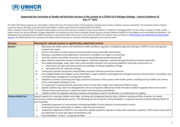
Supporting the continuity of health and nutrition services in the context of COVID-19 in refugee settings
recommended
The 2014–2015 Ebola outbreak was catastrophic in West Africa but the indirect impact of increasing the mortality rates of other conditions was also substantial. The increased number of deaths caused by malaria, HIV/AIDS, and tuberculosis attributable to health system failures exceeded deaths from
...
Accessed on 20.10.2020
L͛analyse des tendances récentes montre que le Burkina Faso a enregistré une réduction significative de la mortalité infanto-juvénile. Même si aucune des cibles des OMD 4 et 5 n͛a été atteinte par le pays, le taux de mortalité infanto-juvénile est passé de 129
...
The steps reassert the sequence of the HPC, with needs analysis directly informing decisions about the response and monitoring, whether for the preparation of new plans or adjustments to existing ones. The steps of the HPC have a rationale and cannot be skipped. However, the depth of work under each
...

Unhealthy diets and excess body weight are leading risk factors for death and disability in the WHO European Region. Addressing malnutrition in all its forms is essential to ensure health and well-being for all and, consequently, sustainable development. It requires coherent and innovative actions c
...

This Guide responds to requests from practitioners and country teams who have learned about the Nurturing care framework and want to understand how to adapt health and nutrition services to be supportive of nurturing care and strengthen caregiversâ€
...
There has been important progress for the rights of adolescent girls and women in recent decades, yet millions still struggle to
access the nutritious diets, essential nutrition services and nutrition
...
Background: Community health worker (CHW) programmes are a valuable component of primary care in resource-poor settings. The evidence supporting their effectiveness generally shows improvements in disease-specific outcomes relative to the absence of a CHW
...
The aim of the present paper is to review capacity building in public health nutrition (PHN), the need for which has been stressed for many years by a range of academics, national and international organisations. Although great strides have been mad
...
Politique du Secteur Santé pour la Nutrition 2016-2025
Chaque année, des milliers d’enfants béninois meurent ou n’arrivent pas à développer pleinement leur potentiel physique ou intellectuel du fait de la malnutrition chronique. La présente politique du secteur de la santé pour la nutrition
...
Supplement Article
J Acquir Immune Defic Syndr Volume 78, Supplement 1, August 15, 2018 www.jaids.com
Joint actions by the Global Fund and UNAIDS are guided by a strong alignment of strategies, goals and targets. UNAIDS has worked with all stakeholders to set a common agenda and targets within the Global AIDS Strategy 2021–2026, and the United Nations General Assembly confirmed this strategy and i
...
English Analysis on World about Food and Nutrition and Epidemic; published on 13 Dec 2021 by FAO
You can also register into a free online course
https://www.open.edu/openlearncreate/course/view.php?id=13
Reach the Unreached - FIND, TREAT, CURE TB, SAVE LIVES
3ie Impact Evaluation Report 39

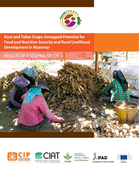
This scoping study done in Myanmar offers the chance for FoodSTART+ to explore prospects for future partnerships in another important country of the region. The study was done from October 2016 to February 2017 and included visits to selected major potato and cassava production areas to meet with re
...
Ce profil pays est le résultat d'une évaluation du paysage menée par le personnel et les collègues d'Advancing Partners & Communuties (APC). Cette évaluation du paysage portait sur les pays prioritaires de l'Agence des États-Unis pour le Développement International (USAID) en termes de Popula
...

Accessed on 28.01.2020
Dans le cadre de la mise en œuvre d’approches spécifiques à la nutrition telles que les pratiques ANJE pour lutter contre la sous-nutrition, le renforcement de la sant
...

Accessed on 29.01.2020
La volonté du CEA-SAMEF à développer des programmes de formation de qualité et des domaines de compétences ciblées a rendu nécessaire l’adoption de référentiels aux exigences internationales. Dans la mise en œuvre de son
...
Policy Brief 2 June 2020
The COVID-19 pandemic is a health and human crisis threatening the food security and nutrition of millions of people around the world. Hundreds of millions of people were already suffering from hunger and malnutrition befor
...
Les mises à jour réalisées pour de nombreux pays ont permis d’estimer la faim dans le monde avec une plus grande précision cette année. En particulier, les données nouvellement accessibles ont permis de revoir l’ensemble des estimations annuelles de la sous-alimentation en Chine en remonta
...
The micronutrient powders will be distributed at the health facilities where instructions on use will be provided by Health Care Providers. Community Health Volunteers will educate, counsel, and mobilize caregivers at the community level to visit health facilities for
...
English Manual and Guideline on World about Food and Nutrition, Health and Epidemic; published on 30 Nov 2021 by USAID
Antibiotic resistant bacteria are spreading at an alarming rate and some bacterial infections may once again be untreatable. Antibiotic resistance (ABR), conservatively calculated, causes more than 500 000 deaths every year. This number is projected to rise dramatically if radical actions are not ta
...
The war in Ukraine has had devasting impact on women and girls
worldwide, widening gender gaps and increasing rates of food insecurity, malnutrition and energy poverty. This brief reviews the available evidence of that impact, recommending urgent attention to its consequences for women and girls. I
...
Asthma is the most common chronic respiratory disease (CRD) worldwide and is estimated to affect 262 million causing significant mortality and morbidity, and has emerged as an important public health problem in many Latin American (LA) countries over the last 30 or so years. LA is a highly diverse r
...
A wide range of potential enablers and barriers were identified for influencing progress for the scale-up of severe wasting services within national health systems. Findings were categorised according to the six pillars of WHO’s health system strengthening framework.
The COVID-19 pandemic is a multiplier of vulnerability, compounding threats to food insecurity, while exposing weaknesses in food and health systems. It is severely undermining the capacity of communities to cope in times of crisis and has become a stress test for political and economic stability.
Revised edition
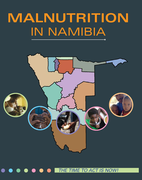
This report details the nutrition situation in Namibia. It provides information on what needs to be done! The situation calls for a consorted action. Nutrition is everyone’s business.The establish
...

Despite improvements in recent years, the prevalence of undernutrition among women and children in Myanmar remains unacceptably high. One in three children are stunted and about 8% are acutely malnourished. Micronutrient deficiencies are common among infants, young children and pregnant women. In fa
...
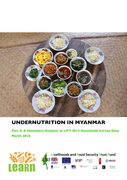
In order to better understand the contributing factors of undernutrition in LIFT program areas and the links between child nutritional status and independent variables of programmatic importance to LIFT (such as income, livelihoods, food security, and water, sanitation and hygiene [WASH]), LEARN com
...
Malawi is a small landlocked country in Sub-Saharan Africa with a population expanding rapidly at 3 percent per year.
With most livelihoods dependent on rainfed agriculture, the population is highly vulnerable to the effects of natural disasters, prolonged dry spells and flash floods.
Accessed on 01.03.2020

The UNICEF-GAIN Partnership Project
The report notes that iodine deficiency is a leading cause of preventable brain damage worldwide. Insufficient iodine during pregnancy and infancy results in neurological and psychological deficits, reducing a child’s IQ by 8 to 10 points. This translates ...
The report notes that iodine deficiency is a leading cause of preventable brain damage worldwide. Insufficient iodine during pregnancy and infancy results in neurological and psychological deficits, reducing a child’s IQ by 8 to 10 points. This translates ...
In response to a call by the United Nations Secretary-General and the Governments of Guinea, Liberia and Sierra Leone, an international team conducted an Ebola Recovery Assessment.The aim was to contribute towards laying the foundation for short-, medium- and long-term recovery while the medical eme
...
IN NUMBERS
60 MILLION people affected globally at present.
32 MILLION people food insecure in Southern Africa.
10.2 MILLION people in Ethiopia need emergency food assistance.
50 PERCENT crop losses in Haiti due to El Niño-influenced drought.
Highlights
The third corridor for delivery of humanitarian assistance from Sudan to South Sudan is open.
In response to the drastic increase in humanitarian needs, WFP continues to scale up its assistance in Eastern Equatoria, Northern Bahr El Ghazal and Lakes states.
Construction w
...

Key figures (to date)
• 168,254 people affected in Cabo Delgado and 900 people affected in Nampula (preliminary estimates from INGC)
• 35,000 houses partially or destroyed
• 37,696 people hosted in accommodation centers throughout the province
• 9 districts identified in Cabo Delgado and
...
Accessed: 02.04.2020
This module introduces the “Vaccinator’s Manual”, a guideline for vaccinators. The aim of the manual is to update EPI guidelines to include all the changes since the third edition of the Vaccinators Manual (2008)
A Learning Programme for Professionals
The report will describe how the Ebola Response MPTF, which has attracted contributions from 38 Member States, one business and many individuals, has offered a transparent and strategic tool to support the Ebola response. As of 31 January 2015, the Fund had total pledges amounting to US$142 million,
...

2018 monitoring report: current status and strategic priorities
The report sets out the status of women’s, children’s and adolescents’ health, and on health systems and social and environmental determinants. Regional dashboards on 16 key indicators highlight where progress is being made o ...
The report sets out the status of women’s, children’s and adolescents’ health, and on health systems and social and environmental determinants. Regional dashboards on 16 key indicators highlight where progress is being made o ...
