
Filter
585
Text search:
cholera
epidemic
Featured
80
218
Language
Document type
346
80
54
39
36
14
9
4
1
1
1
Countries
41
36
24
18
18
17
16
16
15
15
14
14
13
11
11
10
9
9
8
8
8
7
7
7
6
6
6
6
5
5
4
4
4
3
3
3
3
2
2
2
2
2
2
2
1
1
1
1
1
1
1
1
1
1
1
1
1
1
1
1
1
1
1
1
1
1
Authors & Publishers
Publication Years
Category
243
41
40
30
15
15
3
3
2
Toolboxes
74
61
51
30
28
26
24
18
9
9
8
8
8
6
4
4
4
3
3
2
1
1
Using Epidemiology to Support Primary Health Care. Updated version of the WHO handbook published in the early 1990's entitled: Manual of Epidemiology for District Health Management or those with an interest in applied epidemiology in primary health care and district health systems

To support countries in adapting their response to different COVID-19 scenarios, the World Health
Organization (WHO) Department of Maternal, Newborn, Child and Adolescent Health and Ageing commissioned this scoping review of published and grey literature. The objective was to identify interventions
...
Technical document, update 2021
The Event-based Surveillance Framework is intended to be used by authorities and agencies responsible for
surveillance and response. This framework serves as an outline to guide stakeholders interested in implementing
event-based surveillance (EBS) using a multisectoral, One Health approach. To
...
Equity and Quality in Health: a People's Right

The Health Sector Policy gives general orientations for the sector which are further developed in the various sub-sector policies guiding key health programs and departments. All health sub-sector policies will be updated in line with this new policy. The Health Sector Policy is the basis of nationa
...
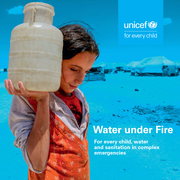
UNICEF trucks water to the camps where people displaced by the conflict have temporarily settled. UNICEF also installed latrines, showers and water storage tanks in the camps and distributed family hygiene kits to protect children against waterborne diseases.
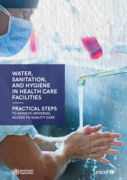
Purpose of this document: to present eight practical steps that Member States can take at the national and sub-national level to improve WASH in health care facilities
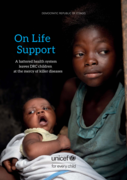
ON LIFE SUPPORT3The Democratic Republic of Congo’s Ebola outbreak has been contained, but confl ict and under-development leave over three million children at risk from measles and other killer diseases. The country’s medical services – ill-equipped and under-resourced – are on life support
...
Communicable Diseases Control in Emergencies
recommended
A field manual

The purpose of this booklet is to assist WHO and other
Public Health workers in the field when an emergency
occurs. The booklet provides technical hints on how to
carry out a rapid health assessment, how to facilitate
coordination, how departments in WHO can assist, etc.
Standard formats for re
...
2nd edition. Essential guideline for humanitarian assistance
A toolkit for behavioural and social communication in outbreak response
This guidance note is intended primarily for health actors working in emergency and disaster risk management (hereafter 'emergency risk management') at the local, national or international level, and in governmental or nongovernmental agencies. People with disabilities, those
...
Please read and download the latest updates at the website
http://www.who.int/hac/crises/ssd/epi/en/
This interim guidance is aimed at assisting organizers of international meetings attended by individuals from EVD-affected countries and individuals with a travel history to EVD-affected countries within the previous 3 weeks.
The first part is intended for organizers of international meetings, to
...
Real Time Evaluation of the Ebola Control Programs in Guinea, Sierra Leone and Liberia. Final Report
The scope includes the assessment of activities to improve the response to affected populations, stakeholders, partners and donors, building on lessons learnt so far in this outbreak.
Interim emergency guidelines
In light of the decline in new Ebola cases, strategies are now needed to scale down the activities and bed capacities in Ebola care facilities. These facilities include Ebola treatment units, community care centres, Ebola treatment centres and isolation centres. The Governments of Guinea, Liberia an
...
A survey was conducted in countries in all six WHO regions and focused on the building blocks that are considered prerequisites to combat antimicrobial resistance: a comprehensive national plan, laboratory capacity to undertake surveillance for resistant microorganisms, access to safe, effective ant
...
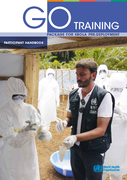
GO pre-deployment training: participant handbook
recommended
This is a pre-deployment training, tailored specially to the Ebola outbreak in West Africa, offered to WHO personnel, consultants, and key partners. The material covered in modules 1-4 is applicable and useful to frontline response workers, national and international. Only Module 5, which focuses on
...
This manual has been developed to guide rapid risk assessment of acute public health risks from any type of hazard in response to requests from Member States of the World Health Organization (WHO). The manual is aimed primarily at national departments with health-protection responsibilities, Nationa
...
Second edition
Early detection, assessment and response to acute public health events:
The new five-year agenda of WHO in Africa, The Africa Health Transformation Programme, 2015–2020: a vision for universal health coverage, is the strategic framework that will guide WHO’s contribution to the emerging sustainable development platform in Africa. It articulates a vision for health a
...

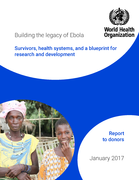
This report describes the work done by WHO from January 2015 up to the end of December 2016 to address the long-term issues of survivor care, health-systems strengthening and research.
Towards a Healthier Botswana
Public Health Situation Analysis and Interventions 10 October 2017
A GUIDE FOR HEALTH WORKERS AND AUTHORITIES IN NIGERIA
UNICEF Child Alert | February 2018
Back in Myanmar, an estimated half million Rohingya remain largely sealed off in their communities and displacement camps, fearful that the violence and horror that had driven so many of their relatives and neighbours to fl ee would engulf them too. Today, t ...
Back in Myanmar, an estimated half million Rohingya remain largely sealed off in their communities and displacement camps, fearful that the violence and horror that had driven so many of their relatives and neighbours to fl ee would engulf them too. Today, t ...
For biological agents, the publication covers 11 bacteria,
fungi and viruses listed by states parties to the Biological
Weapons Convention in declarations of past offensive
research and development programmes, or considered of
special concern for possible use in terrorism. All of these
agents c
...
In 2005, the World Health Organization (WHO) Member States adopted the revised International
Health Regulations (IHR) (2005). The Regulations provide a unique public health framework in the
form of obligations and recommendations that enable countries to better p
...

The health of the people and health services are in crisis, and together as partners this plan commits us to strategies aimed at achieving our goal of:
Strengthened primary health care for all, and improved service delivery for the rural majority and the urban disadvantaged.
Original fi ...
Strengthened primary health care for all, and improved service delivery for the rural majority and the urban disadvantaged.
Original fi ...

This year marked the beginning of the WHO biennium 2016-2017 action plan; this annual report highlights WHO’s key achievements in 2016
It also documents the extraordinary efforts by a broad coalition of government ministries, municipalities, international agencies, community groups, women’s or
...
This learning report attempts to understand the drivers for, and barriers to, effective implementation as well as review the experiences of Start Fund members in responding to these outbreaks to support evidence-based decision-making within the Start Network at project, crisis, and system level. Spe
...
It provides insight into WHO’s work that aims to improve the health of the people of the United Republic of Tanzania in collaboration with key stakeholders.
The humanitarian crisis in Yemen remains the worst in the world. Nearly four years of conflict and severe economic decline are driving the country to the brink of famine and exacerbating needs in all sectors. An estimated 80 per cent of the population – 24 million people – require some form of h
...
Women and girls are paying the price of the war in Yemen – Humanitarian actors must increase the priority given to women and girls’ needs, with specific attention to GBV prevention and response, and reproductive health services
The floods caused by the Tropical Cyclone IDAI has affected 3 million people in the Republics of Malawi, Mozambique and Zimbabwe leaving 839 people dead, and this figure continued to rise as the rains stopped and water subsided. To date, over 201,476 people (Table 1) have been displaced and about 31
...
Public Health is the science field dedicated to promoting health and well-being, and preventing disease within the human population to ultimately increase the quality of our livelihood and life span. Public Health does not focus on individual patients or diseases, but rather a given population and
...
This short paper aims to identify key evidence gaps in our knowledge of livestock- and fisheries-linked antimicrobial resistance in the developing world, and to document on-going or planned research initiatives on this topic by key stakeholders.
The antimicrobial resistant (AMR) infections in anima
...
Accessed on 31.03.2020
This Guidance Note aims to provide humanitarian child protection practitioners, particularly child protection advisors and program managers, with guidance on how to engage in responses to infectious disease outbreaks to ensure children’s protection needs are taken into ac
...
27 March 2020
Countrys: World and Kenya, Zambia, Ethiopia
The restrictions on movement imposed as a result of the COVID-19 pandemic constitute one of the largest single global challenges that the humanitarian community has ever encountered. Maintaining continuity and quality in the delivery of e
...
How should humanitarian organisations prepare and respond to COVID-19 in humanitarian settings in low- and middle-income countries?
This Rapid Learning Review outlines 14 actions, insights and ideas for humanitarian actors to consider in their COVID-19 responses. It summarises and synthesises the
...
Every year, nearly 250 million people move across borders temporarily or permanently for a job opportunity, studying, to flee a crisis back home, or for other reasons. Another 750 million move for similar reasons within the borders of their countries. With the understanding that human mobility affec
...
Summary of the Ethopian country office of WHO on COVID-19 activities.

A Situational Assessment and Five-YearAction Plan for the Africa CDC Strengthening Regional Public Health Institutions and Capacity for Surveillance and Response Program
Earthquake Haiti: Guidelines and Resources
recommended
25 August 2021. The earthquake on August 14, 2021 was almost as strong as the severe quake in 2010, which killed about 300,000 people. The current number of victims is more than 2,200 people, and more than 12,000 people have been injured. More than 52,000 houses were destroyed and more than 77,000
...
In 2007, WHO warned that infectious diseases are emerging and re-emerging at a rate that has not been seen before. The potential for infectious diseases to spread rapidly results in high morbidity and mortality, causing a potential global public health treat of major concern.
Several factors are
...
7 June 2022. To treat complications associated with measles: severe complications with module 1 (50 cases) and mild complications with module 8 (20 cases).
The new measles kit 2021 is designed to prepare for and support the treatment of non-severe and severe measles cases during outbreaks. The kit
...
Published: November 24, 2020 https://doi.org/10.1371/journal.pbio.3000938
Climate change is expected to have complex effects on infectious diseases, causing some to increase, others to decrease, and many to shift their distributions. There have been several important advances in understanding the
...
