
Filter
73
Text search:
World
Meteorological
Organization
WMO
Featured
Recommendations
5
New Publications
17
Language
Document type
Studies & Reports
34
No document type
26
Strategic & Response Plan
4
Training Material
3
Manuals
2
Situation Updates
2
Resource Platforms
1
Guidelines
1
Countries / Regions
Global
8
Myanmar / Burma
4
Kenya
3
Asia
3
Indonesia
2
South–East Asia Region
2
Ethiopia
1
Zimbabwe
1
Philippines
1
Somalia
1
Pakistan
1
Iraq
1
Afghanistan
1
Zambia
1
Cambodia
1
Rwanda
1
Bangladesh
1
Mozambique
1
Papua New Guinea
1
Vanuatu
1
North Macedonia
1
Madagascar
1
Lesotho
1
Sri Lanka
1
Western Pacific Region
1
Latin America and the Carribbean
1
Western and Central Europe
1
Africa
1
Solomon Islands
1
North Korea
1
Laos
1
Iran
1
Authors & Publishers
Publication Years
Category
Countries
15
Key Resources
5
Public Health
1
Toolboxes
Planetary Health
33
Natural Hazards
12
Global Health Education
10
COVID-19
3
Specific Hazards
2
Cholera
1
Rapid Response
1
Health Financing Toolbox
1
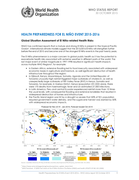
Global Situation Assessment of El Niño-related Health Risks
The climate crisis has many consequences – among them widespread health impacts that will lead to immense societal, ecological, and economic harm.
Over the past two decades multiple large-scale reviews on climate change and health have made clear the need for a multi-sectoral approach to target t
...
Climate change is already having severe impacts across our planet, bringing new and previously unimaginable challenges to the people least responsible for greenhouse gas emissions.
This report, the first we’ve released jointly in the history of our organizations, provides a sobering review of h
...
English Analysis on World and 19 other countries about Agriculture, Food and Nutrition and Drought; published on 13 Jan 2021 by FAO

The Lancet Volume 397, ISSUE 10269, P129-170, January 09, 2021
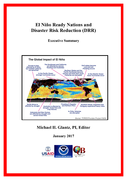

The COVID-19 pandemic is having a profound negative effect on the global economy and is occurring in the context of a rapidly changing climate. This year is expected to be the second hottest in recorded history. Weather forecasts for 2020 indicate a high probability that extreme weather will adverse
...
Asia-Pacific Disaster Report 2017
The report looks at the extent and impact of natural disasters across the region and how these intersect with poverty, inequality and the effects of violent conflict. But it also shows how scientific and other advances have increased the potential for building di ...
The report looks at the extent and impact of natural disasters across the region and how these intersect with poverty, inequality and the effects of violent conflict. But it also shows how scientific and other advances have increased the potential for building di ...

DOI: 10.5772/intechopen.75559
In book: Extreme WeatherPublisher: IntechOpen
This study aims to analyze national and international stakeholders and their initiatives in Early Warning Systems in Myanmar, to identify priority gaps that need to be addressed by all stakeholders. It is presented as a first step towards supporting GoUM in information-gathering under the Myanmar Ac
...
According to the International Science Council, the report focuses on identifying the scope of hazards that should be considered in risk reduction efforts, and provides scientifically robust and internationally agreed definitions of these hazards.

Since the last situation report on the multi-country outbreak of cholera was published on 6 July 2023 (covering data reported until 15 of June), and as of 15 July 2023, one new outbreak of cholera was reported from India on 15 May 2023. In total, 25 countries have reported cases since the beginning
...

Sectors in which Priority Adaptation Projects should be implemented first include:
- 1) Agriculture, Early Warning Systems and Forest (First Priority Level Sectors). This is followed by:
- 2) Public Health and Water Resources (Second Priority Level Sectors);
- 3) Coastal Zone (Thir ...
- 1) Agriculture, Early Warning Systems and Forest (First Priority Level Sectors). This is followed by:
- 2) Public Health and Water Resources (Second Priority Level Sectors);
- 3) Coastal Zone (Thir ...
In Climate Change 2014: Impacts, Adaptation, and Vulnerability. Part A: Global and Sectoral Aspects. Contribution of Working Group II to the Fifth Assessment Report of the Intergovernmental Panel on Climate Change
From the start of the COVID-19 pandemic until August 2021, extreme weather events have affected at least 139.2 million people and killed at least 17,242 people in at least 433 unique events. These figures are certainly an underestimate, as they do not include estimates of numbers of people affected
...
This consultative version of the guideline is the product of literature reviews, discussions and contributions from diverse stakeholders, as well as UNISDR-nominated experts appointed specifically for the development of the Words into Action guideline for Build back better in recovery, rehabilitatio
...
Climate Smart Agriculture provides an excellent opportunity for the transformation by uniting agriculture, development and climate change under a common agenda through integrating the three dimensions of sustainable development (economic, social and environmental) by jointly addressing food security
...
Report V of Conversations on Planetary Health
