
Filter
117
Text search:
Gutiérrez,
J.
Featured
Recommendations
11
New Publications
16
Language
Document type
No document type
51
Studies & Reports
32
Guidelines
14
Manuals
8
Strategic & Response Plan
4
Fact sheets
4
Situation Updates
2
Training Material
1
Resource Platforms
1
Countries / Regions
Global
10
India
4
Latin America and the Carribbean
4
Russia
4
Peru
3
Germany
2
Brazil
2
Western and Central Europe
2
Eastern Europe
2
USA
1
Ethiopia
1
Uganda
1
Zimbabwe
1
Philippines
1
Zambia
1
Kenya
1
Cambodia
1
Indonesia
1
South Africa
1
Bangladesh
1
Malawi
1
Mozambique
1
Argentina
1
North Macedonia
1
Ukraine
1
Colombia
1
Bolivia
1
Angola
1
Lesotho
1
Myanmar / Burma
1
West and Central Africa
1
Paraguay
1
Africa
1
Armenia
1
Southern Africa
1
Moldova
1
Georgia
1
Belgium
1
Portugal
1
Belarus
1
Authors & Publishers
Publication Years
Category
Countries
28
Public Health
14
Clinical Guidelines
14
Women & Child Health
3
Key Resources
3
Pharmacy & Technologies
1
Toolboxes
HIV
14
TB
13
COVID-19
11
NTDs
11
Mental Health
8
Planetary Health
6
NCDs
5
Rapid Response
4
AMR
4
Social Ethics
4
Caregiver
4
Refugee
3
Global Health Education
3
Natural Hazards
2
Health Financing Toolbox
2
Disability
1
Ebola
1
The aim of this toolkit is to guide countries on how to best estimate their current burden of dengue by combining existing data from dengue surveillance systems with on-going research efforts to measure the community burden
of dengue.

Journal of Infectious Diseases and Therapeutics, 2013, 1, 17-24
Environmental Research Volume 151, November 2016, Pages 115-123
Dengue is the world’s most important arboviral disease in terms of number of people affected. Over the past 50 years, incidence increased 30-fold: there were approximately 390 million infections in 2010. Globalization, trade, travel,
...
PLOS ONE | https://doi.org/10.1371/journal.pone.0185526 September 28, 2017
Global Health and Tropical Medicine, GHTM, Instituto de Higiene e Medicina Tropical, IHMT, Universidade Nova de Lisboa, UNL, Lisboa, Portugal
This document should be used in conjunction with the WHO checklist for influenza preparedness planning published by the World Health Organization in 2005. Available in English; Chinese; French
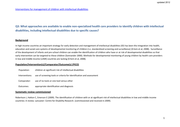
Q3: What approaches are available to enable non-specialized health care providers to identify children with intellectual disabilities, including intellectual disabilities due to specific causes?
Diabetes is a serious, chronic disease that occurs either when the pancreas does not produce enough insulin (a hormone that regulates blood sugar, or glucose), or when the body cannot effectively use the insulin it produces. Diabetes is an important public health problem, one of four priority noncom
...
The document "Global Report on Diabetes" by the World Health Organization (WHO) provides an in-depth analysis of diabetes as a global health challenge. It covers the rising prevalence of the disease, the associated risk factors, and the increasing burden on healthcare systems, particularly in low- a
...
Diabetes is a serious, chronic disease that occurs either when the pancreas does not produce enough insulin (a hormone that regulates blood sugar, or glucose), or when the body cannot effectively use the insulin it produces. Diabetes is an important public health problem, one of four priority noncom
...
Цель настоящего доклада — повысить осведомленность о деменции как
одной из приоритетных проблем общественного здравоохранения, сформу-
лировать подход к этой пÑ
...
Annals of Global Health, 87(1), p.43. DOI: http://doi.org/10.5334/aogh.3269;
The aim of this study was to examine the prevalence of mental health symptoms (anxiety, depression, and stress) in Bangladesh and the factors associated with these symptoms during the COVID-19 pandemic.
They found that
...
The aim of this paper is to investigate how doctors working in primary health care in Latin American address patients with common mental disorders and to investigate how stigma can affect their clinical decisions
PLoSONE 13(11):e0206440.https://doi.org/10.1371/journal.pone.0206440
La presente publicación describe la evidencia científica disponible sobre la utilidad del uso complementario de pruebas moleculares y de detección de anticuerpos para mejorar el diagnóstico de sospechosos de COVID-19. La utilización complementaria de ambas pruebas podría mejorar la identificac
...
Since the World Health Organization (WHO) launched the Global Antimicrobial Resistance Surveillance System (GLASS) in 2015, there has been rapidly growing awareness among many African countries that they need to be doing more to combat antimicrobial resistance (AMR). The Africa Centres fo
...

manuel de mise en oeuvre de l’OMS

In one of his final essays, statesman and former United Nations secretary general Kofi Annan said, ‘Snakebite is the most important tropical disease you’ve never heard of’. Mr. Annan firmly believed that victims of snakebite envenoming should be recognised and afforded greater efforts at impro
...
