Filter
101
Text search:
EMT
Featured
13
20
Language
Document type
32
21
17
15
7
6
3
Countries / Regions
7
4
4
4
4
4
3
3
3
3
2
2
2
2
2
2
1
1
1
1
1
1
1
1
1
1
1
1
1
1
1
1
1
1
1
1
1
1
1
Authors & Publishers
Publication Years
Category
32
12
10
5
3
2
1
Toolboxes
21
18
13
9
7
6
5
3
2
2
2
2
1
1
1

Emergency response framework, 2nd ed.
recommended
The purpose of this Emergency Response Framework (ERF) is to clarify WHO’s roles and responsibilities in this regard and to provide a common approach for its work in emergencies. Ultimately, the ERF requires WHO to act with urgency and predictability to best serve and be accountable to populations
...

The African Region has been experiencing unprecedented health challenges due to the Coronavirus disease 2019 (COVID-19) pandemic, which have compounded the already difficult task the Region was facing in moving towards universal health coverage (UHC) attainment.
The Disaster Recovery Framework (DRF) Guide for the Health Sector provides guidance on how to implement a comprehensive, integrated, and structured approach to disaster recovery. Its overarching goal is to minimize the impact of the disaster on communities and help countries to recover quickly and e
...
Brindar recomendaciones sobre la atención inicial de personas con enfermedad respiratoria aguda (ERA) en el contexto de la infección por coronavirus (COVID-19) en establecimientos de salud basado en flujograma de toma de decisiones. Estas recomendaciones son preliminares y están sujetas a revisiÃ
...
Real Time Evaluation of the Ebola Control Programs in Guinea, Sierra Leone and Liberia. Final Report
The scope includes the assessment of activities to improve the response to affected populations, stakeholders, partners and donors, building on lessons learnt so far in this outbreak.
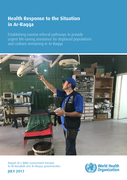
Establishing trauma referral pathways to provide urgent life-saving assistance for displaced populations and civilians remaining in Ar-Raqqa.
In July 2017, a WHO team comprising an external trauma care specialist and two WHO staff members visited the governorates of Ar-Raqqa and neighbouring Al-Ha
...
Table of contents
1: Introdução; 2: Considerações para atendimento em situação de pico de demanda em serviços de saúde e alocação de equipes médicas de emergência; 3: Equipes médicas de emergência; 4: Níveis de resposta em situação de pico de demanda por cuidados médicos; 5: Expan
...
Oferecer atendimento de saúde especializado para o tratamento de pacientes críticos com síndrome respiratória aguda grave (SRAG), encaminhados principalmente de unidades de saúde onde a capacidade das unidades de terapia intensiva tem sido sobrecarregada pelo alto volume de pacientes. A estrutu
...
Working towards better COVID-19 outcomes in the WHO European Region.From the first COVID-19 cases in Europe reported on
24 January 2020, the pandemic reached 1 million cases
within 3 months, 10 million cases within 8 months, and
100 million cases in Europe alone within 2 years. Over
the course o
...
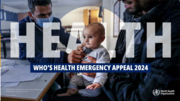
In 2024, we need US$1.5 billion to provide live-saving health care to millions of people in emergencies. An alarming combination of conflict, climate-related threats and increasing economic hardship mean an estimated 166 million people require health assistance.
Myocardial infarctions are generally clinically classified into ST elevation MI (STEMI) and non-ST elevation MI (NSTEMI), based on changes in ECG. When blood flow to a part of the heart stops or the heart is injured and fails to receive enough oxygen required for its adequate functioning the conditi
...
This report provides an overview of the operations and activities of the WHO Country Office in Ukraine in 2023. Despite the acute health impacts of the war in Ukraine, the Country Office continued its work according to its core mandate. WHO supported the Government of Ukraine in managing the health
...
The target audience of this document (and the associated online companion tool) includes WHO country offices
in Member States of the African Region; Member States’ ministries of health and their public health emergency
operation centres; relevant external assessment teams; and partners looking
...
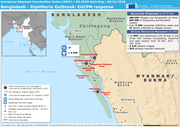
SITUATION OVERVIEW as of 30 Jan.
- 688 000 refugees into Bangladesh (of which 585 000 in Kutupalong and Bulukhali camps)
- over 5000 clinically suspected Diphtheria cases and 37 deaths (reported in refugee camps)