
Filter
2280
Text search:
AIDS
epidemic
Featured
157
676
Language
Document type
1650
284
168
61
47
26
16
11
10
2
1
1
Countries
97
70
69
60
59
59
58
56
55
55
54
53
45
43
42
39
36
35
32
32
32
31
29
29
23
21
20
19
17
16
16
15
14
13
13
11
11
10
9
9
8
8
8
8
7
6
6
5
5
5
5
4
4
4
4
3
3
3
3
3
2
2
2
2
2
2
2
2
2
1
1
1
1
1
1
1
1
1
1
1
1
1
1
1
1
1
1
1
1
1
1
1
1
1
1
1
1
1
1
1
Authors & Publishers
Publication Years
Category
959
117
73
48
33
25
17
2
Toolboxes
666
232
85
46
45
38
33
24
24
22
20
19
16
14
13
13
12
12
12
12
5
3
3

Accessed November 2017.
Special summit of African Union on HIV and Aids, Tuberculosis and Malaria (atm) Abuja, Nigeria 2–4 may, 2006Sp/Assembly/ATM/2 (I), Rev.3
Abuja call for accelerated action towards universal access to HIV and
...
Policy Brief | Number 5 (April 2011)
PLOS ONE | www.plosone.org
September 2014 | Volume 9 | Issue 9 | e103657

This progress report reflects achievements made during the first year of implementation (through December 2016), as countries have taken actions in line with new or existing national strategies. The most recent data on country progress in 2016 are based on country-reported data and country-developed
...
Country Progress Report January 2008 - December 2009

The National Strategic Plan for HIV/AIDS and STIs 2017-2024 spells out the objectives and targets that we have jointly committed to achieve. The plan describes the strategies and activities that will need to be implemented on the ground across India
...

The purpose of the PAS III is to guide Pakistan’s overall national response for HIV and AIDS through 2020, through focused interventions with set targets, costs, roles and responsibilities. The successful implementation of PAS III involves multipl
...
Psychatry & Pediatrics
Chapter I.3

Third Stocktaking Report, 2008
Unite for Children, Unite against AIDS
Accessed: 26.09.2019
2016 data
The report was coordinated by Anastasia Pharris and Annemarie Stengaard.
Report review and production support were provided by Andrew J. Amato-Gauci, Mike Catchpole, Denis Coulombier, Masoud Dara, Nedret Emiroglu, Rachel Katterl, Shahin Khasiyev, Valentina Lazdina, Teymur Noori, Marc
...
Accessed: 17.11.2019

Guidance
Indicators for monitoring the 2016 Political Declaration on Ending AIDS
UNAIDS Joint United Nations Programme on HIV/AIDS
This handbook aims to help labour inspectors deal with the issue of HIV/AIDS.
It establishes the links between the key principles and core responsibilities of labour inspectorates and the management of HIV/
...

This guideline document lays out the indicators for monitoring the 2016 Political Declaration on ending AIDS. The Global AIDS Monitoring (GAM) process has been often referenced as a benchmark for su
...
The new Global AIDS Strategy 2021–2026, End Inequalities, End AIDS, is a bold approach that uses an inequalities lens to close the gaps preventing progress to end
...
This document was conducted as a desk study and provides useful information and practical examples of responses to HIV and AIDS in the fields of agriculture, rural development, self-help and social protection. It aims to invite Misereor partners and
...

AUDIT REPORT NO. 9-000-11-001-P | February 24, 2011
Accessed online August 2018
Data from the 2011 Ethiopia Demographic and Health Survey
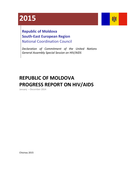
January – December 2014
Republic of Moldova South‐East European Region National Coordination Council
Declaration of Commitment of the United Nations General Assembly Special Session on HIV/AIDS
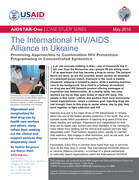
Promising Approaches to Combination HIV Prevention Programming in Concentrated Epidemics
AIDSTAR-One CASE STUDY SERIES May 2010
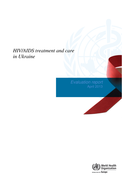
Evaluation report
April 2013
Evaluation report
This report is part of the overall Ukrainian National AIDS programme evaluation conducted
in September 2012
Best Practices Guidelines
Accessed: 06.11.2019
Developed in collaboration with the International Council of AIDS Service Organizations (ICASO)

A Summary
Accessed: 23.11.2019
Oxford Policy Management (OPM) - APW with UNAIDS (thru TSF)
2021 UNAIDS Global AIDS Update. UNAIDS report shows that people living with HIV face a double jeopardy, HIV and COVID-19, while key populations and children continue to be left behind in access to HIV services
Why bold action against inequalities is needed to en AIDS, stop COVID-19 and prepare for future pandemics
23 February 2022
A summary of the commitments and targets within the United Nations General Assembly’s 2021 Political Declaration on HIV and AIDS.The United Nations General Assembly’s 2021 Political Declaration on
...
Government Barriers to Condom Use by Men Who Have Sex With Men

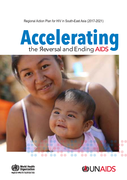
Regional Action Plan for HIV in South-East Asia (2017-2021)
ICAAP12 Secretariat
Partners in population and development, Dhaka, Bangladesh June 2016

Accessed: 03.09.2019
Vol. 7, No. 1 (2018) | ISSN 2166-7403 (online) DOI 10.5195/cajgh.2018.295 | http://cajgh.pitt.edu

The Open AIDS Journal, 2012, 6, 245-258
UNAIDS | 2016–2021 Strategy
Accessed: 20.11.2019

Editorial
Rev Panam Salud Publica 40(6), 2016
Experiences from Indonesia, Kenya, Uganda and Ukraine
The new Global AIDS Strategy 2021--2026, End Inequalities, End AIDS, is a bold approach that uses an inequalities lens to close the gaps preventing progress to end
...

This report makes clear that there is a path to end AIDS. Taking that path will help ensure preparedness to address other pandemic challenges, and advance progress across the Sustainable Development Goals. The data and real-world examples in the rep
...
This publication by UNAIDS, UNDP and the International Organisation for Migration examines various dimensions related to migration and HIV and AIDS.
SAHARA-J: Journal
of Social Aspects of HIV/AIDS, 13:1, 1-7, DOI: 10.1080/17290376.2015.1123646
The 2014–2015 Ebola epidemic in western Africa was the longest and most deadly Ebola epidemic in history, resulting in 28,616 cases and 11,310 deaths in Guinea, Liberia, and Sierra Leone. The Ebol
...
J Epidemiol Infect Dis 1(1): 00003.n DOI: 10.15406/jeid.2017.01.00003
Published: September 14, 2017
Final Draft narrative December 6, 2012 - This strategic plan, developed through the joint collaboration of all stakeholders in the different sectors is aimed at harnessing and bringing together all the stakeholders who have a role in the prevention, detection and management of
...
