
Filter
796
Text search:
USAID,
Deliver
Project
Featured
Recommendations
40
New Publications
333
Language
Document type
No document type
596
Studies & Reports
77
Guidelines
58
Manuals
28
Strategic & Response Plan
15
Training Material
12
Situation Updates
6
Fact sheets
2
App
1
Resource Platforms
1
Countries / Regions
Kenya
52
Uganda
38
Nigeria
36
Malawi
34
Nepal
33
Ethiopia
31
Liberia
30
Rwanda
26
Tanzania
25
Bangladesh
20
Zambia
19
Global
15
Sierra Leone
14
Namibia
14
Haiti
13
Myanmar / Burma
13
India
12
Senegal
11
Ghana
11
Lesotho
11
Ukraine
10
Zimbabwe
8
Philippines
8
South Africa
8
Syria
7
Cambodia
7
Western and Central Europe
7
Mozambique
6
Botswana
6
Asia
6
South Sudan
5
Africa
5
Eastern Europe
5
Burkina Faso
4
Guinea
3
Cameroon
3
Indonesia
3
Eswatini/ Swaziland
3
South–East Asia Region
3
Congo, Democratic Republic of
2
Jordan
2
Afghanistan
2
Thailand
2
Benin
2
Bolivia
2
Middle East and North Africa
2
Venezuela
2
Russia
2
Somalia
1
China
1
Papua New Guinea
1
Sudan
1
Central African Republic
1
Peru
1
Burundi
1
Colombia
1
Angola
1
Madagascar
1
Sri Lanka
1
Chile
1
Yemen
1
East and Southern Africa
1
West and Central Africa
1
Eastern Europe and Central Asia
1
Southern Africa
1
Laos
1
Tajikistan
1
Moldova
1
Georgia
1
Authors & Publishers
Publication Years
Category
Countries
428
Women & Child Health
64
Key Resources
45
Public Health
37
Clinical Guidelines
23
Capacity Building
14
Pharmacy & Technologies
8
Toolboxes
HIV
74
TB
51
Caregiver
25
Pharmacy
23
Disability
18
Conflict
18
Planetary Health
16
Mental Health
15
COVID-19
14
Ebola
11
AMR
9
Global Health Education
8
Health Financing Toolbox
8
Polio
6
Natural Hazards
6
Rapid Response
6
NTDs
3
Cholera
1
South Sudan
1
Refugee
1
Zika
1
Social Ethics
1
Health Financing
1
NCDs
1
The World Health Organization’s comprehensive antenatal care (ANC) guideline WHO recommendations on antenatal care for a positive pregnancy experience was published in 2016 with the objective of improving the quality of routine health care that all women and adolescent girls receive during pregnan
...
The United Nations Commission on Life-Saving Commodities (UNCLSC, 2012) defined 13 health products to end preventable deaths of woman and children. One of those 13 products is the neonatal resuscitator, is indispensable medical device to save newborns from asphyxia at birth. For the efficient use of
...
Key questions
What is already known?
Critical illness is common throughout the world and COVID-19 has caused a global surge of critically ill patients.
There are large gaps in the quality of care for critically ill patients, especially in low-staffed and low-resourced settings, and mortal
...
It provides guidance on care for use in resource-limited settings or in settings where families with sick young infants do not accept or cannot access referral care, but can be managed in outpatient settings by an appropriately trained health worker. The guideline seeks to provide programmatic guida
...

The Atlas of Palliative Care in the Eastern Mediterranean Region is the first systematic attempt to assess the status of resources, activities, and needs of palliative care in the region. It provides a comparative picture of the current state of palliative care in simple and clear graphics, utilisin
...
The Updated guidelines on Management of tuberculosis in children and adolescents include new recommendations that cover diagnostic approaches for TB, shorter treatment for children with non-severe drug-susceptible TB, a new option for the treatment of TB meningitis, the use of bedaquiline and delama
...
The WHO Global strategy on human resources for health: workforce 2030 encourages development partners and global health initiatives to leverage their support to health systems in countries to sustainably strengthen the health workforce. To assess the impact of these investments, a methodology was de
...
Annals of Global Health, 87(1), p.30. DOI: http://doi.org/10.5334/aogh.2647
Implementation guide for national, district and facility levels.
This implementation guide contains practical guidance for policy-makers,
programme managers, health practitioners and other actors working to
establish and implement quality of care (QoC) programmes for maternal,
newborn and child
...
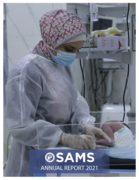
SAMS team rose to meet these challenges, delivering world class COVID treatment with four newly established COVID hospitals complete with 100 ICU beds and state of the art equipment like ventilators, monitors, and oxygen generators. By using innovative technologies, SAMS’ physicians were able to s
...

The sixteenth meeting of the Strategic and Technical Advisory Group for Neglected Tropical Diseases (STAG-NTD) was held as a hybrid meeting, 27–28 September 2022.
Dr Ren Minghui, Assistant Director-General, Universal Health Coverage/Communicable and Noncommunicable Diseases, welcomed participan
...
The revision of the SRHR Policy is based on the results of the analysis of the implementation process of the past policy, which has provided evidence to
ensure that the revised policy is relevant and effective. The revision has also been done with the participation of all national stakeholders who
...
This report presents findings from research conducted by Economist Impact to assess the health, demographic, social and economic impacts associated with different scenarios for financing the HIV epidemic across 13 selected countries in Sub-Saharan Africa. The sponsorship of UNAIDS towards this repor
...
Over the 20 years that followed, this unique partnership has invested more than US$53 billion, saving 44 million lives and reducing the combined death rate from the three diseases by more than half in the countries in which the Global Fund invests.

Ending the epidemics of HIV, tuberculosis and malaria by 2030 is within reach, but not yet fully in our grasp.
With only 11 years left, we have no time to waste. We must step up the fight now.

Previous advocacy efforts have achieved tangible goals in terms garnering political commitments
to increase financing for TB—as seen at the 2018 UN High-Level Meeting on TB. The challenge
now is to ensure that these commitments are actually met within a global biomedical research
ecosystem that
...

The International Rescue Committee (IRC) is a leading humanitarian agency dedicated to helping people whose lives have been shattered by conflict and disaster to survive, recover, and gain control of their future. Health comprises nearly half of IRC’s program portfolio globally and encompasses thr
...

Humanitarian crises exacerbate nutritional risks and often lead to an increase in acute malnutrition. Emergencies include both manmade (conflict) and natural disasters (floods, drought, cyclones, typhoons, earthquakes, volcanic eruptions, etc.). Complex emergencies are combinations of both manmade a
...
