Filter
585
Text search:
UNICEF,
WASH
Cluster
Featured
Recommendations
65
New Publications
237
Language
Document type
No document type
321
Studies & Reports
77
Guidelines
59
Strategic & Response Plan
53
Situation Updates
29
Manuals
24
Fact sheets
18
Training Material
3
Dashboards/Maps
1
Countries / Regions
Myanmar / Burma
32
Sierra Leone
23
Congo, Democratic Republic of
21
Bangladesh
21
Nepal
20
South Sudan
19
Global
18
Liberia
17
Mozambique
17
Yemen
17
Syria
16
Malawi
16
Ethiopia
15
Ukraine
14
Nigeria
13
Kenya
13
Madagascar
12
Uganda
11
Zimbabwe
10
Philippines
10
Sudan
8
Central African Republic
8
Venezuela
8
Burkina Faso
6
Mali
6
Haiti
6
India
6
Tanzania
6
Colombia
6
Guinea
5
Niger
5
Somalia
5
Rwanda
5
Africa
5
West and Central Africa
4
Latin America and the Carribbean
4
Senegal
3
Ghana
3
Pakistan
3
Jordan
3
Lebanon
3
Indonesia
3
Brazil
3
Burundi
3
East and Southern Africa
3
Cameroon
2
Afghanistan
2
Zambia
2
South Africa
2
Papua New Guinea
2
Peru
2
Lesotho
2
South–East Asia Region
2
Palestine
2
Laos
2
Guinea-Bissau
1
Côte d’Ivoire / Ivory Coast
1
Togo
1
Turkey
1
Cambodia
1
Malaysia
1
Argentina
1
Namibia
1
Bolivia
1
Libya
1
Guatemala
1
Sri Lanka
1
Chile
1
Eastern Europe and Central Asia
1
Western and Central Europe
1
Paraguay
1
Congo-Brazzaville
1
Russia
1
Iran
1
Authors & Publishers
Publication Years
Category
Countries
300
Key Resources
55
Women & Child Health
38
Public Health
18
Clinical Guidelines
16
Capacity Building
11
Toolboxes
COVID-19
88
Conflict
59
Natural Hazards
39
Ebola
30
Rapid Response
25
Disability
22
Cholera
20
Planetary Health
18
Refugee
13
Mental Health
9
Caregiver
7
HIV
6
Zika
5
Global Health Education
5
TB
4
Polio
2
Specific Hazards
2
NTDs
2
South Sudan
1
Typhoon
1
AMR
1
NCDs
1
WHO published the first COVID-19 Strategic Response and Preparedness Plan (SPRP) on 3 February, 2020. This report highlights the main points of progress that were made up to 30 June 2020 under the three objectives outlined in the SPRP: scaling up international coordination and support; scaling up co
...
2020 was a year like no other. Amidst on-going humanitarian crises, largely fuelled by conflict and violence but also driven by the effects of climate change – such as the largest locust infestation in a generation – the world had to contend with a global pandemic. In less than one year (March-D
...
In India, in response to the above and guided by our counterparts in the government of India, the UN agencies have developed the Novel Coronavirus Disease Joint Health Response Plan by UN Agencies and Partners, led by WHO-India, in close collaboration with the Ministry of Health and Family Welfare,
...
Le Plan de réponse humanitaire (PRH) 2020 a été révisé et publié en mai 2020 afin d’intégrer l’impact de l’épidémie de COVID-19 sur les besoins humanitaires existants et sur les activités des partenaires humanitaires.
Dans le contexte de l’épidémie de COVID-19, la portée de lâ€
...
The COVID-19 pandemic is a multiplier of vulnerability, compounding threats to food insecurity, while exposing weaknesses in food and health systems. It is severely undermining the capacity of communities to cope in times of crisis and has become a stress test for political and economic stability.
COVID-19 has resulted in an unprecedented global crisis. As the pandemic spreads and countries around the world continue to struggle to contain its health and socio-economic consequences, UNRWA is issuing a new humanitarian appeal from August through December 2020 to address the worst impacts of the
...
The Bolivarian Republic of Venezuela has been facing a sociopolitical and economic situation that has negatively impacted social and health indicators. There have been intensified population movements both within the country and to other countries, particularly to Argentina, Brazil, Chile, Colombia,
...
This report presents examples from different agencies on how they approached community engagement in their Covid-19 responses, the tools and methodologies used, as well as the challenges they encountered and how they attempted to overcome these. It discusses what community engagement means to the va
...

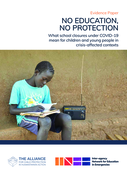
What school closures under COVID-19 mean for children and young people in
crisis-affected contexts

Enabling young children to achieve their full developmental potential is a human right and an essential requisite for sustainable development. Given the critical importance of enabling children to make the best start in life, the health sector, among other sectors, has an important role and responsi
...

Food and nutrition security in the Democratic Republic of the Congo is subject to the relentless impact of conflict, epidemics and climate events that have persisted in the country for decades, further compounded by the global COVID-19 pandemic. Lack of infrastructure and investment in agriculture,
...
The African Development Bank has launched a consultation process with health ministers and other partners as it develops a strategy to drive enhanced access to health services across Africa through 2030.
Input from ministers in the Bank’s 54 regional member countries, development partners and c
...

For humanitarian organisations to respond effectively to complex crises, they require access to up-to-date evidence-based guidance. The COVID-19 crisis has highlighted the importance of updating global guidance to context-specific and evolving needs in humanitarian settings. Our study aimed to under
...
New funding requirements: CHF 2.8 billion IFRC-wide of which CHF 670 million is channelled through the IFRC Emergency Appeal in support of National Societies