
Filter
514
Text search:
planetary
Featured
16
14
Language
Document type
318
46
25
25
19
18
17
14
11
10
6
3
2
Countries
52
6
5
5
4
4
3
3
3
2
2
2
2
2
1
1
1
1
1
1
1
1
1
1
1
1
1
1
1
1
1
1
1
1
1
1
Authors & Publishers
Publication Years
Category
35
30
14
2
2
2
1
Toolboxes
431
35
19
9
9
6
4
2
2
2
2
1
1
1
1

En 2015, el 26% de los decesos de 5,9 millones de niños que murieron antes de cumplir los cinco años podría haberse prevenido
abordando los riesgos medioambientales; una impactante oportunidad perdida. El período prenatal y de la primera infancia
representa un escenario de particular vulnerabi
...
Published: November 24, 2020 https://doi.org/10.1371/journal.pbio.3000938
Climate change is expected to have complex effects on infectious diseases, causing some to increase, others to decrease, and many to shift their distributions. There have been several important advances in understanding the
...
Environmental Research Volume 151, November 2016, Pages 115-123
Dengue is the world’s most important arboviral disease in terms of number of people affected. Over the past 50 years, incidence increased 30-fold: there were approximately 390 million infections in 2010. Globalization, trade, travel,
...
PNAS | March 4, 2014 | vol. 111 | no. 9
Malaria is an important disease that has a global distribution and significant health burden. The spatial limits of its distribution and seasonal activity are sensitive to climate factors, as well as the local capacity to control the disease. Malaria is also
...
Dengue is a mosquito-borne viral disease that occurs mainly in the tropics and subtropics but has a high potential to spread to new areas. Dengue infections are climate sensitive, so it is important to better understand how changing climate factors affect the potential for geographic spread and futu
...
As the nation’s public health leader, the Centers for Disease Control and Prevention (CDC) is actively engaged in a national effort to protect the public’s health from the harmful effects of climate change. Scientists from CDC’s National Center for Emerging and Zoonotic Infectious Diseases (NC
...
In 2013 the World Health Organization (WHO) published the report Protecting health from climate change:vulnerability and adaptation assessment. The aim was to provide basic and flexible guidance on conducting national or subnational assessments of current and future vulnerability (the susceptibilit
...
Establecimientos de salud resilientes al clima y ambientalmente sostenibles: orientaciones de la OMS
La finalidad de estas orientaciones es aumentar la capacidad de los establecimientos de salud para proteger y mejorar la salud de las comunidades destinatarias ante un clima inestable y cambiante;
y habilitarlos para que sean ambientalmente sostenibles, optimizando el uso de los recursos y reducien
...
RÉSUMÉ D’ORIENTATION
L’objectif des présentes orientations est de renforcer la capacité des établissements de santé à protéger et à améliorer la santé des communautés desservies face à un climat instable et changeant ; et de donner aux établissements de santé les moyens d’assur
...

nt. J. Environ. Res. Public Health 2014, 11(12), 13097-13116; https://doi.org/10.3390/ijerph111213097
Climate change will increase the frequency and magnitude of extreme weather events and create risks that will impact health care facilities. Health care facilities will need to assess climate chang
...
Die Deutsche Allianz Klimawandel und Gesundheit (KLUG) gründete sich im Oktober 2017 als Netzwerk von Einzelpersonen, Organisationen und Verbänden aus dem gesamten Gesundheitsbereich.
Dazu vernetzen sich die Akteure quer zu Sektoren und Hierarchien in der gesamten Gesellschaft und werden insbeson
...
Verstädterung, Flächennutzung, globaler Handel und Industrialisierung haben auf der ganzen Welt tiefgreifende negative Folgen für Natur, Biodiversität und Ökosysteme. Der fortwährende Abbau natürlicher Ressourcen wirkt sich nicht nur auf den Zustand der Umwelt aus, sondern hat auch enorme Aus
...
This publication presents a framework to implement the Agenda for the Americas on Health, Environment, and Climate Change 2021–2030 (the Agenda) that is structured around essential public health functions focused on environmental determinants of health. The Agenda is a call to action to the health
...
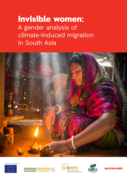
New research exposes how women and children are disproportionally affected by climate migration, which puts them at greater risk of gender-based violence, child labour and exploitation.
Governments must ensure the safety and protection of women and girls in climate emergencies, including the safe
...
