
Filter
525
Text search:
afro
Featured
41
129
Language
Document type
275
95
52
40
30
14
14
2
2
1
Countries
45
28
23
22
19
18
14
14
14
12
12
11
10
10
9
9
9
8
8
7
7
7
6
6
6
6
5
5
5
5
4
4
4
3
3
3
3
3
3
2
2
2
2
2
2
2
2
1
1
1
1
1
1
1
1
1
1
1
1
1
1
1
1
1
1
1
1
Authors & Publishers
Publication Years
Category
232
39
38
13
10
10
1
Toolboxes
71
56
41
32
29
21
17
14
12
10
9
8
7
7
6
5
4
4
3
2
2
1
1
1
This chapter addresses the biogeochemical cycles of carbon dioxide. (CO2), methane (CH4) and nitrous oxide (N2O)
Injection Safety and Safe Disposal of Medical Waste National Communication Strategy and Health Care Waste Management Standard
Operating Procedures (SOPs).
The overall objective of the consultancy was to review and align the three national technical and communication guiding documents on HCWM to th
...
This report has been prepared in response to informal requests by SIDS Member States and territories for WHO assistance in confronting the stark and dire situation which climate change has created in their countries and the impact it is having on their peoples
WHY THIS GUIDE?
Because, in the face of crises and emergencies, it is vital to include a human rights perspective in responses. Vulnerable groups face major obstacles to accessing and benefiting from prevention, mitigation, and health care policies due to structural barriers of inequality. To offer
...
Monkeypox is an emerging viral zoonosis with symptoms similar to those observed in smallpox patients, although less severe. Since the global eradication of smallpox in 1980, monkeypox has emerged as the most important orthopoxvirus in humans. The Advisory Committee on Variola Virus Research (ACVVR)
...

Tuberculosis continues to represent a severe public health problem in the Region of the Americas, even more so in the case of indigenous peoples, whose TB incidence is much higher than that of the general population. To achieve tuberculosis control in these communities, it is necessary to respond t
...
Cancer in sub-Saharan Africa
recommended
Lancet Oncol 2022; 23: e251–312Published OnlineMay 9, 2022 https://doi.org/10.1016/S1470-2045(21)00720-8
In sub-Saharan Africa (SSA), urgent action is needed to curb a growing crisis in cancer incidence and mortality.
Without rapid interventions, data estimates show a major increase in cancer mo
...
For health care providers.
Sub-Saharan Africa has the highest maternal mortality in the world. According to estimates by the United Nations Maternal Mortality Estimation Inter-Agency Group (UN MMEIG)1 in September 2017, while the African Region had recorded a significant decline in maternal mortali
...
The EYE communication strategy is intended for use by all EYE partners and respective communication teams, as well as regional and country colleagues who will need to communicate about the work of EYE. It will also be publicly available for others, such as non-governmental organizations (NGOs) and p
...

Brazil ́s response is taking place in strict compliance with the International Health Regulations (IHR) 2005.
Brazil created the Emergency Operations Center (COE) and immediately notified WHO when the first case in Brazilian territory
was confirmed on February 26.
The objective of Health in the Americas: Overview of the Region of the Americas in the Context of the COVID-19 Pandemic is to respond to the need to address important public health issues in an increasingly timely manner, while serving as a platform with a close focus on specific issues of regional
...
Mettre fin au choléra- Feuille de route mondiale pour 2030 rend opérationnelle la nouvelle stratégie mondiale de lutte contre le choléra au niveau des pays et fournit une voie concrète vers un monde où le choléra ne représente plus une menace pour la santé publique. En mettant en œuvre la
...
Maternal mortality has fallen significantly in recent years, especially in countries that have emphasized the prevention of its main causes, such as hemorrhagic and infectious complications and hypertension , including in the Region of the Americas. In its final report on the Plan of Action to Accel
...
The World Health Organization's fourth Country Cooperation Strategy 2022-2026 is an outcome of a consultative process with inputs from the Ministry of Health, various agencies in the health sector, and other relevant stakeholders. It has been developed to provide strategic direction and support towa
...
As countries aim to progress towards the Sustainable Development Goals (SDGs) and achieving universal health coverage, health inequities driven by racial discrimination and intersecting factors remain pervasive. Inequities experienced by indigenous peoples as well as people of African descent, Roma
...
Trachoma is the leading infectious cause of blindness (2). It is characterized by repeated
conjunctival infection with particular strains of Chlamydia trachomatis. This scars the conjunctivae and,
in some cases, leads to trichiasis with or without entropion. The abrasive action of eyelashes can
d
...

WHO needs US$2.54 billion to provide life-saving assistance to millions of people around the world facing health emergencies. WHO’s Health Emergency Appeal is a consolidation of WHO’s priorities and financial requirements for 2023 to carry out health interventions in emergency and humanitarian r
...
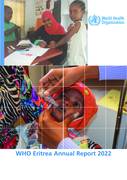
During the year 2022, COVID-19 continued to be a significant challenge in Eritrea as in many other countries across the world. As COVID-19 devastated communities around the world, WHO worked with the MoH to strengthen the National and Sub-National health systems in order to meet community needs and
...
